
Headache and neck pain care
Working out whether your headaches start in your neck, and caring for the joints and muscles involved when they do.

Sound familiar?
- “headaches from my neck”
- “band around my head”
- “headache behind my eyes”
- “daily headaches at work”
- “stiff neck”
- “woke up with a sore neck”
What’s happening in your body
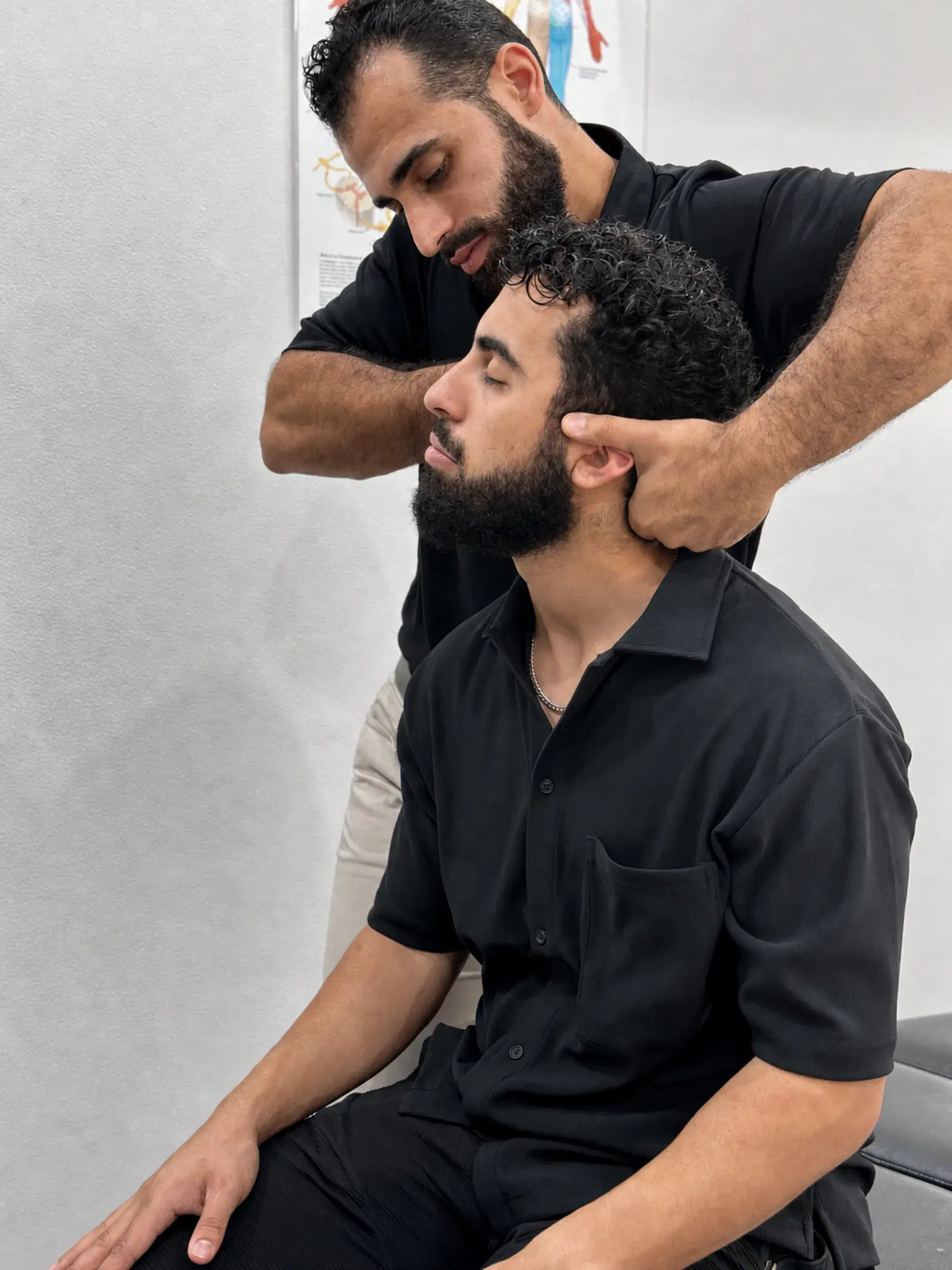
The top three joints in your neck sit directly under the base of your skull. The nerves that supply them run into the same relay point in the brainstem as the nerves that supply your forehead, your temples and the area behind your eyes. Because those signals arrive at the same place, the brain can read irritation in the neck as pain in the head. That is why a neck problem can feel like a headache and never feel like a neck problem at all.
The muscles matter too. Holding your head forward towards a screen asks the muscles at the base of the skull to hold on all day. Muscles that never let go get tender, and tender muscles refer pain into the head in their own patterns: a band around the head, an ache behind one eye, a tight line up the back of the skull.
None of that tells us your headaches are coming from your neck. It tells us why they can. Working out whether they are is what the first visit is for.
Headaches and neck pain we see
- Tension-type and neck-related (cervicogenic) headaches
- Neck pain and stiffness
- Neck and shoulder tension from desk work
The two we are asked about most have pages of their own: neck pain and headaches that start in the neck.
How we go about it
Headache assessment
Testing that works out whether your neck joints and muscles are part of the headache pattern, and what sets it off.
Hands-on neck care
Gentle joint and muscle techniques on the upper neck and shoulders, guided by that testing.
Habit and posture coaching
Practical changes to the desk, screen and phone patterns that keep the cycle going.
What care looks like week to week
Early visits
The first job is to settle the pain you have now and confirm what is driving it. That usually means hands-on work on the neck joints and muscles the assessment pointed to, plus one or two things to do at home.
Progressing
If the headaches ease, the balance shifts. Hands-on time comes down, and movement and habit changes take over: strength work through the neck and upper back, the height of your screen, how you hold your phone, how long you sit before you get up.
Tapering
Once things are steady, visits spread out. Some people finish here. Others check in through busy stretches at work.
Everyone moves through this differently. Some people respond quickly, some take longer, so the plan is set at your first assessment and adjusted as your body responds, never read off a calendar.
The red flags we screen for
Some headaches need a doctor before anyone else. Screening for them is the first thing every assessment here does.
Call an ambulance if there is any confusion, sudden weakness or numbness in the face, arm or leg on one side, facial drooping, slurred speech, sudden trouble speaking, seeing or understanding, loss of vision, a seizure, or a sudden loss of balance or coordination. Call an ambulance or go to a hospital emergency department straight away if a headache comes on suddenly and severely (the worst you have ever had), if a headache arrives with fever, a stiff neck or a rash, or if a headache follows a knock to the head.
Go to a hospital emergency department straight away for back or neck pain after a serious fall or a high-impact accident, such as a car accident; back or neck pain with a fever or feeling generally unwell; or new back or neck pain if your immune system is weakened, for instance by long-term steroids or chemotherapy, if you inject drugs, or if you have recently had a spinal injection, spinal surgery or a dental procedure.
Go to a hospital emergency department straight away if you have weakness in one arm that is severe or getting worse, or numbness in an arm that is spreading or getting worse quickly. Go to a hospital emergency department the same day if you have new clumsiness in both hands, or new unsteadiness on your feet.
See your GP promptly, before booking here, if you have pins and needles, numbness or weakness in an arm or hand, a history of cancer, unexplained weight loss, pain at night that will not settle in any position, or known osteoporosis with new severe pain.
See your GP first if you have a brand-new type of headache, if your usual headache has changed its pattern, if your first bad headaches have started after the age of 50, if they are worse lying down or when you cough or strain, if you are taking pain relief for headaches more than a couple of days most weeks, or if you think you may have migraine and have never been assessed.
Migraine diagnosis and migraine medication sit with your GP; our work on the neck runs alongside that care.
Common questions
How do I know if my headaches are coming from my neck?
You often cannot tell from the headache alone, which is why we assess rather than assume. Headaches that start at the base of the skull, sit mostly on one side, follow a stiff neck, or build through a desk day are worth checking. The examination looks at how your neck moves and whether the usual pain can be reproduced and eased.
Do you have to adjust my neck? I am nervous about it.
No. A neck adjustment is one option, not the only one, and it is never automatic. Gentle joint mobilisation, soft-tissue work and exercise can do the same job for many people. We explain what we are suggesting and why before anything happens, and you can decline any part of it without it being awkward.
Can chiropractic care treat my migraines?
Diagnosing migraine and prescribing for it belong with your GP. What we can do is assess the neck joints and muscles that sometimes add to the load, and work on them alongside the care your doctor is already providing. The two work together, each doing what it does best.
How long before my headaches change?
We will not put a number on it, because it depends on how long the pattern has been there, what is feeding it, and what you can change day to day. Some people notice a difference early, others take longer. We review it with you as we go.
Is it worth keeping a headache diary?
Yes, and it does not need to be complicated. For a fortnight before your visit, note the day, roughly when it started, how long it lasted, where the pain sat, and what you were doing beforehand. Patterns show up in writing that nobody remembers accurately in a consultation.
Take the first step towards better movement.
Suite 1, Lower Ground Floor, 225 Macquarie Street, Sydney. No referral needed to book.