Posture care
This is alignment and strength work, planned around how you sit, stand and move.
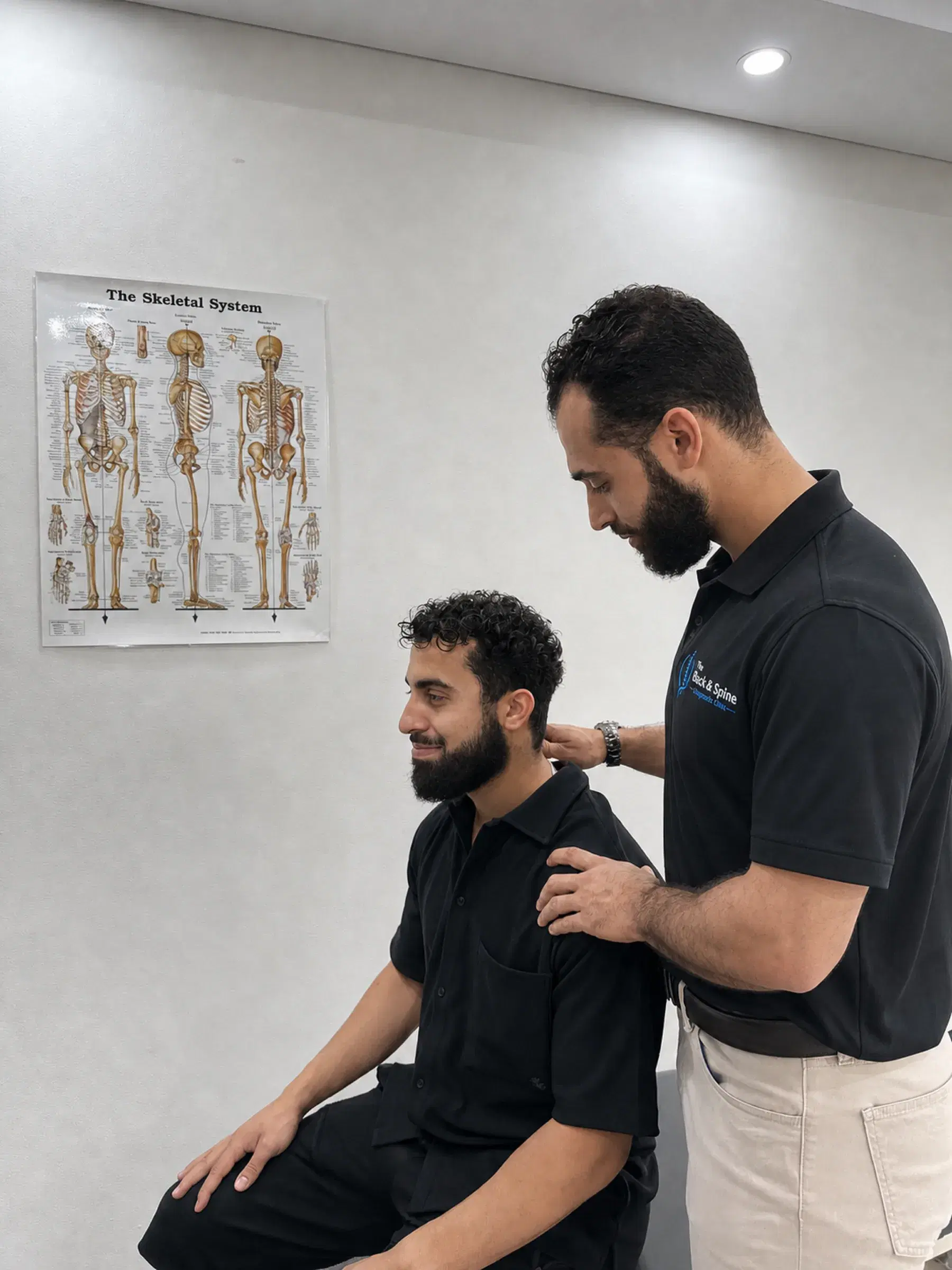
Sound familiar?
- “tech neck”
- “hunched at my desk all day”
- “sore by the end of the work day”
- “rounded shoulders”
- “pain between my shoulder blades”
- “one shoulder higher than the other”
What’s happening in your body
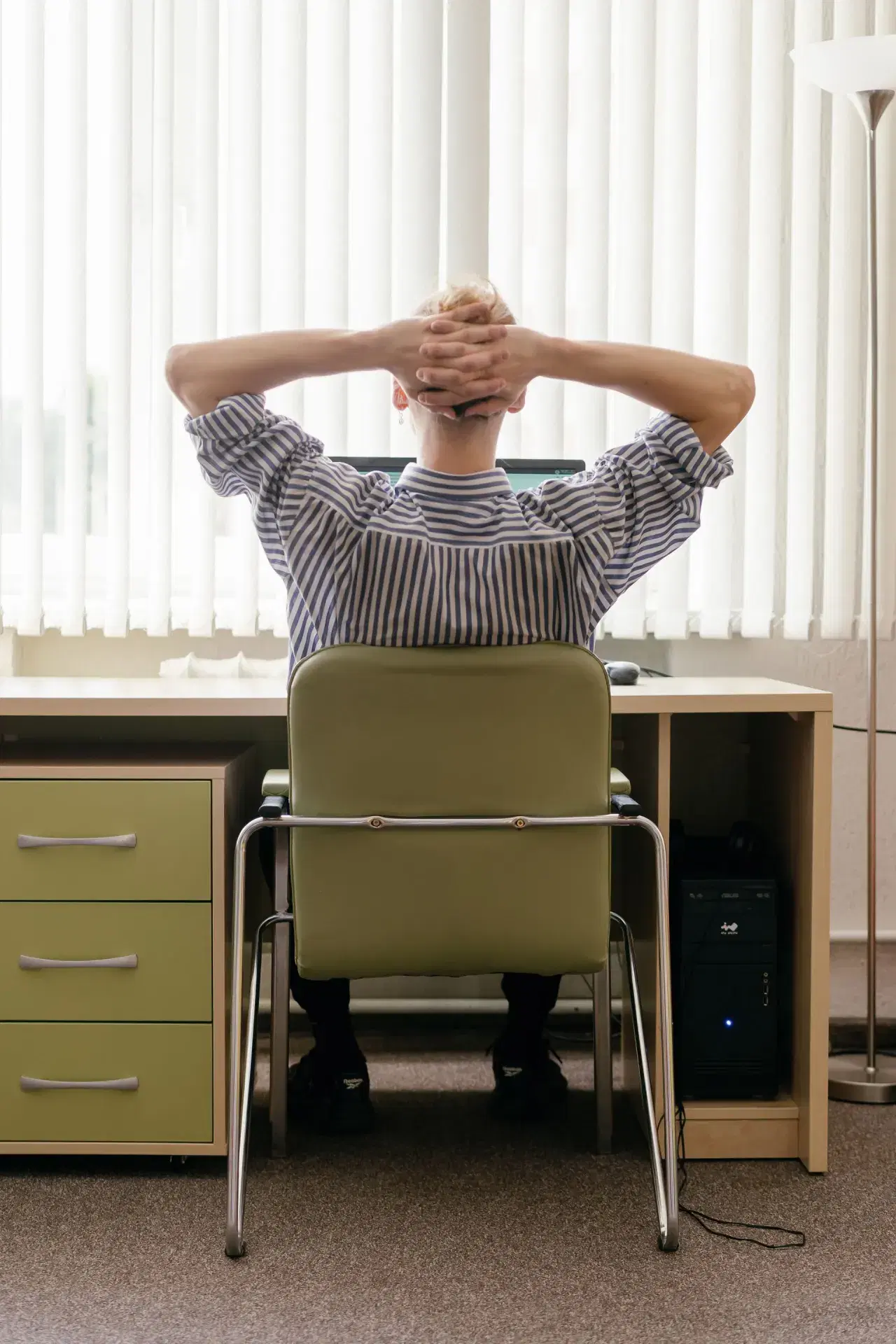
Your spine isn’t a straight column. It has three gentle curves: forward at the neck, backward through the mid-back, forward again at the low back. Together they work like a spring, sharing load between joints, discs and muscles.
That system is built to move. Muscles work best in short bursts, with rest in between. Head tipped toward a screen, shoulders rolled forward, hips folded into a chair. Hold that for hours and the same small muscles stay switched on all day without a break. That is the ache that turns up late in the afternoon.
Joints that stay still get stiff, particularly through the mid-back and ribs. When the mid-back stops sharing the work, the neck and shoulders take up the slack. Sitting also shortens the muscles at the front of the hips, which tips the pelvis and leaves the low back working harder than it needs to.
One thing worth saying plainly: there is no single correct posture. How long you hold a position, and how much you move in between, matters more than the shape.
The patterns we work on
- A head that sits forward of the shoulders, or "tech neck" as most people call it
- Shoulders rolled forward, and shoulder blades sitting unevenly (scapular imbalance)
- An uneven pelvis, and a curve that comes from posture rather than bone (functional scoliosis)
- A stiff mid-back, and the postural fatigue that arrives with it
There is a full page on posture and desk-work care.
How we go about it
Assessment and plain feedback
You find out what your alignment is actually doing, and what to change about it in an ordinary day.
Guided exercise, kept simple
A short set of guided movements: strength for the muscles that hold you up, and work on the flexibility around them.
Hands-on work where it helps
Gentle manual techniques on the stiff or guarded areas your assessment turns up.
What care looks like week to week
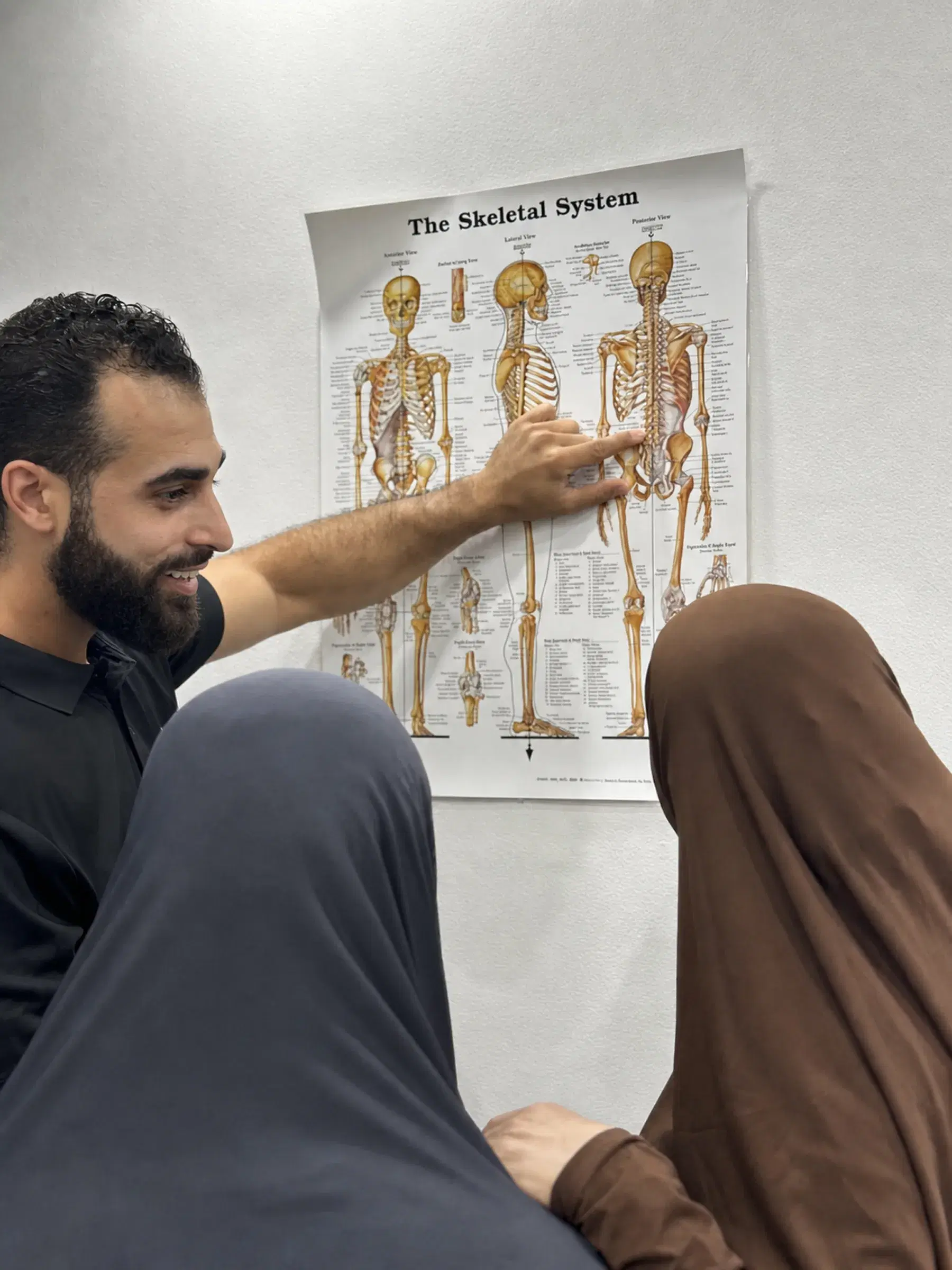
Early on, we assess how your neck, mid-back, hips and shoulders actually move, work on the areas that are stiff or irritated, and explain what we found before anything else happens.
As things settle, the balance shifts. Hands-on work becomes a smaller part of the visit and movement takes over: a short set of exercises you can do at your desk or at home, plus practical changes to your chair, screen height and how often you get up.
Later, visits space out. Some people finish here. Others come back now and then to stay on top of it, particularly through busy stretches at work.
Every plan is different. Your starting point, your job and your history all change what’s realistic, so your plan is mapped at the first assessment and reviewed as you go, not promised off a calendar.
The red flags we screen for
Every assessment starts with a safety screen: the short list of signs that need medical care involved first.
Go to a hospital emergency department straight away if you have numbness or altered feeling around the saddle area, meaning the groin, the inner thighs, the buttocks or the genitals; a loss of normal sensation in the genitals, including during sex; trouble starting to pass urine, or any new change in your bladder or bowel control; weakness in both legs, particularly if it is getting worse; new or worsening pain running down both legs; weakness in one leg that is severe or getting worse, or a foot that has started to catch or drag when you walk; or numbness in a leg that is spreading or getting worse quickly. Go to a hospital emergency department straight away for back or neck pain after a serious fall or a high-impact accident, such as a car accident; back or neck pain with a fever or feeling generally unwell; or new back or neck pain if your immune system is weakened, for instance by long-term steroids or chemotherapy, if you inject drugs, or if you have recently had a spinal injection, spinal surgery or a dental procedure.
Go to a hospital emergency department straight away if you have weakness in one arm that is severe or getting worse, or numbness in an arm that is spreading or getting worse quickly. Go to a hospital emergency department the same day if you have new clumsiness in both hands, or new unsteadiness on your feet.
See your GP promptly, before booking here, if you have a history of cancer, unexplained weight loss, pain at night that will not settle in any position, known osteoporosis with new severe pain, numbness that is spreading or getting worse slowly, new, unexplained back pain as an older adult, or pins and needles, numbness or weakness in an arm or hand. We coordinate care with them.
Common questions
Can posture actually be corrected, or is it just how I’m built?
Some of your shape is inherited and won’t change. Bone is bone, and we won’t pretend otherwise. What can change is how freely your joints move, how strong the muscles holding you up are, and the daily habits that load them. That is what we work on, and it is where the difference gets made.
Is my spine out of alignment?
Probably not in the way the phrase suggests. The joints of your spine are held together by strong ligaments and discs, and bones do not slip out of line in everyday life and get pushed back in by hand. What people feel as being “out” is usually a joint that has stopped moving freely and the muscles around it holding on. So the assessment looks at how each part of your neck, mid-back and hips moves, which muscles are doing more than their share, and what your day asks of them. We tell you plainly what we find, and we work on what can change.
Do I need an X-ray or scan before you can help?
Usually not. We start with your history, a look at how you move, and a physical examination. If something in that examination suggests an image would change what we do, we will arrange a referral or write to your GP about it. We don’t image for the sake of it.
How long before I notice a difference?
Some people find movement easier early on. For others it takes longer, especially when the pattern has built up over years of the same desk and the same hours. We would rather give you an honest expectation than a flattering one, so we review how you’re going as we go.
Do posture braces and standing desks help?
A brace can be a useful reminder for short stretches, but it won’t build the strength that holds you up. Only movement does that. Standing desks help mainly because they change your position, not because standing is better than sitting. The best posture is usually the next one.
Can you help with scoliosis?
Scoliosis itself is diagnosed and monitored through your GP, and by the doctor they refer you to where it needs watching, particularly in a teenager who is still growing. Chiropractic care is not a way to straighten the curve. What we can assess is the stiffness and muscle tension that often come with it, and set you exercises to stay comfortable and moving, alongside that medical care.
Take the first step towards better movement.
Suite 1, Lower Ground Floor, 225 Macquarie Street, Sydney. No referral needed to book.