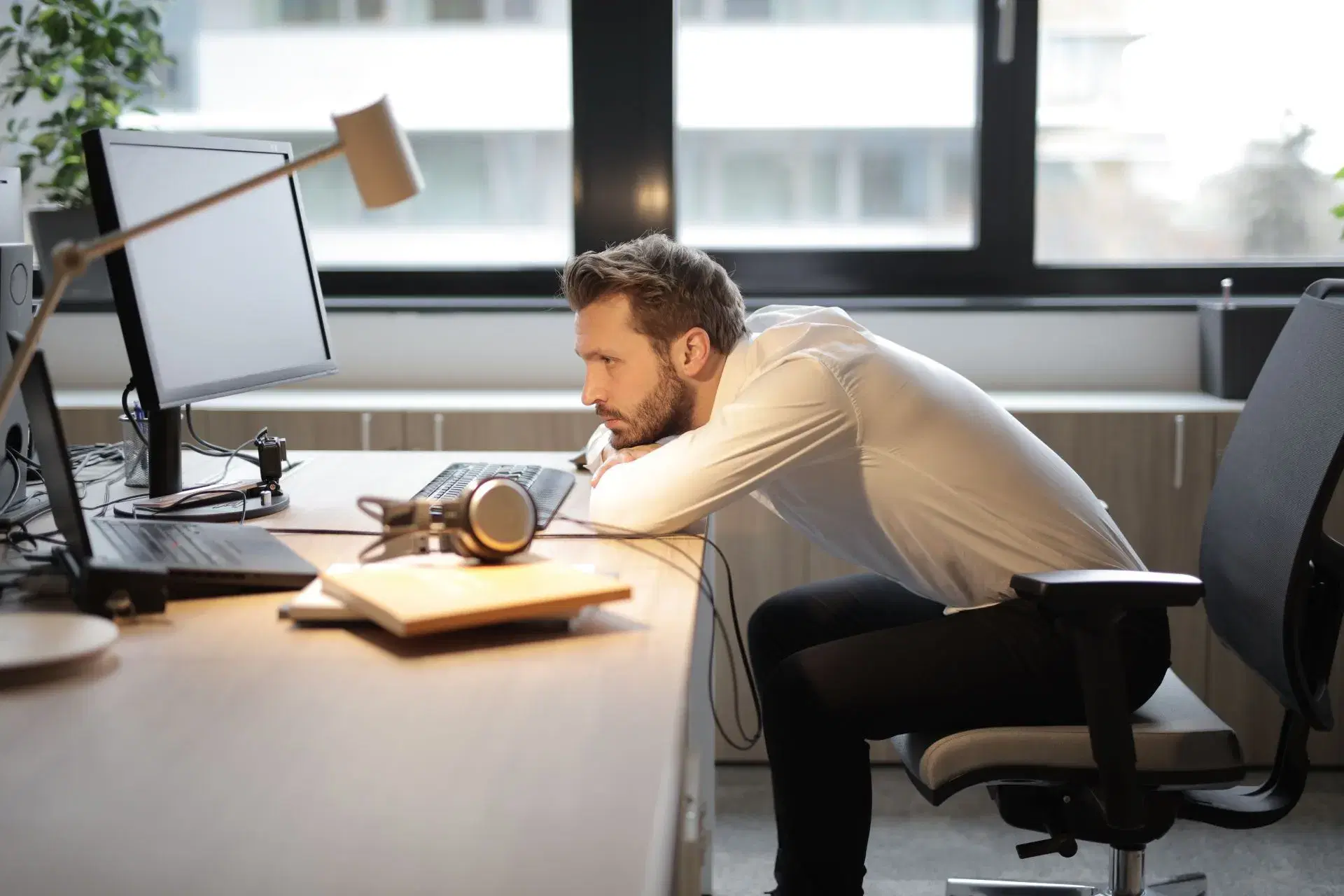
Shoulder blade pain at a desk is often the muscles and joints of your upper and mid back objecting to holding one position for hours. It tends to build as the day goes on and ease once you move. Sometimes the heart, lungs or gallbladder send pain to the same spot, so those signs come first.
What sits between the shoulder blades
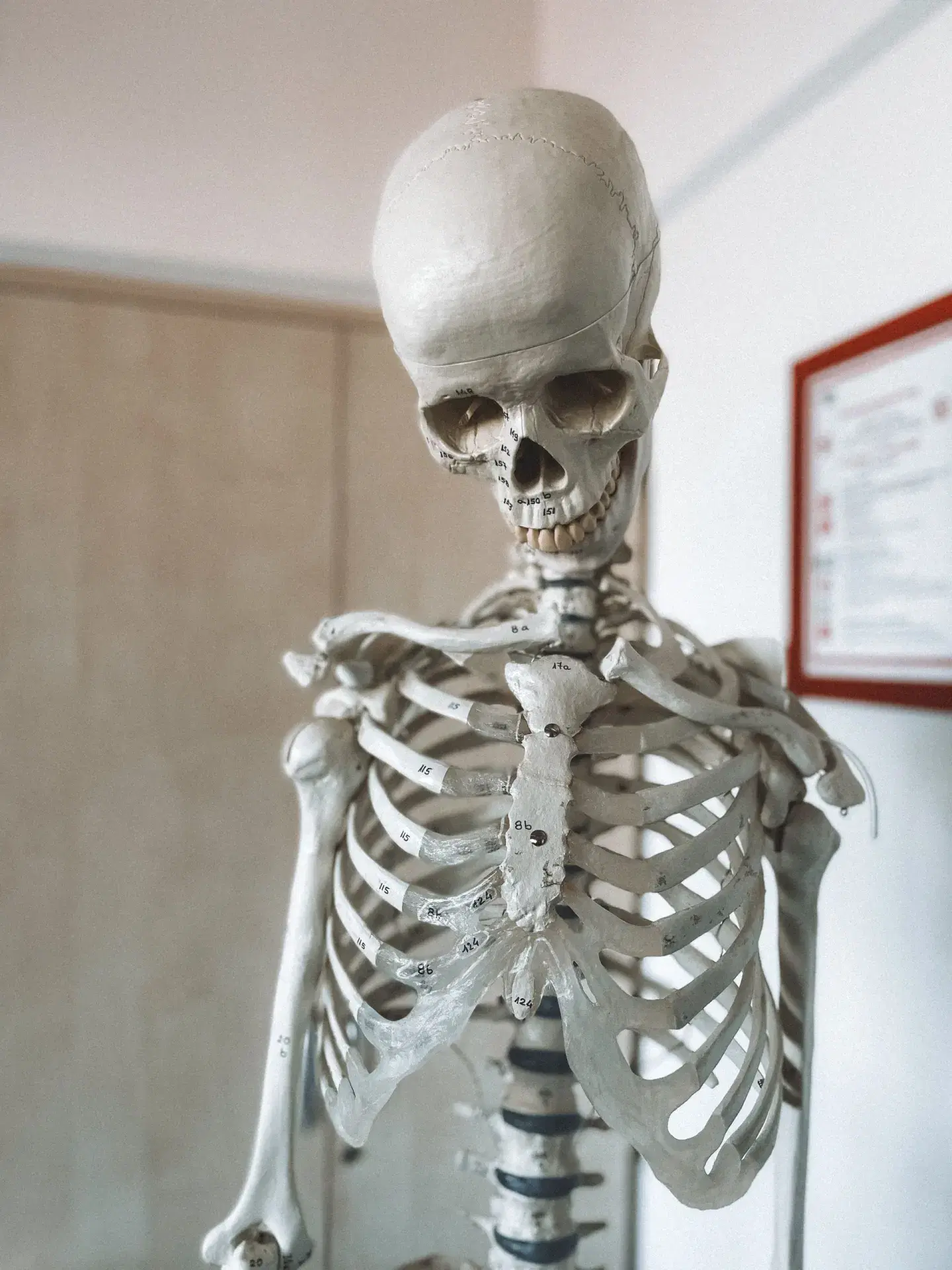
The stretch of back between your shoulder blades is the thoracic spine: twelve vertebrae running from the base of your neck to roughly the bottom of your ribcage. People call the top of it the upper back and the part around and just below the shoulder blades the mid back. It is one column of bones either way; the names describe where you feel it.
What sets this part of the spine apart is the ribs. Each vertebra carries a pair, meeting the spine at small joints that move with every breath and every twist. An irritated rib joint tends to ache a thumb’s width off the spine and catch on a deep breath in: “a knot I can’t reach”. The lungs can produce a similar catch, which is one reason for the section further down.
Then the muscles. Your shoulder blades have no bony joint with the spine. They rest on the ribcage, held there by the rhomboids, the middle and lower trapezius and serratus anterior, which anchor the blades whenever your hands work out in front of you. The long muscles beside the spine run underneath them and hold you upright.
The neck can join in as well: irritated joints low in the neck can be felt around the shoulder blade rather than in the neck itself. If your neck is stiff too, our page on neck pain covers that side of it.
Why it builds through a desk day
At a desk your arms reach forward to the keyboard and mouse for most of the day, and even a small reach has to be anchored. The muscles between your shoulder blades hold the blades steady against that pull at a low level that never quite switches off, the way your arm would tire holding a coffee cup out in front of you all morning.
Meanwhile the mid back hardly moves. It is built to turn and arch, and a desk day asks it to hold one gentle curve from the first email to the last, so the first twist to grab your bag at the end of the day can feel like a grind.
The neck and the desk itself have guides of their own: Why does my neck hurt after a day at my desk? and what can I actually do about my posture?.
When the pain is not coming from your back
Nerves from the heart, the lungs and the gallbladder share pathways with nerves from the upper back, so the brain can place their pain in the back. That is why we ask about your chest, breathing and digestion when you come in with upper back pain.
- The heart. The Heart Foundation lists pain in the back among the warning signs of a heart attack, alongside chest pain or pressure, breathlessness, sweating, feeling sick, dizziness and pain in the arm, jaw or neck. Pain that comes on with effort, such as climbing stairs, and settles when you stop is one to see your GP about promptly, before booking here; if pain like that does not settle within a few minutes of rest, or is severe or getting worse, call an ambulance.
- The lungs. Healthdirect, the Australian Government’s health information service, notes that pleurisy, an inflamed lining around the lungs, can be felt in the back or shoulders. Pain that sharpens when you breathe in deeply or cough, especially with a fever or a cough, needs a doctor. If it comes with shortness of breath, call an ambulance as below.
- The gallbladder. Healthdirect also lists pain in the back or right shoulder among the ways gallstones show up, often after a fatty meal. Pain under the right shoulder blade that tends to follow fatty meals is one for your GP. If it comes with any of the heart signs below, call an ambulance. Go to a hospital emergency department straight away if that pain lasts a few hours, does not go away after simple pain relief, stops you eating and drinking normally, or comes with a fever or yellowing of the skin or eyes. Healthdirect advises urgent medical attention for pain like that or a fever, and lists yellowing of the skin or eyes among the signs of a complication.
- The aorta. The main artery from the heart runs down in front of the spine. Healthdirect describes a tear in its wall, an aortic dissection, as a sudden, excruciating pain in the chest, upper back or abdomen that feels sharp, ripping or tearing.
Call an ambulance if pain between the shoulder blades comes with chest pain, pressure or tightness, shortness of breath, sweating, nausea or dizziness, or pain spreading into the arm, jaw or neck. Call an ambulance if pain in the chest or upper back comes on suddenly and severely and feels sharp, ripping or tearing.
One pattern is worth holding on to. Pain from the muscles and joints of the back usually changes with position. Pain that stays exactly the same whatever you do is worth raising with your GP before anyone works on your back.
Movement for the mid-back
If none of those signs fit and the ache follows the desk-day pattern, gentle movement is reasonable to try. These are general ideas, not a program written for you. Keep them slow and inside comfort: a mild stretch is fine, a sharp pain is not.
- Seated turn. Sit forward on your chair, feet flat, arms crossed over your chest. Breathe out and turn slowly to one side from the ribs, not the hips or neck, then the other way, five slow turns each side. It is aimed at the turning a desk day leaves out. Stop and get it checked if a turn sends pain into your arm or around to the front of your chest.
- Extension over a chair back. Use a stable chair whose firm back reaches about the bottom of your shoulder blades; a dining chair beats one that rolls. Fingers linked loosely behind your head, lean back gently over the top edge so your chest lifts, hold for a breath and come back up. It is aimed at the arching the mid back rarely gets. Stop and get it checked if leaning back brings on sharp pain or a feeling running into your arms.
- Shoulder blade squeezes. Sitting or standing tall, draw your shoulder blades gently back and slightly down, as if tucking them into your back pockets. Hold for a slow breath without shrugging, then let go, five to eight times. It is aimed at the anchoring muscles working through a range instead of holding still. Stop and get it checked if squeezing brings on pins and needles or numbness in your hands.
- Breaks. When a call ends or you refill your water bottle, stand, reach both arms up, turn each way and sit back down. It is aimed at breaking up the one held position. Stop and get it checked if the ache is just as strong on days away from the desk.
With any of these, stop and get it checked if pain spreads into an arm, you notice pins and needles, numbness or weakness, you feel dizzy or your vision changes, or the pain climbs rather than eases. If moving brings on chest pain, pressure or breathlessness, stop and follow the ambulance advice above.
If the ache keeps returning with the working week, the desk is only part of the picture. Posture care here looks at how your upper back, neck and shoulders move and carry load, alongside the habits of your working day.
Questions people ask
What happens at an assessment for upper back pain? You are seen by Dr Laith Musallam, chiropractor. It starts with where the pain sits, what changes it, and the chest, breathing and digestion questions above, then an examination of how your neck, mid back and shoulders move, which rib joints and muscles are tender, and the nerves to your arms if you have arm symptoms.
Do I need a scan for mid back pain? Imaging is arranged when clinically indicated, meaning when your history or the examination points to something a scan would change. Do I need an X-ray or scan before seeing a chiropractor? explains how that is decided.
When to get it looked at
Call an ambulance if pain between the shoulder blades comes with chest pain, pressure or tightness, shortness of breath, sweating, nausea or dizziness, or pain spreading into the arm, jaw or neck. Call an ambulance if pain in the chest or upper back comes on suddenly and severely and feels sharp, ripping or tearing. Call an ambulance if there is any confusion, sudden weakness or numbness in the face, arm or leg on one side, facial drooping, slurred speech, sudden trouble speaking, seeing or understanding, loss of vision, a seizure, or a sudden loss of balance or coordination. Go to a hospital emergency department straight away for back or neck pain after a serious fall or a high-impact accident, such as a car accident; back or neck pain with a fever or feeling generally unwell; or new back or neck pain if your immune system is weakened, for instance by long-term steroids or chemotherapy, if you inject drugs, or if you have recently had a spinal injection, spinal surgery or a dental procedure. Go to a hospital emergency department straight away if you have numbness or altered feeling around the saddle area, meaning the groin, the inner thighs, the buttocks or the genitals; a loss of normal sensation in the genitals, including during sex; trouble starting to pass urine, or any new change in your bladder or bowel control; weakness in both legs, particularly if it is getting worse; new or worsening pain running down both legs; weakness in one leg that is severe or getting worse, or a foot that has started to catch or drag when you walk; or numbness in a leg that is spreading or getting worse quickly.
The heart signs follow the Heart Foundation’s warning signs of a heart attack, and the tearing pain follows healthdirect. In Australia, call triple zero (000) for an ambulance.
Go to a hospital emergency department straight away if you have weakness in one arm that is severe or getting worse, or numbness in an arm that is spreading or getting worse quickly. Go to a hospital emergency department the same day if you have new clumsiness in both hands, or new unsteadiness on your feet.
See your GP promptly, before booking here, if you have a history of cancer, unexplained weight loss, pain at night that will not settle in any position, known osteoporosis with new severe pain, numbness that is spreading or getting worse slowly, new, unexplained back pain as an older adult, or pins and needles, numbness or weakness in an arm or hand.
Otherwise, an assessment is worth booking if the ache keeps coming back with the working week or is changing how you sit, sleep or train. We will work out what is loaded, explain what we find and suggest what to change about your desk day.