
Often because your neck has spent the day holding your head in one position. Sitting at a desk is not damaging. What your neck usually objects to is doing the same small job for hours without a break. That is why the ache tends to build after lunch and peak on the walk to the train.
Your head is heavier than it feels
An adult head weighs roughly five kilograms, near enough to a bowling ball. When it sits balanced over your shoulders, the bones of your neck carry most of that weight and the muscles barely have to work.
Move the head forward towards a screen and the arrangement changes. Now the muscles at the back of your neck and between your shoulder blades have to hold it there, like holding a weight out in front of you instead of against your chest. The further forward it drifts, the harder they work. Do that for eight hours and those muscles get tired, tight and sore, exactly the way any muscle does when you ask it to hold something for too long.

“Tech neck” is a habit, not a diagnosis
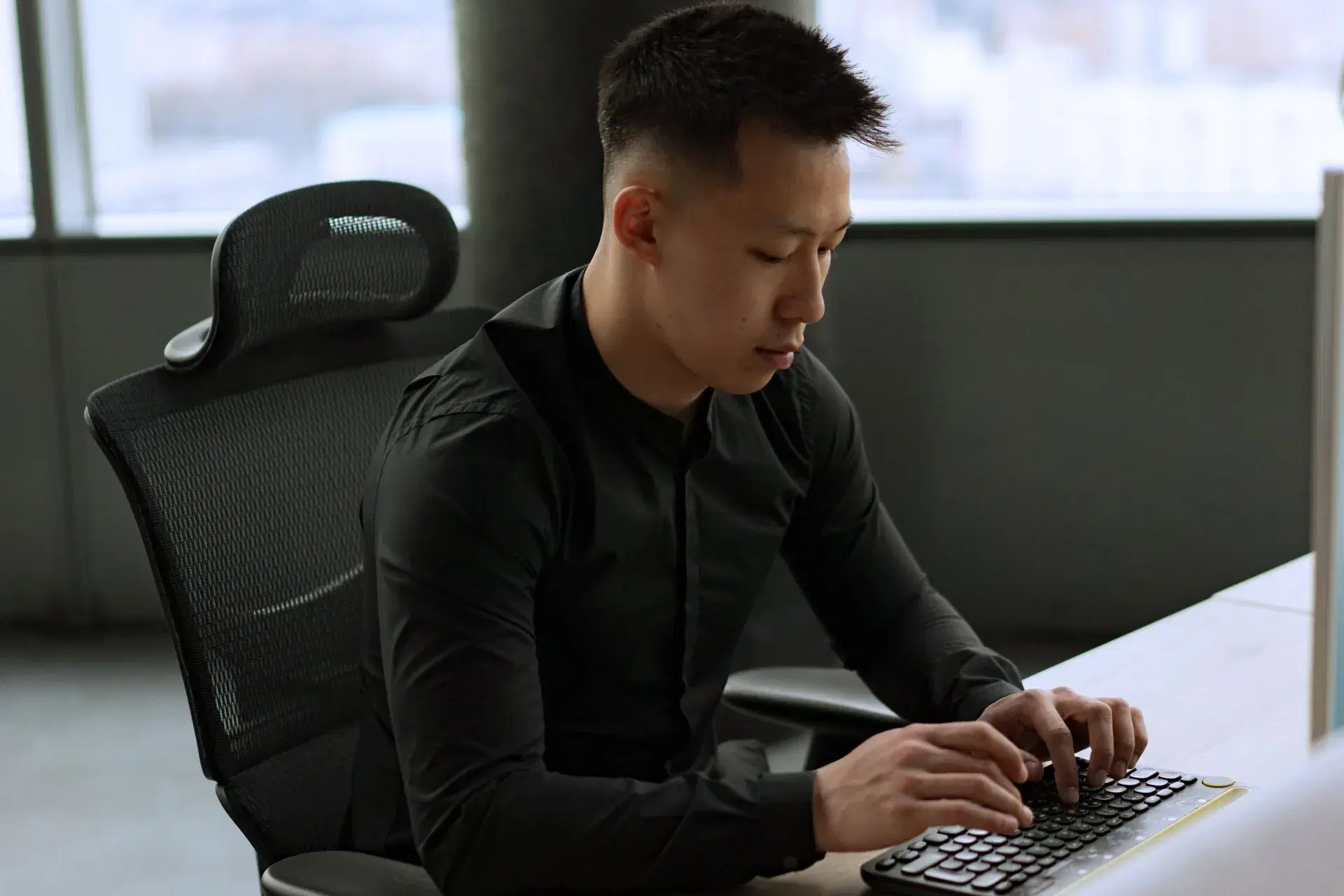
Tech neck is the name people give to the shape we fall into over a laptop or a phone: head forward, chin poking, shoulders rounded, upper back slumped. Screens sit lower than eye level, and we follow them down.
It is worth being clear about what it is not. It is not a disease, it is not permanent damage, and a photo of your posture is not a prognosis. It is a loading pattern, a description of where the strain is going. Change the pattern and the strain moves with it.
It is the staying still that hurts, more than the sitting
There is no single posture that is bad for you, and no single posture that is safe. Joints do well on movement; muscles fatigue when they are held. Two hours without shifting will make almost any position uncomfortable, including a textbook-perfect one.
This is why we tell people the best posture is the next one. If you take nothing else from this article, take that.
What actually helps at work
- Lift the screen. The top of the monitor should sit at about eye height. On a laptop that means a riser or a stack of books, plus a separate keyboard and mouse. A laptop on its own cannot put the screen and the keyboard where they both need to be.
- Bring the phone up to you. Raise the phone towards your eyes instead of dropping your head towards the phone.
- Move roughly every half hour. A minute is enough. Stand, roll the shoulders, turn the head both ways, look out a window. The break matters more than the exercise.
- Set the chair up once, properly. Feet flat on the floor, forearms level with the desk, back supported.
- Use a sit-stand desk for the change, not the standing. Standing all day causes its own aches. Alternating is the point.
- Build some strength. Stronger upper-back and neck muscles tolerate more hours before they complain. A few simple exercises done regularly are a good place to start.
Some simple exercises for the upper back and neck, and the rest of the desk set-up, are in posture exercises and desk setup. For a neck that has already stiffened, neck stretches for a stiff neck goes through gentle ones to try, and if the ache sits between your shoulder blades instead, shoulder blade pain has a page of its own.
If your neck is already sore every day, the desk set-up is one part of it. An assessment looks at the joints and muscles as well, and the habits get coaching alongside the hands-on work. That is what posture care is for. If the neck pain arrives with headaches, it is also worth reading can a headache really start in your neck?
When to get it looked at
Some things should be checked before anyone treats your neck.
Call an ambulance if there is any confusion, sudden weakness or numbness in the face, arm or leg on one side, facial drooping, slurred speech, sudden trouble speaking, seeing or understanding, loss of vision, a seizure, or a sudden loss of balance or coordination. Call an ambulance or go to a hospital emergency department straight away if a headache comes on suddenly and severely (the worst you have ever had), if a headache arrives with fever, a stiff neck or a rash, or if a headache follows a knock to the head. Go to a hospital emergency department straight away for back or neck pain after a serious fall or a high-impact accident, such as a car accident; back or neck pain with a fever or feeling generally unwell; or new back or neck pain if your immune system is weakened, for instance by long-term steroids or chemotherapy, if you inject drugs, or if you have recently had a spinal injection, spinal surgery or a dental procedure.
Go to a hospital emergency department straight away if you have weakness in one arm that is severe or getting worse, or numbness in an arm that is spreading or getting worse quickly. Go to a hospital emergency department the same day if you have new clumsiness in both hands, or new unsteadiness on your feet.
See your GP promptly, before booking here, if you have pins and needles, numbness or weakness in an arm or hand, a history of cancer, unexplained weight loss, pain at night that will not settle in any position, or known osteoporosis with new severe pain.
Otherwise, it is worth booking an assessment if your neck has not settled after a couple of weeks, the same pain keeps coming back every week, or it is bringing headaches with it. We will work out what is actually loaded, care for what we find, and show you what to change at your desk.