Mostly three things, and sitting bolt upright is not one of them. Move more often, build strength in the muscles that hold you up, and set your desk up to fit you. If you have been searching how to “fix” posture, there is no single correct shape to get to, and what you can act on happens mostly during your working day.
What people mean by bad posture
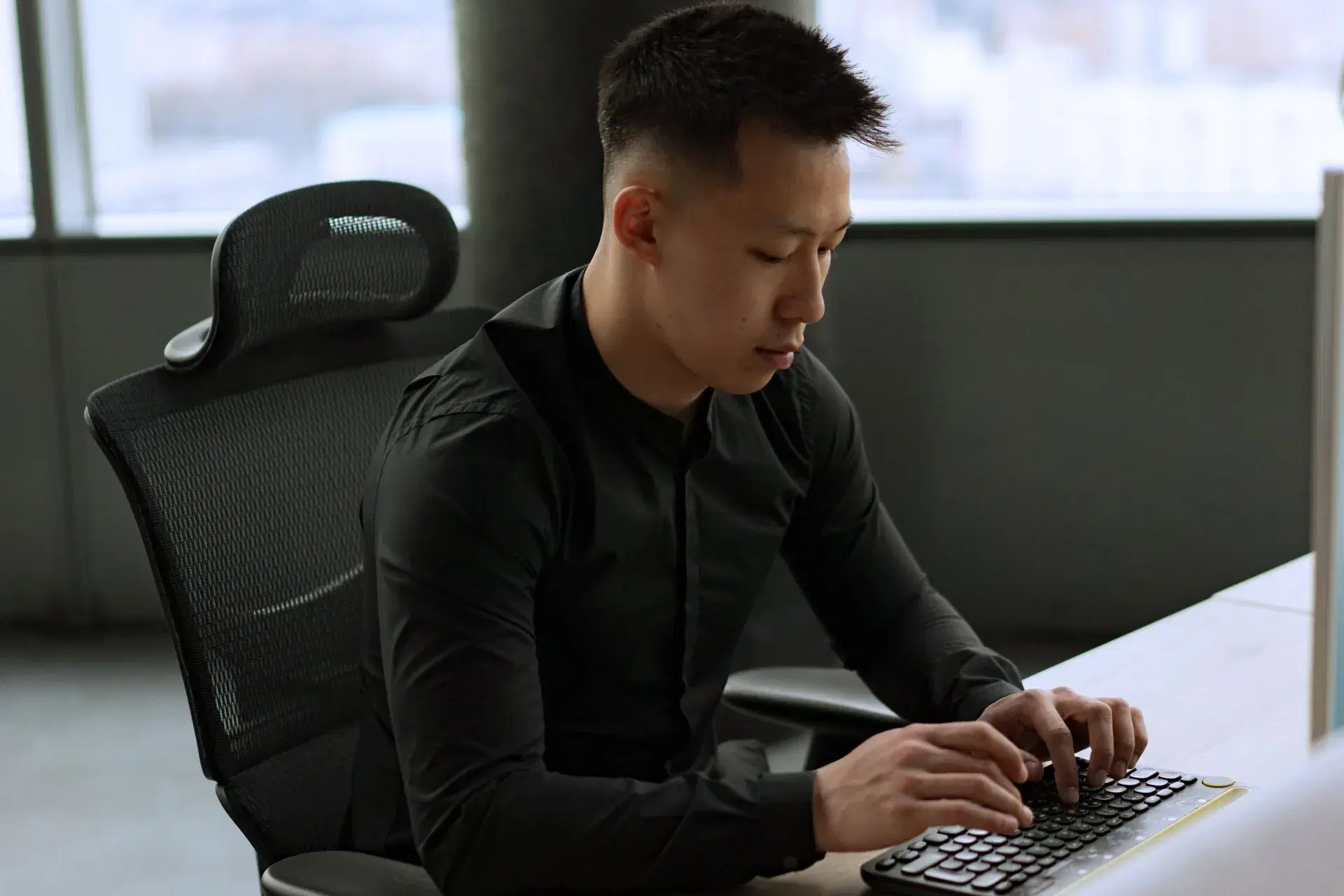
When someone says they have bad posture, they usually mean one shape: the head drifting forward of the shoulders, the shoulders rolled in and the upper back rounded. It is the shape a desk pulls most of us into, because the screen, the keyboard and the work are all in front of us.
The research is more cautious than most of what is written about it. A 2020 paper in the Journal of Biomechanics that drew together 41 systematic reviews, No consensus on causality of spine postures or physical exposure and low back pain: A systematic review of systematic reviews, found posture associated with low back pain, while the reviews do not establish posture as its cause. So this page will not tell you that the way you sit explains your pain.
That is not the same as saying posture does not matter. A position held for hours asks the same few muscles to carry the same load without a break, and that is often what people are describing when they point to the base of the neck, or to an ache between the shoulder blades, at the end of a long day.
Exercises for rounded shoulders and forward head posture
These are general, gentle exercises, not a program written for you. Move slowly, stay within comfort and never bounce: a stretch should feel like a stretch and nothing sharper. Each one is aimed at a part of the desk shape above.
- Chin tucks. Sit tall and look straight ahead. Glide your chin straight back, as if making a double chin, without tipping your head. Hold for a slow breath, relax, and repeat a handful of times. Aimed at the small muscles at the front of the neck that hold the head over the shoulders. Stop if it brings on dizziness, a headache or tingling into an arm.
- Wall slides. Stand with your back against a wall, feet a small step out. Raise your arms against it in a goalpost shape and slide them slowly up only as far as your forearms can stay near the wall, then back down. Aimed at the muscles that draw the shoulder blades down and around the ribcage. Stop if the shoulder pinches or pain runs down the arm.
- Doorway chest stretch. Rest one forearm flat on a door frame, elbow at about shoulder height, and step through gently until you feel a stretch across the chest. Hold for a few slow breaths, then swap sides. Aimed at the chest muscles that sit shortened while the shoulders roll forward. If you feel it in the shoulder joint rather than the chest, lower the elbow; stop if the arm goes numb or tingly.
- Band rows. Anchor a light resistance band at chest height, hold an end in each hand, and draw your elbows back past your sides without shrugging, then let the band out slowly. A few controlled repetitions are plenty to begin with. Aimed at the muscles between and below the shoulder blades that hold the upper back up. Stop if the effort turns into pain in the neck or the shoulder joint.
- Mid-back extension over a chair back. Sit on a sturdy kitchen or dining chair, not one with wheels or a reclining back, whose backrest reaches the bottom of your shoulder blades. Cradle your head in your hands and lean back gently over the backrest, then come back up. Aimed at the middle of the back, which spends a desk day curled forward. Go only as far as feels easy, and stop if it sends pain around the ribs or into the lower back.
Stop and get it checked if any of these sends pain, pins and needles or numbness into an arm, brings on weakness, dizziness, a headache or a change in your vision, or leaves you with pain that climbs through the day rather than easing. Mild muscle tiredness after something new is ordinary; those are not.
Setting up your desk
An ergonomic desk setup will not give anybody a particular shape. What it can do is stop the desk pulling you into one position and pinning you there, and most of it costs little.
- The screen. About an arm’s length away, top edge level with or a little below your eyes, so you read it by lowering your gaze rather than your head. With two screens, the one you use most goes straight in front of you.
- The chair. Sit right back so the backrest takes some of your weight. Set the height to the desk first, then give your feet a footrest or a box if they no longer sit flat.
- The keyboard and mouse. Close enough that your elbows hang near your sides with the forearms level and the wrists straight. The mouse sits beside the keyboard, not out at a stretch.
- The laptop. It joins the screen to the keys, so one of them is always in the wrong place. For a long day, raise it on a stand or a pile of books and plug in a separate keyboard and mouse.
- The phone. Lift it towards your eyes rather than folding down to it, and use headphones for long calls instead of wedging it against your shoulder.
For the neck in particular, read why does my neck hurt after a day at my desk?
Moving often matters more than the shape
Even a well set-up desk becomes uncomfortable if you never leave it. A muscle held in one position tires whatever shape it is held in, and joints are built to move. The most useful thing to know about desk posture is that it is meant to keep changing.
- Borrow the pauses already in your day. When you send something or come off a call, stand up, roll your shoulders and look at something far away.
- Move within the chair too: sit forward, sit back, change where your feet are.
- Take calls standing, or walking, when the call allows it.
- With a sit-stand desk, the value is in switching. Standing still all day is just another position to get stuck in.
If your lower back is the part that complains after a long sit, why does my lower back hurt after sitting all day? goes through that side of it.
When the same ache turns up day after day regardless, an assessment is the next step. Dr Laith Musallam, chiropractor, looks at where your head sits over your shoulders, how far your mid-back turns and extends, what your hips do when you stand, and how your desk and your day are arranged, then explains what he finds before anything is worked on. Imaging is arranged only when clinically indicated. The hands-on and exercise work that can follow is described under posture care.
How often should I do posture exercises?
Little and often is easier to keep up than a long session now and then. Pick two or three and hang them on something you already do on a working day, like the kettle boiling or the end of a meeting. If they leave you sore, do fewer and go gentler.
When to get it looked at
Whatever the shape of your day, a few things need a medical opinion before anybody works on your neck or back, and every assessment here starts by checking for them.
Call an ambulance if pain between the shoulder blades comes with chest pain, pressure or tightness, shortness of breath, sweating, nausea or dizziness, or pain spreading into the arm, jaw or neck. Call an ambulance if pain in the chest or upper back comes on suddenly and severely and feels sharp, ripping or tearing. Call an ambulance if there is any confusion, sudden weakness or numbness in the face, arm or leg on one side, facial drooping, slurred speech, sudden trouble speaking, seeing or understanding, loss of vision, a seizure, or a sudden loss of balance or coordination. Call an ambulance or go to a hospital emergency department straight away if a headache comes on suddenly and severely (the worst you have ever had), if a headache arrives with fever, a stiff neck or a rash, or if a headache follows a knock to the head.
Go to a hospital emergency department straight away if you have numbness or altered feeling around the saddle area, meaning the groin, the inner thighs, the buttocks or the genitals; a loss of normal sensation in the genitals, including during sex; trouble starting to pass urine, or any new change in your bladder or bowel control; weakness in both legs, particularly if it is getting worse; new or worsening pain running down both legs; weakness in one leg that is severe or getting worse, or a foot that has started to catch or drag when you walk; or numbness in a leg that is spreading or getting worse quickly. Go to a hospital emergency department straight away for back or neck pain after a serious fall or a high-impact accident, such as a car accident; back or neck pain with a fever or feeling generally unwell; or new back or neck pain if your immune system is weakened, for instance by long-term steroids or chemotherapy, if you inject drugs, or if you have recently had a spinal injection, spinal surgery or a dental procedure. Go to a hospital emergency department straight away if you have weakness in one arm that is severe or getting worse, or numbness in an arm that is spreading or getting worse quickly. Go to a hospital emergency department the same day if you have new clumsiness in both hands, or new unsteadiness on your feet.
The back signs above go to an emergency department because the Australian guidance on low back pain puts them there: the Low Back Pain Clinical Care Standard, published by the Australian Commission on Safety and Quality in Health Care in 2022, and the Royal Australian College of General Practitioners’ 2022 guidance for GPs on imaging in adults with acute low back pain both send suspected cauda equina syndrome, suspected spinal infection, a fracture after a high-impact injury and severe or rapidly worsening nerve weakness for emergency assessment.
See your GP promptly, before booking here, if you have a history of cancer, unexplained weight loss, pain at night that will not settle in any position, known osteoporosis with new severe pain, numbness that is spreading or getting worse slowly, new, unexplained back pain as an older adult, or pins and needles, numbness or weakness in an arm or hand.
A curve in a teenager who is still growing is a separate question from a desk slouch, and the posture page explains who should see it.
Otherwise, book an assessment when the ache is there most days, when it no longer eases overnight or over a weekend, or when it has started to shape how you work.