

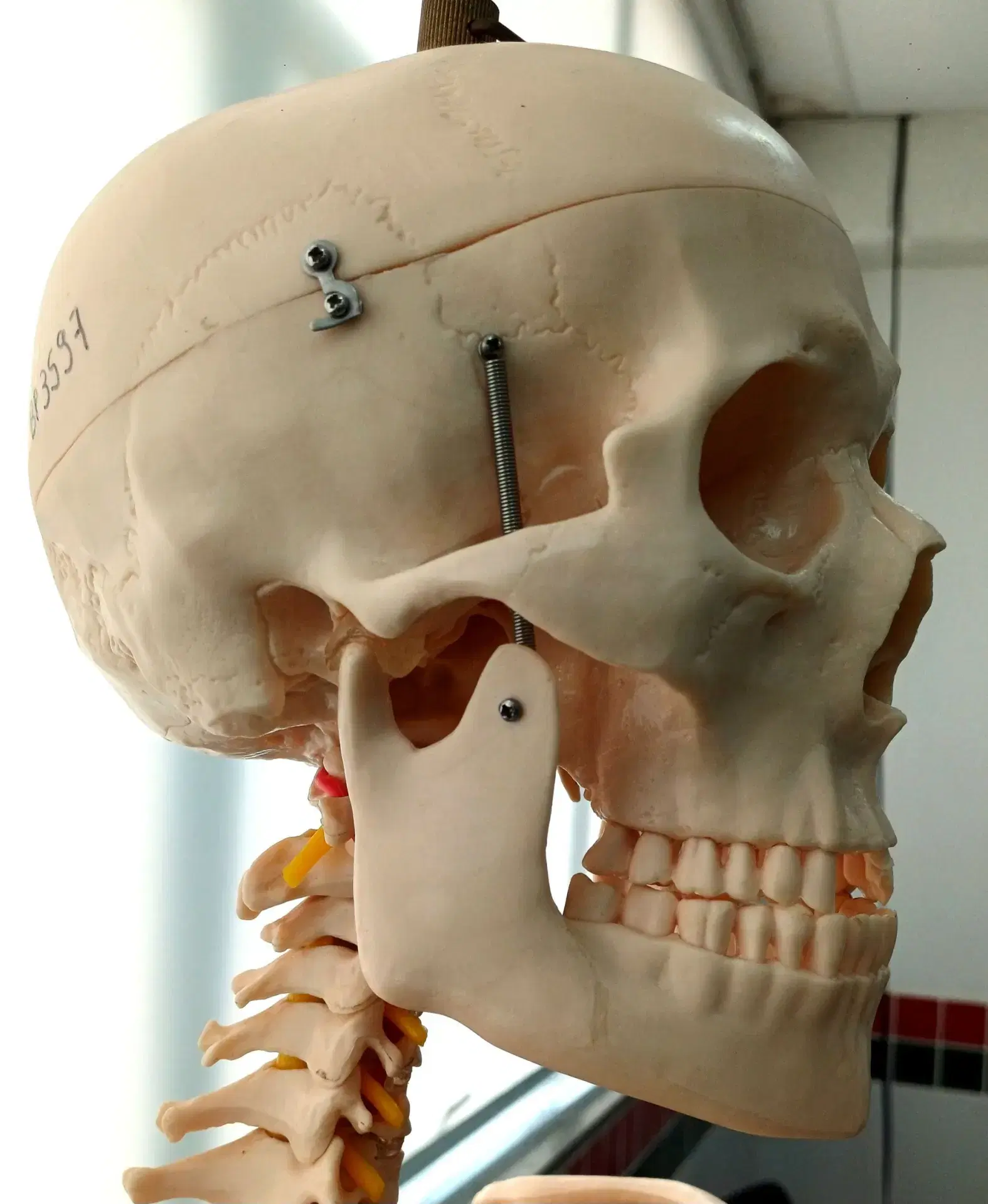
What is changing in the neck
The neck, or cervical spine, has seven vertebrae stacked beneath the skull, with a disc between each pair except the top pair. Over the years those discs lose some height and water, small ridges of bone grow at the edges of the vertebrae, the small joints at the back thicken, and a ligament at the back of the canal can thicken too. Cervical spondylosis is the word for the sum of these changes. With the region left off, spondylosis is the same bundle of wear anywhere along the spine.
The neck is also the part of the spine that turns and tilts the most. A region that moves that much shows change on an image readily, and a picture with several changes on it describes how the neck is built, which is not the same as how it feels or what you can do.
The stiff, aching neck
In its ordinary form the picture is quiet. The neck is stiffer in the morning, turning to check a blind spot takes more effort, and an ache gathers at the base of the neck or across the tops of the shoulders as a long day goes on. Some people also notice a crunch or a grinding sound on turning.
Usually that is the joints and muscles working harder around the changes. Noise on its own, without pain or a limit to movement, is a sound and not a finding. An assessment of the neck looks at how far it turns, tilts and bends, which positions bring on the ache and which let it settle back, and how the shoulders and upper back are sharing the work. The same questions apply to any neck pain, whatever the report says.
When a root in the neck is crowded
The nerve roots leave the neck through small tunnels at the side. Bony spurs, thickened joints and a narrowed disc space can tighten a tunnel, so a root can be irritated on its way out. The result is arm symptoms: pain from the neck into the shoulder blade or the arm, pins and needles or numbness along a strip of the arm and hand, or weakness. Which strip depends on the root. One reaches the thumb side of the hand, the next the middle finger, and the one after the little finger side.
The numbering in the neck works differently from the lower back. A cervical root leaves above the vertebra that shares its number, so a disc at C5–C6 sits beside the C6 root. From the symptom side, the same crowding is called a pinched nerve in the neck: arm symptoms traced back to one root. Pins and needles, numbness or weakness in an arm or hand go to your GP before an appointment here, and weakness in an arm that is severe or getting worse goes to a hospital emergency department straight away.
The cord shares the canal
At the neck the canal holds the spinal cord, the thick cable that carries signals between the brain and the body, with the roots branching from it. If the canal narrows enough, the cord itself can be pressed, which doctors call cervical myelopathy. It tends to show up not as neck pain but as changes below the neck: hands that feel clumsy, things dropped, buttons or handwriting that have become fiddly, and legs that feel stiff, heavy or unsteady, so that you watch your feet or reach for a rail on the stairs.
It can build slowly, in both hands, with little or no pain, and a slow change is easy to put down to age or a busy week. That is why new clumsiness in both hands, or new unsteadiness on your feet, goes to a hospital emergency department the same day. New means new for you, even when it is small.
A report can raise the same question. If it mentions pressure on the spinal cord, flattening of the cord or a change in the cord’s signal, take it to whoever ordered the scan promptly, before booking here, even if you feel well.
Looking at the whole neck, every time
An assessment checks arm strength, reflexes and feeling, and then goes beyond the arm. It watches how the hands handle small tasks and how you walk, because that is where the cord shows itself, and it does this whatever brought you in, not only when an arm is involved. Scans follow the question. An X-ray shows the bony changes. An MRI shows the discs, the roots and the cord, and both are requested when clinically indicated.
A report on the neck may also say its curve is straighter than expected, which it calls loss of cervical lordosis. That describes a shape on a picture, and an assessment reads it next to how the neck moves, never on its own. All of it sits in the seven vertebrae, the canal and the root tunnels of the cervical spine.
Sorting what you notice
Each of these patterns has a usual direction, but working out which one is yours takes an examination.
- A stiff, aching neck, worse by the end of the day
- The pattern of neck joints and muscles working around change. An assessment looks at movement and loading, and the report is read beside it.
- Pain or pins and needles into one arm or hand
- A root in the neck is one possibility, and a GP sees it first. An arm that is severely weak or getting worse goes to a hospital emergency department straight away.
- Clumsy hands, dropped things, trouble with buttons
- A sign the cord may be involved, especially in both hands. New clumsiness goes to a hospital emergency department the same day.
- Unsteady or heavy-feeling walking
- The same pathway as clumsy hands, and new unsteadiness goes to a hospital emergency department the same day.
- A sudden severe headache, facial drooping or slurred speech
- Not a feature of neck stiffness. Call an ambulance.
When to get it looked at
Call an ambulance if there is any confusion, sudden weakness or numbness in the face, arm or leg on one side, facial drooping, slurred speech, sudden trouble speaking, seeing or understanding, loss of vision, a seizure, or a sudden loss of balance or coordination.
Call an ambulance or go to a hospital emergency department straight away if a headache comes on suddenly and severely (the worst you have ever had), if a headache arrives with fever, a stiff neck or a rash, or if a headache follows a knock to the head.
Go to a hospital emergency department straight away for back or neck pain after a serious fall or a high-impact accident, such as a car accident; back or neck pain with a fever or feeling generally unwell; or new back or neck pain if your immune system is weakened, for instance by long-term steroids or chemotherapy, if you inject drugs, or if you have recently had a spinal injection, spinal surgery or a dental procedure.
Go to a hospital emergency department straight away if you have weakness in one arm that is severe or getting worse, or numbness in an arm that is spreading or getting worse quickly.
Go to a hospital emergency department the same day if you have new clumsiness in both hands, or new unsteadiness on your feet.
See your GP promptly, before booking here, if you have pins and needles, numbness or weakness in an arm or hand, a history of cancer, unexplained weight loss, pain at night that will not settle in any position, or known osteoporosis with new severe pain.
A stiff, aching neck is a reasonable reason to be assessed, and cervical spondylosis on a report is not an emergency. Book if the stiffness keeps returning, if turning to check traffic has become something you plan around, or if the ache has started reaching into the shoulder blade. Take the report, with the levels it names.