

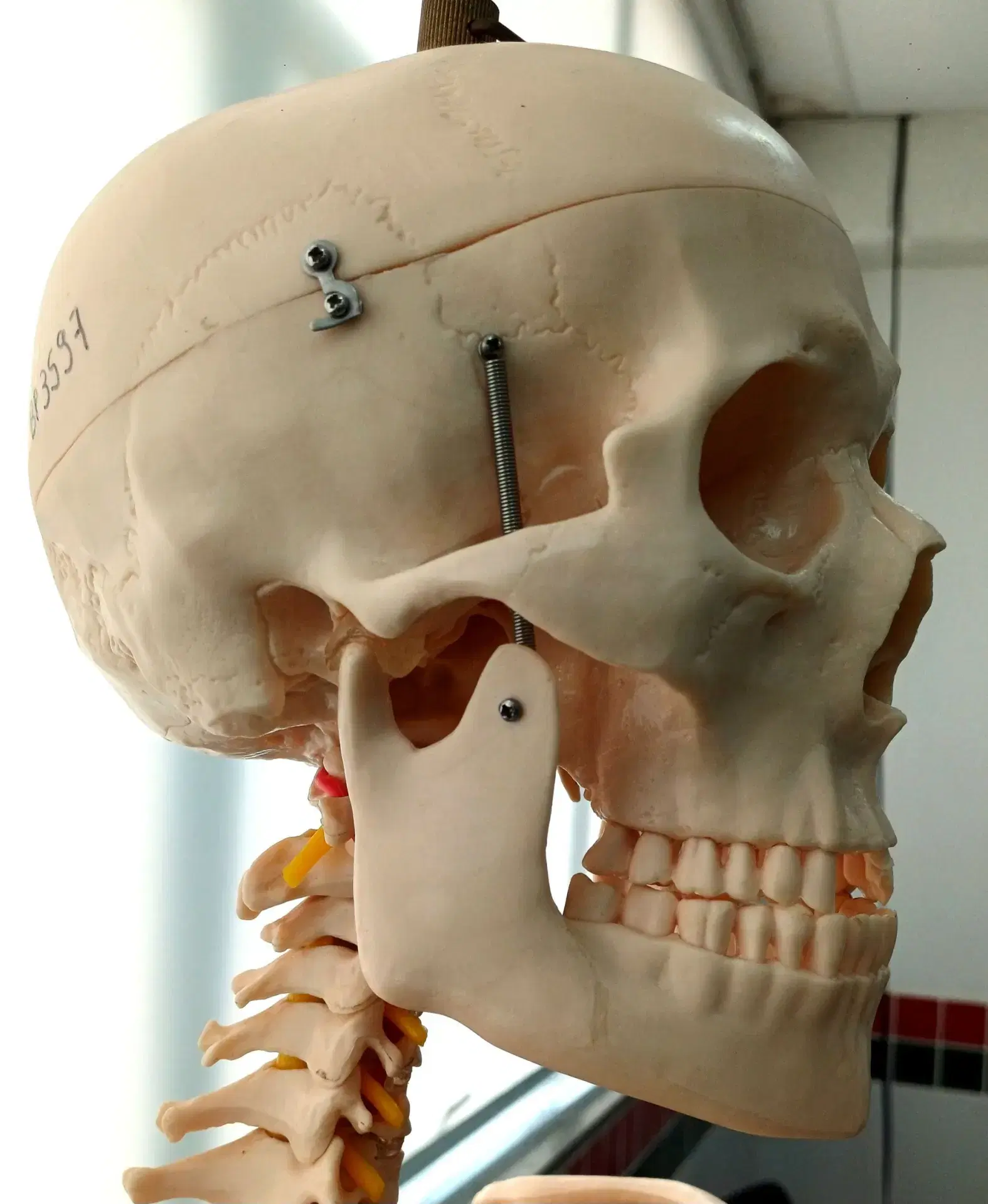
The top pair, built for nodding and turning
Directly below the skull sits the atlas, named for the figure in myth who held up the sky. It has no solid body at the front. It is a ring of bone, with two cupped surfaces on its upper face that the rounded bumps at the base of the skull rest in, a little like the rockers of a chair. That joint is where the nod of a “yes” happens, a small, smooth rocking and very little else.
The second vertebra, the axis, carries a peg of bone called the dens that points up through the front of the atlas ring and is held against it by a strong ligament. The atlas pivots around that peg, and that joint supplies much of the head’s turning, the movement of a “no”. The rest of the neck contributes what remains. Neither of these top joints has a disc. They rely on ligaments and joint capsules, which is why this part of the neck is so mobile and why a stiff upper neck can make a shoulder check in the car feel shorter than it should.
The neck from the left side with the front of the body on the left: C1 to C7, with the start of the thoracic spine at the bottom edge. C1, the atlas, is a ring with no solid body at the front. Below it, C2, the axis, carries a peg of bone, the dens, that points up through the front of the ring and is drawn dashed where C1 hides it. C1 and C2 are highlighted. The five vertebrae below share one pattern: a small body, a disc between each pair and a spinous process at the back, longer at C7.
C3 to C7 and the curve they carry
The five vertebrae below follow one design. Each has a small body, a short spinous process at the back that is often forked at the tip (C7’s is longer), and a small hole through each transverse process at the side. Between each pair sits a disc, and along the upper edge of each body a small lip of bone rises on either side. Those lips form little joints with the vertebra above, called uncovertebral joints, and they guide the neck as it bends and limit sideways slide between the bones.
Seen from the side, the neck bows gently forward, so the hollow of the curve faces the back of the neck. That is the cervical lordosis. Its shape differs between people and changes as you move, flattening when you look down and deepening when you look up. A report may call a flatter curve straightened or reduced, which is what loss of cervical lordosis means: the shape of the neck on one picture, which says nothing by itself about why that shape is there or whether it matters.
Seven bones, eight nerves
There are seven neck vertebrae and eight pairs of neck nerves, and that mismatch is the detail that trips people up when they read a report. In the neck each nerve leaves through the opening above the vertebra that shares its number, so the C3 nerve leaves between C2 and C3. The first one leaves between the skull and C1. No vertebra is left to name the eighth, so C8 leaves between C7 and T1.
From T1 downward the rule flips, and each nerve leaves below the vertebra it shares a number with. The result is easy to state and easy to mix up. The nerve that leaves at C5/6 is C6, which takes the number of the bone below it, while the nerve that leaves at L4/5 is L4, which takes the number of the bone above. The flipped rule holds from T1 all the way down to the sacrum, so in the lower back L4 can name a bone, a level or a nerve, and that same mix-up runs through how vertebrae are numbered.
The lower nerves each supply a patch of skin and a group of muscles in the shoulder, arm and hand. The maps overlap and vary from person to person, which is why a report that says a nerve is under pressure only means something next to what you feel in the arm and what the examination finds. Radiculopathy is the word for a nerve root that is not working properly, with the effects felt in the arm and hand and not only in the neck.
What passes through the neck besides nerves
The canal behind the vertebral bodies carries the spinal cord, the cable that links the brain to the body. The nerves for the arms branch from it low in the neck. The small holes in the transverse processes carry the vertebral arteries, two blood vessels that run up each side of the neck towards the brain. Blood supply to the brain is the reason sudden weakness on one side, a drooping face, slurred speech or a sudden loss of balance mean calling an ambulance: they are never a neck problem to wait on.
Higher up, the nerves from C2 and C3 run to the back of the head and the scalp, which is where occipital neuralgia is felt. The wear in the discs and joints that builds up with age is called cervical spondylosis, and it can be quiet or can bring a stiff, aching neck.
Why a neck is such a busy place
The neck carries a head that is heavy for its size and turns it many times an hour, to a screen, a mirror, a doorway, a person speaking. It has the smallest vertebrae above the tailbone and the widest range of movement, and it leans on muscle to steady the head between those movements. A neck can feel tired after a long spell held in one position for that reason, and an assessment of neck pain looks at the joints, the muscles and the nerves together because each of them shares the load.
Neck levels and the nerve that leaves at each
Once the numbering rule is clear, the pattern is regular. The arm and hand details are general maps. They overlap, and they vary from one person to the next.
- C1/2
- The atlas and the axis. There is no disc here, and much of the head’s turning happens at this level. The C2 nerve leaves above the axis and runs to the back of the head.
- C2/3
- The first level with a disc. The C3 nerve leaves here and supplies skin and muscle at the side and front of the neck.
- C3/4
- The C4 nerve leaves here. It supplies the skin over the top of the shoulder and, with C3 and C5, the nerve to the diaphragm.
- C4/5
- The C5 nerve leaves here and supplies some of the muscles that lift the arm at the shoulder.
- C5/6
- The C6 nerve leaves here. This level sits low in the mobile part of the neck, where a lot of the bending forward and back takes place.
- C6/7
- The C7 nerve leaves here and supplies, among other things, the muscle at the back of the upper arm.
- C7/T1
- The C8 nerve leaves here, the one nerve with no neck vertebra of its own, and it reaches the inner edge of the forearm and hand.
When to get it looked at
Call an ambulance if there is any confusion, sudden weakness or numbness in the face, arm or leg on one side, facial drooping, slurred speech, sudden trouble speaking, seeing or understanding, loss of vision, a seizure, or a sudden loss of balance or coordination.
Call an ambulance or go to a hospital emergency department straight away if a headache comes on suddenly and severely (the worst you have ever had), if a headache arrives with fever, a stiff neck or a rash, or if a headache follows a knock to the head.
Go to a hospital emergency department straight away for back or neck pain after a serious fall or a high-impact accident, such as a car accident; back or neck pain with a fever or feeling generally unwell; or new back or neck pain if your immune system is weakened, for instance by long-term steroids or chemotherapy, if you inject drugs, or if you have recently had a spinal injection, spinal surgery or a dental procedure.
Go to a hospital emergency department straight away if you have weakness in one arm that is severe or getting worse, or numbness in an arm that is spreading or getting worse quickly.
Go to a hospital emergency department the same day if you have new clumsiness in both hands, or new unsteadiness on your feet.
See your GP promptly, before booking here, if you have pins and needles, numbness or weakness in an arm or hand, a history of cancer, unexplained weight loss, pain at night that will not settle in any position, or known osteoporosis with new severe pain.
A stiff or aching neck at the end of a long day is not unusual. Booking makes sense once the two directions of turning stop matching, the stiffness keeps coming back, or an ache starts to travel towards the shoulder blade or upper arm with no tingling, numbness or weakness in the arm.