

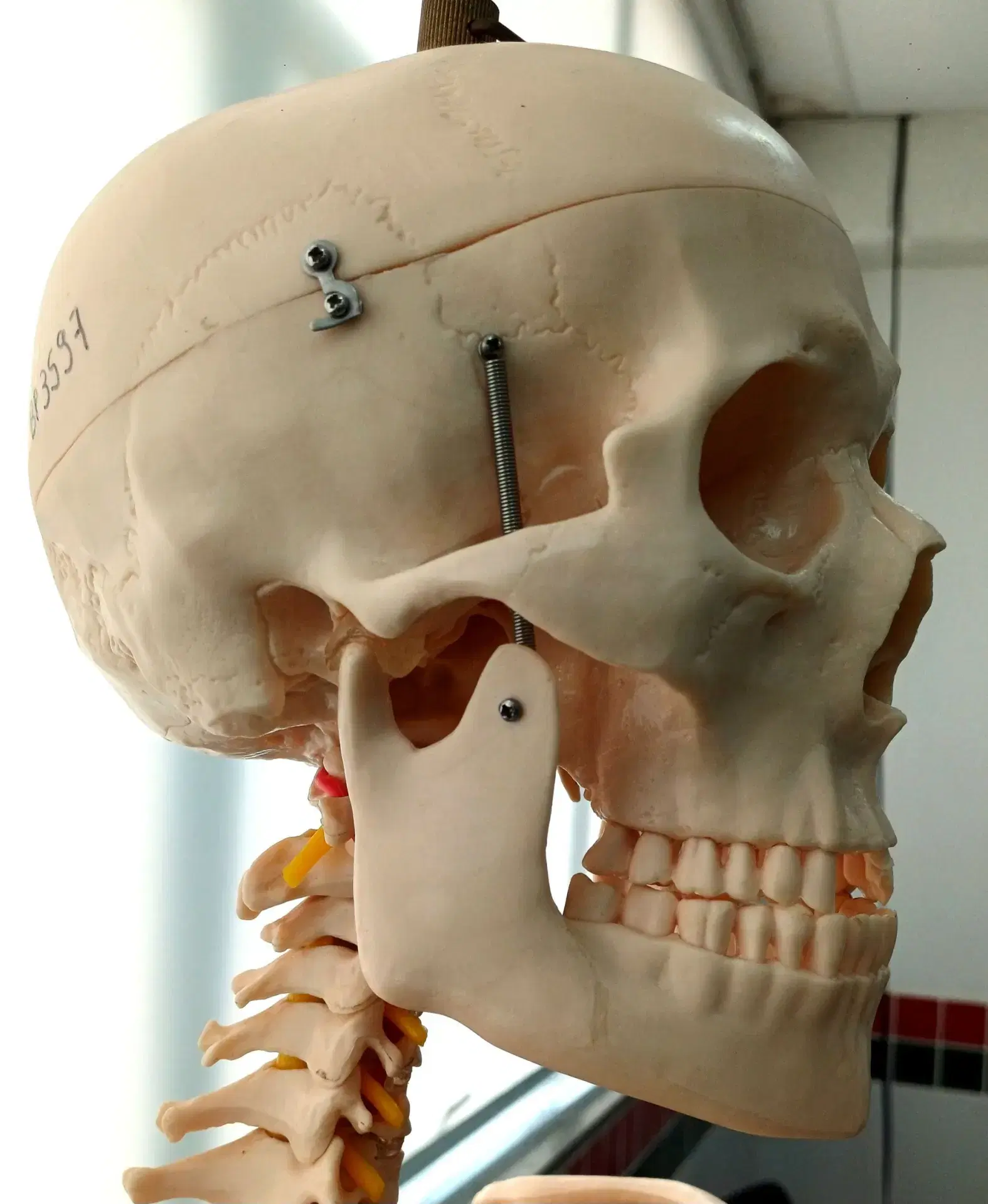
What pinched means when a nerve is involved
The word suggests a nerve squeezed flat, like a hose under a boot, and that is rarely the picture. A nerve root leaves the spinal cord, passes through a small opening between two neck bones and carries on out to the shoulder, arm and hand. Where that opening is crowded by a disc at the front (a layered ring that can bulge, not a block that slips out of place), the small joints at the back or swollen soft tissue, the root becomes sensitive to pressure and to being stretched, and it reports that along its whole length.
Two medical terms sit behind the everyday phrase. Radicular pain is pain carried by an irritated root. Cervical radiculopathy is the fuller picture, in which the root also stops working normally, so there may be numbness, a dulled reflex or a weak muscle as well. In the neck the root is most often crowded in the opening it leaves through beside each joint, and a report calls narrowing there foraminal stenosis.
Following the symptom from the neck to the fingers
The roots that serve the arm leave the neck at four levels, and each has a rough territory. Territories overlap and differ between people, so think of it as a rough map, not a measurement.
- Top of the shoulder and outer upper arm. The fifth root, which also drives the muscle that lifts the arm out to the side.
- Outer forearm, thumb and index finger. The sixth root, with the muscles that bend the elbow and cock the wrist back.
- Back of the arm and the middle finger. The seventh root, with the muscle that straightens the elbow.
- Inner forearm, ring and little fingers. The eighth root, with the muscles behind your grip.
Pain usually travels further than numbness does. An ache that runs from the base of the neck over the shoulder blade and down the arm may stop at the elbow, while the tingling sits only in the fingertips. If the fingers are your main complaint, which fingers matters: the thumb side tends to point to the sixth neck root, the middle finger to the seventh and the little-finger side to the eighth, and the nerves at the wrist and elbow can imitate each of them, which is why pins and needles in the hands need sorting finger by finger.
What a head position does to the arm
A neck nerve root has little spare room, and some positions take more of it than others. That is why the arm so often gives away what the neck is doing.
- Looking up and turning towards the sore side. This narrows the openings on that side, so it tends to stir the arm up. Painting a ceiling and checking a blind spot while driving are two familiar examples.
- Tipping the head away from the sore side. This stretches the nerve along its length and can send a pull into the arm.
- A hand resting on top of the head. This slackens the nerve, so the arm can feel different with the hand up. Examiners look for that, and some people find it themselves when sleeping with an arm overhead.
- Hours of chin-forward screen time. The joints and discs of the neck carry load for longer than they like. It is a familiar background to arm symptoms, though not an explanation on its own.
What the examination adds, and where a report fits
The examination starts with the story: which fingers, which movements, what the nights are like. Then we move the neck in each direction while you tell us what the arm does, check the shoulder to rule it in or out, and check the wrist and elbow in case the nerve is irritated further down. A catch in the outer upper arm when you lift can come from the shoulder itself: shoulder pain when lifting the arm that peaks partway up and eases higher up points to the shoulder rather than the neck.
Weakness is the finding that changes the plan more than pain does. It shows up as a cup slipping, a wrist that will not lift to type or a grip that has become unreliable, and you may not notice it until it is tested. Strength, reflexes and sensation are compared with the other arm. Weakness in an arm that is severe or getting worse, or numbness that is spreading quickly, is not a see-someone-this-week matter: it means a hospital emergency department straight away.
Imaging has a place when clinically indicated, for example when weakness is progressing or the examination does not fit the story. A report describing wear in the neck does not settle where an arm symptom comes from, because the examination is what links a finding to a nerve. If you already have a report, bring it.
Sleeping, driving and the rest of an ordinary day
Nothing about a nerve root asks you to stop using your arm. It asks for attention to the positions that stir it: work brought down to eye level if looking up sets it off, a head restraint and mirrors set so you are not twisting on a long drive, and a pillow that holds your head level rather than tipped up or dropped down. One small movement is the chin tuck, and it is worth learning how to do one properly, along with the signs that mean stop. If a movement sends symptoms further down the arm, or leaves them there afterwards, leave it out and mention it at your assessment.
Two neighbouring pictures are worth keeping apart. A neck that has locked to one side overnight, with nothing in the arm, is a wry neck. Sharp, electric pain at the back of the head belongs to the nerves at the top of the neck, and sounds more like occipital neuralgia.
Pinched nerve, or something else in the arm?
Plenty of things can feel like a pinched nerve in the neck, and two can be present at once. The pattern only tells an examination where to start.
- Neck ache into the shoulder blade, upper arm and fingers, changing with head position
- Fits an irritated nerve root, and the neck is then examined movement by movement.
- Tingling in the thumb, index and middle fingers, worst on waking, different after shaking the hand out
- Leans towards the median nerve at the wrist, although the neck can produce the same fingers, so both get tested.
- Pain at the point of the shoulder when lifting the arm, with nothing in the neck
- More likely the shoulder itself, particularly if the pain catches at one height.
- Tingling in the little and ring fingers after leaning on the elbow
- Suggests the ulnar nerve at the elbow, although the eighth neck root supplies the same fingers.
- Clumsy hands, or legs that feel stiff, heavy or unsteady
- Not a single nerve root. The spinal cord itself may be crowded, so new clumsiness in both hands, or new unsteadiness on your feet, means a hospital emergency department the same day, with or without neck pain.
- Arm pain with chest pressure, breathlessness, sweating or nausea
- Needs an ambulance, whichever arm it is, even if the neck is stiff as well.
When to get it looked at
Call an ambulance if there is any confusion, sudden weakness or numbness in the face, arm or leg on one side, facial drooping, slurred speech, sudden trouble speaking, seeing or understanding, loss of vision, a seizure, or a sudden loss of balance or coordination.
Call an ambulance or go to a hospital emergency department straight away if a headache comes on suddenly and severely (the worst you have ever had), if a headache arrives with fever, a stiff neck or a rash, or if a headache follows a knock to the head.
Call an ambulance if arm, jaw or neck pain comes with chest pain, pressure or tightness, shortness of breath, sweating, nausea or dizziness.
Go to a hospital emergency department straight away for back or neck pain after a serious fall or a high-impact accident, such as a car accident; back or neck pain with a fever or feeling generally unwell; or new back or neck pain if your immune system is weakened, for instance by long-term steroids or chemotherapy, if you inject drugs, or if you have recently had a spinal injection, spinal surgery or a dental procedure.
Go to a hospital emergency department straight away if you have weakness in one arm that is severe or getting worse, or numbness in an arm that is spreading or getting worse quickly.
Go to a hospital emergency department the same day if you have new clumsiness in both hands, or new unsteadiness on your feet.
See your GP promptly, before booking here, if you have pins and needles, numbness or weakness in an arm or hand, a history of cancer, unexplained weight loss, pain at night that will not settle in any position, or known osteoporosis with new severe pain.
Arm pain that follows your neck movements, with no pins and needles, numbness or weakness, can be examined here once it has lasted beyond a few days, keeps coming back or reaches further down the arm than it did. If tingling is part of the picture, see your GP first, and an assessment can follow. Either way, bring a note of which fingers are involved and which positions change it.