

Every upper back has this curve
Seen from the side, a spine is not straight. The neck and lower back curve inward, and the thoracic spine between them curves outward, with its rounded side to the back. That outward curve is kyphosis. It is present in every adult, it helps the spine take load the way a spring does, and it comes in a range of shapes. A report that says “thoracic kyphosis” has named the curve. More curve than usual may be written as increased kyphosis or hyperkyphosis, and the next question is what that is being measured against.
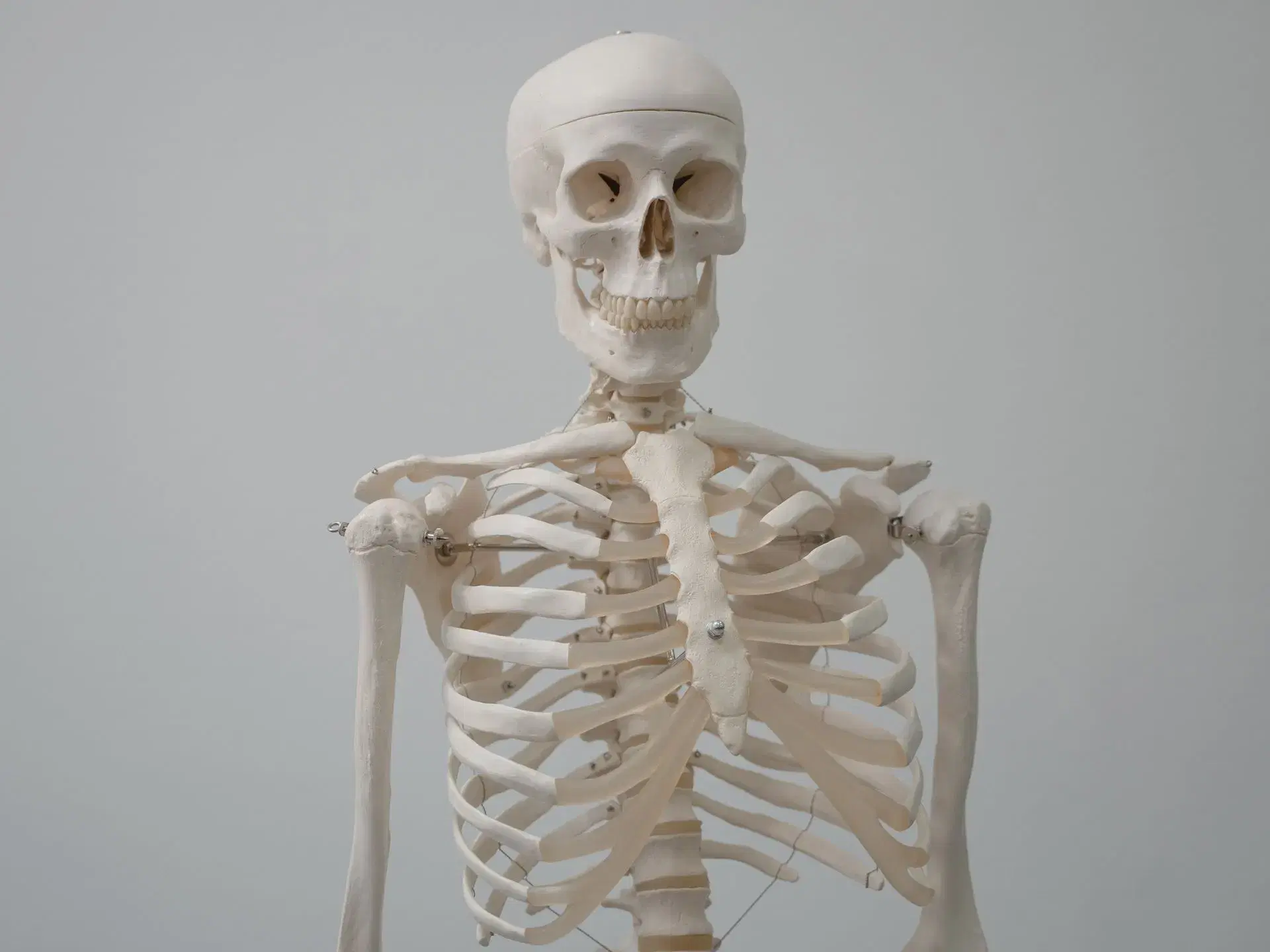
The whole spine from the left side, with the front of the body on the left, from the top of the neck to the tailbone. The spine is not straight. The neck and the lower back each curve inward, toward the front. Between them the thoracic spine, the twelve vertebrae that carry ribs, curves outward, with its rounded side toward the back. That outward curve and the thoracic vertebrae are highlighted.
A curve that moves and a curve that does not
In a postural curve the bones are ordinary and the shape comes from how the spine is being held. It changes with position, softening when you lie on your back or reach overhead and deepening when you are tired or slumped. The muscles along the spine and between the shoulder blades are doing the holding, which is why an upper back can ache by the end of a long day.
In a structural curve, sometimes called a rigid one, the shape no longer depends on position. Something in the bones or the discs has altered it, often a gradual wedging of the front edges of several vertebrae or a loss of height in the discs between them. It tends to look much the same lying down as standing. In adults, wedging has more than one cause, including thinning of the bones, which is not always painful.
Why a new or growing stoop goes to a GP first
A stoop that has been there for years and has not changed is usually a matter of shape. One that is new, or that you or someone close to you notices is increasing over months, is a different question. In an older adult especially, a growing curve, a loss of height or new pain in the middle of the back can go with osteoporosis, where thinned vertebrae slowly compress at the front, and that can happen with little pain and little or no injury. A GP can check bone health and, when clinically indicated, request imaging. So the GP comes first, and an assessment of how the spine moves can follow.
In a younger adult, a back that is stiffening and rounding, with morning stiffness that loosens with movement, goes to a GP for a different reason: an inflammatory pattern that often starts in the sacroiliac joints, where it is called sacroiliitis, can climb the spine, and is one a doctor leads on.
None of this makes a rounded upper back a cause for alarm in itself. The question is change, and the answer comes from comparing: a photograph from a few years ago, a height written down at a past appointment, a relative’s remark. Those are more useful than any single measurement taken today.
What a report is measuring when it says kyphosis
A standing side-on X-ray can be used to put a figure on the curve, in degrees. It is called the Cobb angle, and it is found by drawing a line along the top of one vertebra and another along the bottom of a vertebra further down, then measuring the angle between those lines. Where the normal range ends depends on who you ask, and the range is wide, so a figure on its own is not a verdict. It describes the shape on that day, in that position.
Other words on the same report are worth knowing. “Wedging” describes a vertebra that is shorter at the front than at the back. “Schmorl’s nodes” are small pushes of disc material into the bone above or below, often found by chance. “Degenerative change” describes wear that goes with age. The thoracic spine, where this curve sits, is the twelve vertebrae that each carry a pair of ribs.
A lump at the base of the neck
A bulge at the base of the neck is related to the curve but is not quite the same thing. A neck hump is usually the top of the thoracic curve with the head carried forward, or a pad of fat over the bone, and one that is new or growing goes to a GP. When posture is assessed, the upper back, neck and shoulders are looked at as one unit, because the head’s position over the shoulders changes how the curve below it sits.
Watching the curve stand, bend and breathe
An assessment looks at the curve standing, from the side and from behind, and then at how it changes: bending forward, lying on the front, reaching overhead and breathing in. It tests how freely the ribs and the joints between them move, how the muscles along the spine are working, and the shoulders and neck, since the three work together. It asks how long the curve has been there and whether anyone has noticed it change. A movement such as thoracic extension over a foam roller is aimed at how far the mid back extends. It does not change the shape of a structural curve, and it is one to leave out with known osteoporosis, or until a GP has looked at any new or growing stoop.
Postural curve or structural curve?
A curve can have a bit of both, and only an examination can say how much of each.
- Lying on your back
- Postural: the curve tends to soften. Structural: the shape stays much the same.
- Reaching overhead or lifting the chest
- Postural: the upper back extends a fair way. Structural: very little change, and the movement may feel blocked.
- Bending forward, seen from the side
- Postural: the curve tends to look even and rounded. Structural: the curve can look more angular, with a sharper point.
- How long it has been there
- Postural: often gradual and hard to date. Structural: may be long-standing, or may be new, and new is the one to mention to a GP.
- The bones on imaging
- Postural: the vertebrae look ordinary in shape. Structural: some may be wedged or may have lost height.
- Who looks first
- Either can be assessed, but a new or growing curve goes to a GP first, at any age.
When to get it looked at
Call an ambulance if pain between the shoulder blades comes with chest pain, pressure or tightness, shortness of breath, sweating, nausea or dizziness, or pain spreading into the arm, jaw or neck.
Call an ambulance if pain in the chest or upper back comes on suddenly and severely and feels sharp, ripping or tearing.
Call an ambulance if there is any confusion, sudden weakness or numbness in the face, arm or leg on one side, facial drooping, slurred speech, sudden trouble speaking, seeing or understanding, loss of vision, a seizure, or a sudden loss of balance or coordination.
Go to a hospital emergency department straight away for back or neck pain after a serious fall or a high-impact accident, such as a car accident; back or neck pain with a fever or feeling generally unwell; or new back or neck pain if your immune system is weakened, for instance by long-term steroids or chemotherapy, if you inject drugs, or if you have recently had a spinal injection, spinal surgery or a dental procedure.
Go to a hospital emergency department straight away if you have numbness or altered feeling around the saddle area, meaning the groin, the inner thighs, the buttocks or the genitals; a loss of normal sensation in the genitals, including during sex; trouble starting to pass urine, or any new change in your bladder or bowel control; weakness in both legs, particularly if it is getting worse; new or worsening pain running down both legs; weakness in one leg that is severe or getting worse, or a foot that has started to catch or drag when you walk; or numbness in a leg that is spreading or getting worse quickly.
Go to a hospital emergency department straight away if you have weakness in one arm that is severe or getting worse, or numbness in an arm that is spreading or getting worse quickly.
Go to a hospital emergency department the same day if you have new clumsiness in both hands, or new unsteadiness on your feet.
See your GP promptly, before booking here, if you have a history of cancer, unexplained weight loss, pain at night that will not settle in any position, known osteoporosis with new severe pain, numbness that is spreading or getting worse slowly, new, unexplained back pain as an older adult, or pins and needles, numbness or weakness in an arm or hand.
A new or growing stoop goes to your GP first. For a curve that has stayed the same, the reasons to have it examined are an upper back that aches by the afternoon and keeps returning, reaching overhead or turning to look behind you becoming harder, or a wish to have the curve looked at by someone who can tell how much of it moves.