

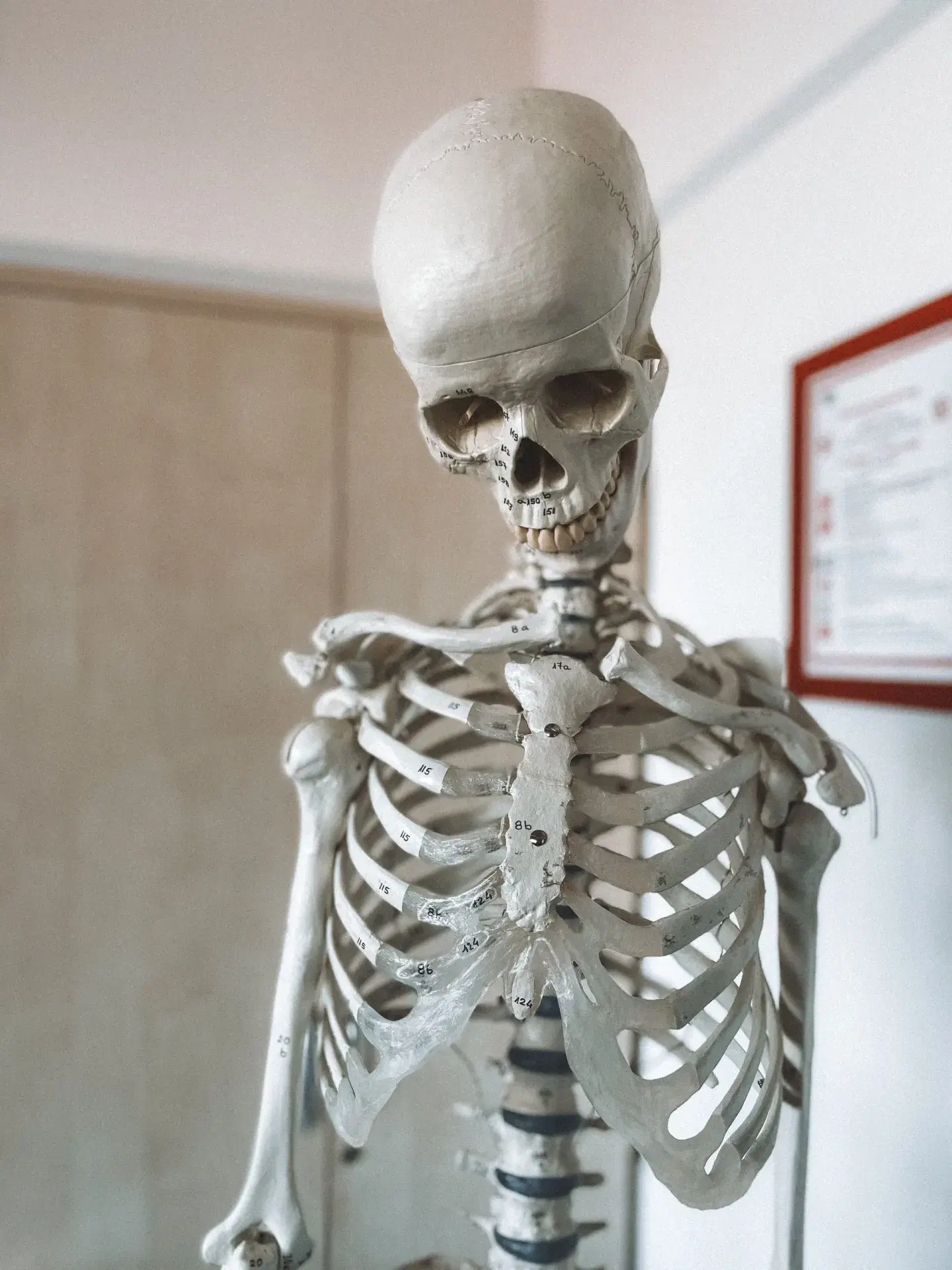
The stretch between the shoulder blades and the last rib
The middle of the back is the thoracic spine: twelve vertebrae, each with a pair of ribs hinged to it. Mid back pain is pain in the lower part of that stretch, from the bottom edge of the shoulder blades down to the last rib. Pain higher up, between and above the shoulder blades, is a separate complaint: shoulder blade pain.
Because of the ribs, this is the stiffest part of the spine. The neck and lower back are built to move, so they ask a lot of their joints and complain after a long day. The middle of the back mostly protects what sits behind the ribcage, and moves a little with every breath. That is what the thoracic spine is for.
Why it feels different from a sore neck or lower back
A sore lower back is often a broad ache you can cover with the flat of your hand. Pain in the middle of the back is more often a band, a deep point beside the spine, or a catch that comes and goes with a breath or a turn. Most ribs join the spine at two small joints, and one that has stopped moving freely can object when the rib swings on a deep breath.
Long, thin muscles run up either side of the spine and fan out to the ribs, holding you upright while your arms work out in front. Hold that long enough and the ache builds low between the shoulder blades, then peaks when you finally stand up.
What tends to set it off
- Long stretches in one position, with the arms out in front at a keyboard or a steering wheel.
- A twist or reach bigger than usual, such as grabbing a bag from the back seat.
- A new load across the chest or shoulders: a heavy strap, a low-slung backpack, or a fresh round of press-ups or rowing.
- A night in an unfamiliar bed that leaves you curled into one shape.
- A chest cold or a long bout of coughing, which works the ribs hard.
Noticing which one fits your week gives an assessment something to work with.
Why pain here is checked sooner
Behind the ribs sit the lungs and the heart, with the main artery running down beside the spine, and just beneath them the stomach, gallbladder, pancreas and kidneys. Pain from any of these can be felt in the middle of the back, which is why mid back pain is taken a little more seriously than pain in the neck or lower back.
The useful difference is how the pain behaves. A joint or muscle usually changes with something you do: a breath, a twist, lying on that side. Pain from an organ tends to stay the same whatever you do with your body, or to arrive with something else, such as feeling unwell, a cough or a change in eating. Neither pattern is certain, so an examination asks about both.
The bones matter here as well. A vertebra thinned by osteoporosis or long-term steroid medicine can crack after a cough, a stumble or an ordinary lift, and the mid back is a common place for it. New, sharp pain in the middle of the back in an older adult is one to see your GP about promptly, even when it started with something small.
Rib pain when breathing, the kind that catches on every deep breath, cough or sneeze, points towards a rib joint or the muscles between the ribs; with breathlessness, call an ambulance. Pain low on one side under the ribs that ignores every position is the one to tell apart from kidney pain, and a fever with it goes to an emergency department.
What you can try while you wait for an appointment
Holding one position is usually harder on this area than moving, so break up the long holds. Stand, turn your trunk from side to side, reach an arm up a wall. A minute is enough, and it is worth doing before the ache has built. At night, a pillow between the knees and another hugged to the chest gives the ribs some room if lying on your side is the sore position.
Carrying a bag on alternate shoulders stops one side doing all the holding. For a movement to try, thoracic rotation is aimed at the turning of the middle back. Stop if it catches sharply around a rib, or sends pins and needles into an arm or a leg.
What happens when the mid back is examined
It starts with a conversation: where you feel it, what it does when you breathe in, twist or lie down, and whether there has been a cough, a fever, a change in eating or any chest symptoms. Then comes hands-on testing of how the ribs move with breathing, how far the mid back turns each way, and which joints and muscles are sore to press. The neck, shoulders and lower back are tested too, because they share work with the middle of the back and often take the blame.
Strength, reflexes and sensation are checked when a nerve may be involved. Not every first visit includes a scan. Imaging is arranged when clinically indicated, and if the picture points away from your back, your GP is the next step.
What the pattern can point to
These are patterns, not diagnoses, and you can have more than one. Describing the pain this precisely is what lets an examination make sense of it.
- Catches on a deep breath or a twist, sore to press beside the spine
- Fits a rib joint or the muscles beside it, which is where an examination begins.
- A dull ache that builds through a sitting day and eases once you move
- Fits muscles that have held one position for too long, often with a stiff joint close by.
- A band of pain that follows one rib round towards the front
- Points to the nerve that runs beneath that rib. If a rash appears along the same band, see a GP promptly.
- Dull, deep pain that stays the same whatever you do
- Does not follow a joint or muscle pattern, so a GP is the first stop.
- Pain on the right, under the ribs, brought on by eating
- Can come from the gallbladder or stomach rather than the back, and belongs with a GP.
- Severe, steady pain high in the abdomen that goes through to the back, often with vomiting
- Can come from the pancreas or a stomach ulcer. Go to a hospital emergency department straight away.
When to get it looked at
Call an ambulance if pain between the shoulder blades comes with chest pain, pressure or tightness, shortness of breath, sweating, nausea or dizziness, or pain spreading into the arm, jaw or neck.
Call an ambulance if pain in the chest or upper back comes on suddenly and severely and feels sharp, ripping or tearing.
Call an ambulance if there is any confusion, sudden weakness or numbness in the face, arm or leg on one side, facial drooping, slurred speech, sudden trouble speaking, seeing or understanding, loss of vision, a seizure, or a sudden loss of balance or coordination.
Go to a hospital emergency department straight away for back or neck pain after a serious fall or a high-impact accident, such as a car accident; back or neck pain with a fever or feeling generally unwell; or new back or neck pain if your immune system is weakened, for instance by long-term steroids or chemotherapy, if you inject drugs, or if you have recently had a spinal injection, spinal surgery or a dental procedure.
Go to a hospital emergency department straight away if you have numbness or altered feeling around the saddle area, meaning the groin, the inner thighs, the buttocks or the genitals; a loss of normal sensation in the genitals, including during sex; trouble starting to pass urine, or any new change in your bladder or bowel control; weakness in both legs, particularly if it is getting worse; new or worsening pain running down both legs; weakness in one leg that is severe or getting worse, or a foot that has started to catch or drag when you walk; or numbness in a leg that is spreading or getting worse quickly.
Go to a hospital emergency department straight away if you have weakness in one arm that is severe or getting worse, or numbness in an arm that is spreading or getting worse quickly.
Go to a hospital emergency department straight away for severe, steady pain high in the abdomen that goes through to the back.
Go to a hospital emergency department the same day if you have new clumsiness in both hands, or new unsteadiness on your feet.
Pain under the right ribs that follows meals can come from the gallbladder, and a GP is the place to start. Go to a hospital emergency department straight away if that pain lasts a few hours, does not go away after simple pain relief, stops you eating and drinking normally, or comes with a fever or yellowing of the skin or eyes.
See your GP promptly, before booking here, if you have a history of cancer, unexplained weight loss, pain at night that will not settle in any position, known osteoporosis with new severe pain, numbness that is spreading or getting worse slowly, new, unexplained back pain as an older adult, or pins and needles, numbness or weakness in an arm or hand.
Mid back pain that is new and does not change with any movement, that wakes you whatever position you try, or that comes with a cough or a change in eating is worth having looked at by a GP before anything else. Pain that catches with a breath or a twist, keeps coming back, or has started to shape how you sit, drive or sleep is worth an assessment, which looks at the ribs, the mid back and the neighbouring regions together.