

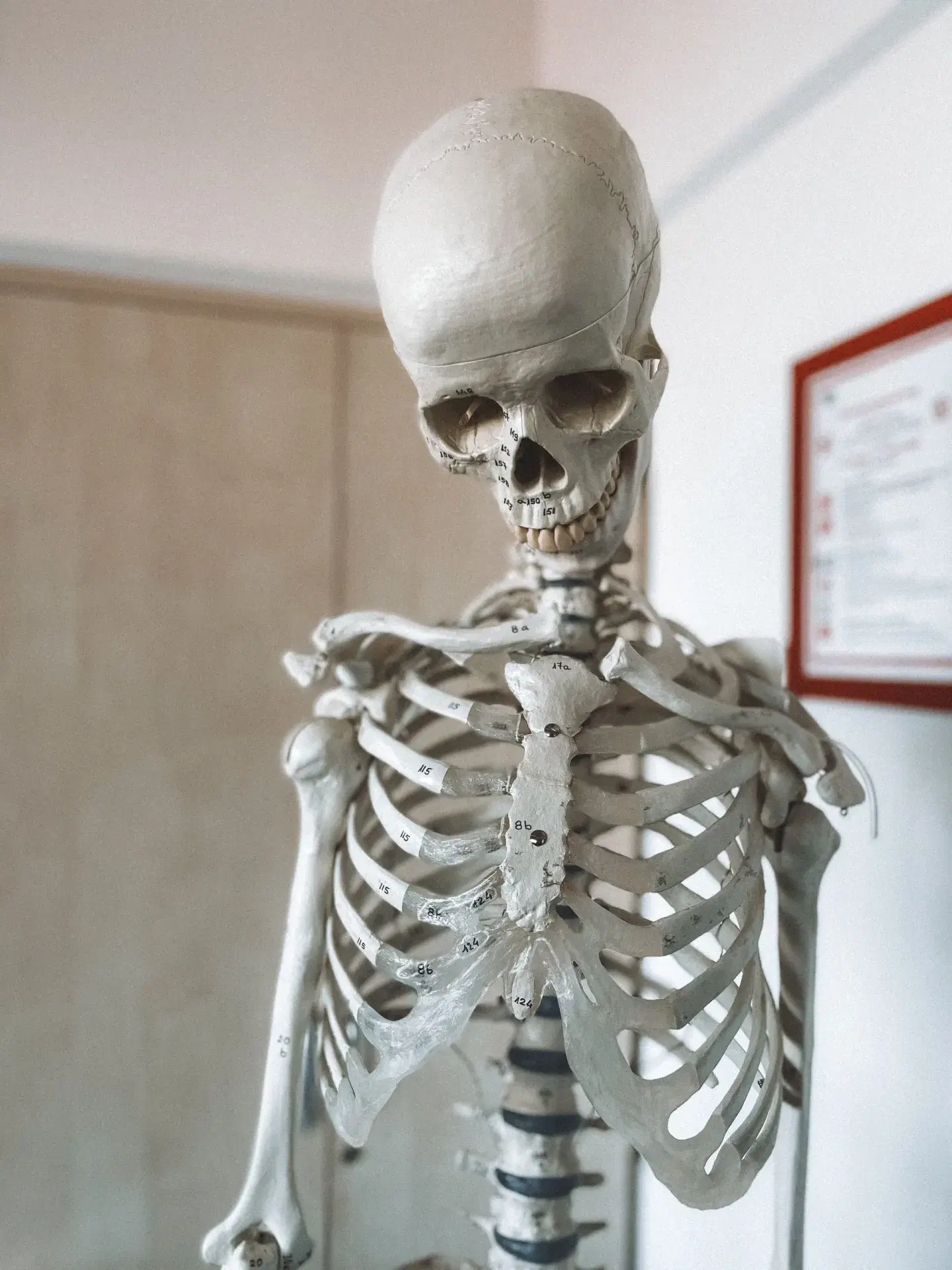
Twelve levels, each with a pair of ribs
Each thoracic vertebra, T1 to T12, carries a rib on either side. Most ribs meet the spine at two small joints, one at the body of the vertebra and one at the wing, the transverse process, a little further out. At the front, the upper ten pairs reach the breastbone through cartilage, and the lowest two end freely in the muscle of the side wall, which is why they are called floating ribs.
Together the vertebrae, ribs and breastbone form a cage, and the cage is the point of the design. It protects the heart and lungs, it gives the shoulder blades a firm platform to glide on, and it makes the mid back much steadier than the neck above or the lower back below. There are twelve thoracic vertebrae, numbered T1 to T12 from the top, one for each pair of ribs.
The mid back from the left side, with the front of the body on the left: T1 at the top to T12 at the bottom, with the base of the neck above and the top of the lower back below. The twelve vertebrae and a bracket beside them are highlighted. At each level a short bar at the back of the vertebral body marks where a rib meets the spine. The discs between the vertebrae are thin. The longer bars that slope backward and down are the spinous processes, one of them labelled, and they are bone of the spine, not ribs.
Why the mid back is stiff, and why it is strong
The ribs act like struts, holding each vertebra in a ring that cannot easily open out. The discs between thoracic vertebrae are thin in proportion to the bone either side, thinner by that measure than in the neck or the lower back, and the small joints at the back are angled so that turning comes more easily than bending. The result is a section that rotates more readily than it folds, and some stiffness is part of its design rather than a fault.
Strength follows from the same arrangement. A section that moves less has less to strain, and the load is shared between bones, ribs and a broad sheet of muscle. That does not make it immune to soreness. It means the usual reasons for pain differ from those lower down, and when the mid back moves less, the neck and lower back can be left to supply more of the turning and reaching, which is one reason an assessment looks at all three.
A stiff middle with a neck above and a lower back below
The thoracic spine is not uniform. The top few vertebrae move closely with the neck, and the muscles that steady the shoulder blades run up into that area. The bottom few, where the ribs are short or free, begin to look and move more like the lumbar vertebrae beneath them. The tightly caged middle is where the stiffness is greatest. That is why pain at the base of the neck and pain just above the waist can sometimes belong to this region and not to the neck or the lower back.
Seen from the side, the whole region curves gently outward, with its rounded side to the back. That is kyphosis, and every upper back has one. The word on its own describes shape, not a problem. A curve that is deepening, or kyphosis in adults that arrives with new pain, is the kind worth a closer look.
What the ribs take on, and what that means for pain here
Every breath moves the ribs a little at their joints with the spine, and so does every twist and every reach overhead. Pain that changes with a breath, a cough or a turn in bed is one of the patterns that points towards the rib joints and the muscles between the ribs, though it is never the whole answer. Pain between the shoulder blades that arrives with chest pressure, breathlessness or sweating is an ambulance call, and not a pattern to test against a stretch. Costochondritis, soreness where the ribs meet the breastbone at the front, is the front-of-the-chest counterpart to that soreness at the back.
The shoulder blade is the other neighbour. It glides across the back of the rib cage, and lifting an arm overhead needs the mid back to extend a little as well as the shoulder to rise. A mid back with little give can therefore be part of a shoulder problem, and the reverse. Movements such as thoracic rotation are aimed at the turning this region does most readily. An ache that stays put in the area itself is mid back pain, which tends to follow a few usual patterns.
Why discs are less often the story in the mid back
Disc trouble is rarer here than in the neck or lower back. The same features that make the region stiff, the thin discs, the ribs and the angle of the joints, mean there is less bending and less load on each disc. That is a general tendency and not a rule about any one person. It is also why new pain here is not assumed to be a disc: the muscles around the ribs, the rib joints themselves and the cartilage at the front of the chest are all candidates. Some pain felt in the upper back starts in organs in the chest or upper abdomen, which is why a sudden, severe, tearing pain, or upper back pain with chest pressure, breathlessness or sweating, is an ambulance call. The canal here is also narrow and holds the spinal cord, which is why weakness in both legs, or new unsteadiness on your feet, matters even when the pain is in the mid back.
Words for this region on a report
The same stretch of spine goes by several names, and a report may use whichever the writer prefers.
- T spine, thoracic spine, dorsal spine
- Three names for the twelve vertebrae of the mid back. Dorsal is the older word and still appears in some reports.
- Costovertebral and costotransverse joints
- The two small joints where a rib meets its vertebra, one at the vertebral body and one at the transverse process.
- Thoracolumbar junction
- The meeting point of the mid back and the lower back, around T12/L1, where the ribs end and the joints begin to face a different way.
- Kyphosis
- The outward curve of the thoracic spine. A report that says thoracic kyphosis has named the curve, and the adjectives around it carry the finding.
When to get it looked at
Call an ambulance if pain between the shoulder blades comes with chest pain, pressure or tightness, shortness of breath, sweating, nausea or dizziness, or pain spreading into the arm, jaw or neck.
Call an ambulance if pain in the chest or upper back comes on suddenly and severely and feels sharp, ripping or tearing.
Call an ambulance if there is any confusion, sudden weakness or numbness in the face, arm or leg on one side, facial drooping, slurred speech, sudden trouble speaking, seeing or understanding, loss of vision, a seizure, or a sudden loss of balance or coordination.
Go to a hospital emergency department straight away for back or neck pain after a serious fall or a high-impact accident, such as a car accident; back or neck pain with a fever or feeling generally unwell; or new back or neck pain if your immune system is weakened, for instance by long-term steroids or chemotherapy, if you inject drugs, or if you have recently had a spinal injection, spinal surgery or a dental procedure.
Go to a hospital emergency department straight away if you have numbness or altered feeling around the saddle area, meaning the groin, the inner thighs, the buttocks or the genitals; a loss of normal sensation in the genitals, including during sex; trouble starting to pass urine, or any new change in your bladder or bowel control; weakness in both legs, particularly if it is getting worse; new or worsening pain running down both legs; weakness in one leg that is severe or getting worse, or a foot that has started to catch or drag when you walk; or numbness in a leg that is spreading or getting worse quickly.
Go to a hospital emergency department straight away if you have weakness in one arm that is severe or getting worse, or numbness in an arm that is spreading or getting worse quickly.
Go to a hospital emergency department the same day if you have new clumsiness in both hands, or new unsteadiness on your feet.
See your GP promptly, before booking here, if you have a history of cancer, unexplained weight loss, pain at night that will not settle in any position, known osteoporosis with new severe pain, numbness that is spreading or getting worse slowly, new, unexplained back pain as an older adult, or pins and needles, numbness or weakness in an arm or hand.
Aching between the shoulder blades after a long day at a desk, or soreness that comes with a twist or a deep breath, is worth an assessment when it keeps coming back, when it is changing how you sleep or reach, or when reaching overhead has started to catch.