

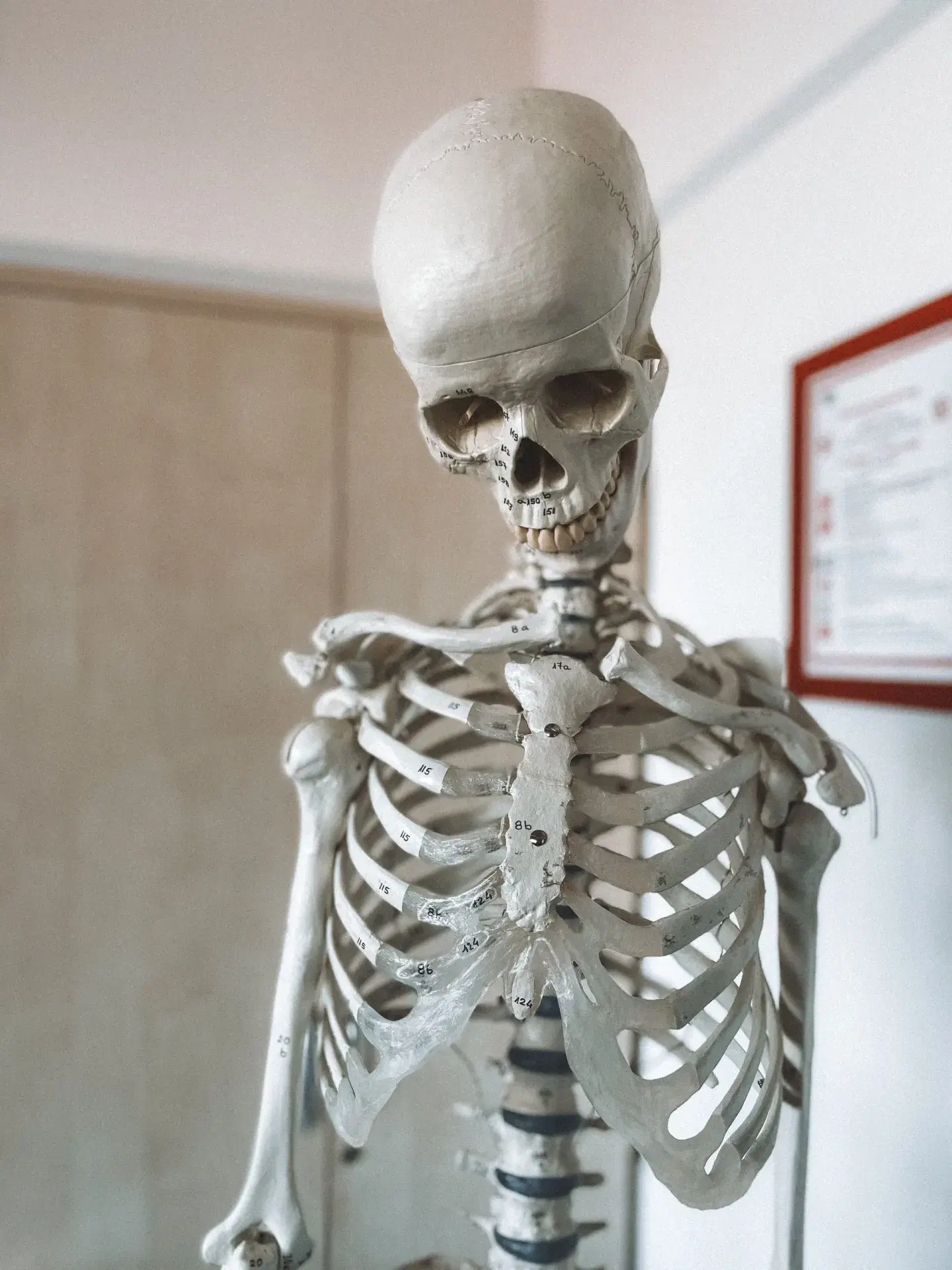
What the shoulder blade is meant to do
The shoulder blade sits on the back of the ribcage and has no bony joint with the spine, so muscle holds it there. The serratus anterior, a broad sheet running from the upper ribs round the side to the inner edge of the blade, pulls the blade flat against the ribs, while the trapezius and the rhomboids steer it. When the arm lifts, the blade tilts up and rotates so the socket follows the arm. Winging is what it looks like when the inner edge, and sometimes the lower tip, stands away from the ribs like a small wing.
Seeing it without making a drama of it
A mirror is a poor way to see the back of your own shoulder blades, and a short video taken from behind is better. Stand facing a wall at arm’s length, put both hands on it at shoulder height and lean in gently, as if starting a push-up, while someone films your back. A little visible edge is ordinary. What matters is a blade that stands out clearly, that differs from the other side, or that sticks out more as you tire. Keep it to a couple of tries, and stop if anything hurts or tingles.
Muscle control or nerve: two different stories
The common version is about control. The blade sits normally at rest and its edge lifts when the arm is loaded, held out for a long time or tired, often on both sides to a small degree and often with an ache around the blade or the shoulder. It reflects how the muscles around the blade share the work, which can shift with a long run of desk work, a new sport or an injury that made the arm hard to use.
The rarer version is a nerve palsy. The serratus anterior is supplied by a single nerve, the long thoracic nerve, which arises from three neck roots and runs a long, exposed course down the side of the chest. If it is injured, stretched or inflamed, the muscle weakens, the blade can wing at rest as well as under load, and lifting the arm overhead becomes difficult. A second nerve, the spinal accessory, supplies the trapezius and can produce a slightly different shape of winging. Both of those are for a doctor, and what led up to it often says more than how the blade looks.
Why a winging blade often comes with a sore shoulder
The shoulder needs a steady base to lift from. When the blade lags or tips, the arm is lifting from a moving platform, and the tendons under the bony roof can be asked to cope with positions they dislike, so a winging blade and a sore shoulder often turn up together. That sore shoulder tends to catch when you lift the arm at around shoulder height. Pain between the blades, with the blades sitting normally, is usually ordinary shoulder blade pain.
Watching the blade move, and asking what came first
Expect to be asked how it started, and whether sudden pain, an injury or an illness came before it, because that history counts for as much as the look. Then both blades are watched at rest, as the arms go up in front and out to the side, and as they come down slowly, since control often gives out on the way down. You repeat the wall push, the muscles around the blade are tested for strength, and the shoulder, the neck and the nerves to the arm are checked too. A pattern that fits a nerve palsy goes to your GP, who can arrange nerve conduction studies.
Strengthening, and the order of things
When the picture is one of control, the work is usually about teaching the blade to sit and move well, in small, slow steps and well below the point of fatigue. Scapular retraction draws the blades gently down and back, and wall angels slide the arms up a wall while the back stays in touch with it. Pins and needles, numbness or pain running down an arm is the cue to stop either one. If a nerve palsy is suspected, the GP comes first, because a hard exercise programme is not a way of testing for it.
Muscle control or nerve palsy?
A few questions sort the two apart.
- Gradual, with no injury, and the blade edge lifts only under load or when tired
- The control pattern, which shows up when you watch how the blade moves.
- Both blades lift a little when tired, with no other change
- A common variation in how the muscles share the work, and a reason to look at control rather than the nerve.
- Appeared within days of a burst of intense shoulder or upper arm pain, or after an illness
- A nerve inflammation known as neuralgic amyotrophy, or Parsonage-Turner syndrome, is possible, and that goes to a doctor rather than to an exercise plan.
- Followed a blow, a stretch injury, an operation near the armpit or chest wall, or heavy strap pressure on the shoulder
- The long thoracic nerve can be injured in these ways, and the history is what raises the question.
- The blade stands out at rest and the arm is hard to raise overhead
- Marked weakness of the serratus anterior, which needs a doctor.
- Both blades winging more over months, with weakness elsewhere, such as the face or upper arms
- Some muscle conditions begin this way, so this goes to a GP, and often on to a neurologist.
When to get it looked at
Call an ambulance if there is any confusion, sudden weakness or numbness in the face, arm or leg on one side, facial drooping, slurred speech, sudden trouble speaking, seeing or understanding, loss of vision, a seizure, or a sudden loss of balance or coordination.
Call an ambulance if arm, jaw or neck pain comes with chest pain, pressure or tightness, shortness of breath, sweating, nausea or dizziness.
Go to a hospital emergency department straight away for back or neck pain after a serious fall or a high-impact accident, such as a car accident; back or neck pain with a fever or feeling generally unwell; or new back or neck pain if your immune system is weakened, for instance by long-term steroids or chemotherapy, if you inject drugs, or if you have recently had a spinal injection, spinal surgery or a dental procedure.
Go to a hospital emergency department straight away if you have weakness in one arm that is severe or getting worse, or numbness in an arm that is spreading or getting worse quickly.
Go to a hospital emergency department the same day if you have new clumsiness in both hands, or new unsteadiness on your feet.
See your GP promptly, before booking here, if you have pins and needles, numbness or weakness in an arm or hand, a history of cancer, unexplained weight loss, pain at night that will not settle in any position, or known osteoporosis with new severe pain.
If the wing appeared quickly after a burst of shoulder pain, an injury or an illness, or the arm has become hard to lift overhead, see your GP promptly, before booking here. If it crept up slowly, shows more as you tire and comes with an ache around the blade, come in and have the way it moves looked at.