

A standing desk is not an antidote to a sore back. Standing is another position, and a back tires of any position held for hours, which is why people who stand all day get sore too, in the lower back and in the legs and feet. The useful question is how often you change.
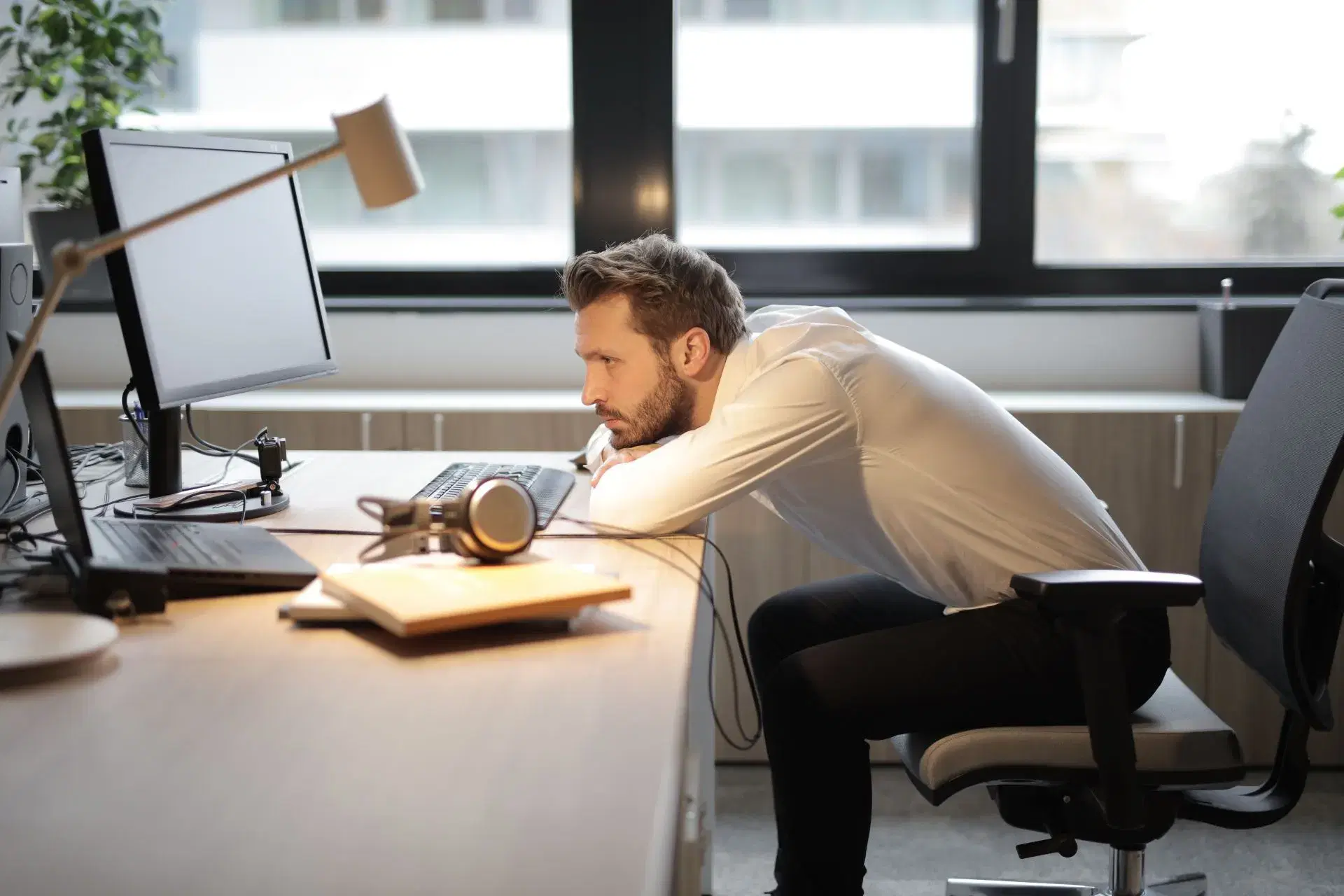
Why standing is not a rest for your back
The muscles that hold you upright do not switch off when you stand up from a chair. They change jobs. Sitting asks them to stop you folding forward. Standing asks them to keep you balanced over your feet, with the lower back holding a gentle arch while the hips and knees stay still. Keep that up for long enough and the muscles tire, whichever position you started from.
That is why moving from a chair to a standing desk can swap one sort of sore for another. The ache moves. Long sitting can show up in the lower back and the hips. Long standing can show up in that same lower back, and also in the calves and the soles of the feet.
A 2020 review of 41 systematic reviews in the Journal of Biomechanics, No consensus on causality of spine postures or physical exposure and low back pain, found posture associated with low back pain, but not shown to be its cause. So no desk position, seated or standing, can be named as the reason your back hurts. That is not the same as saying posture does not matter. It means a position alone does not explain a sore back, and how long you stay in any one of them is a fair question to ask.
If your back objects within minutes of standing still and settles when you walk or sit, that fits a back sensitive to the arch of standing, the pattern behind lower back pain when standing still. If your legs turn heavy or achy as you stand, and ease only when you sit or lean forward, that is a different pattern, one a narrowed spinal canal can produce. It tends to show up as lower back pain when walking too, where the clue is how far you get before it starts.
Setting the desk height by your elbows
Set the standing height by the keyboard first, because the rest follows it. Stand in the shoes you wear to work, let your arms hang, then bend your elbows to a right angle. The desk surface should meet your forearms there, with your wrists straight and your shoulders low. If you catch yourself shrugging to type, the desk is too high. If you are folding over it, it is too low.
A desk that moves needs two settings, not one. Work out the elbow height for sitting and again for standing, then mark the pair: a strip of tape on the desk leg, or the memory buttons if it has them. With both heights marked the switch takes seconds, which leaves one less reason to skip it.
The usual slip is raising the desk and leaving the monitor where it was. When the desk goes up, the screen goes up with it, until the top edge sits about level with your eyes. A laptop cannot manage both heights by itself, because the keys and the screen are joined, so lift it on a stand and add a separate keyboard.
The floor is part of the set-up too. Hours on polished concrete in thin soles load the feet and calves differently from the same hours on carpet in cushioned shoes, and a mat under the desk changes the surface again. Change one thing at a time and notice whether the ache moves.
Splitting the day without a stopwatch
There is no set ratio of sitting to standing to aim for, because nobody can say from a distance how much your back will take. The rule that travels well is to change before the ache asks you to. A desk day has natural joints in it, such as a phone call or a meeting you can take on your feet. Use those for standing, and keep the careful typing and the tired end of the afternoon for sitting.
Give yourself an early signal to watch for, because pain is a late one. The first sign of too much standing tends to be small. You start leaning on the desk, drifting onto one hip, locking your knees or craning towards the screen. That is the cue to sit, walk to the kitchen or change how you are standing, before the ache has begun.
If standing is new, build up to it. Your calves, feet and trunk are taking on work they have not done for a while, and feeling tired in new places for the first few days is ordinary. Start with the calls and the reading, add a little as that stops feeling like effort, and drop back a step if the lower back starts to grumble.
Standing is not the only way to change position. Walking to a colleague instead of messaging them, or taking a call on the move, changes the load as well. The sitting half of the day brings a different ache, lower back pain from sitting all day, and the desk basics and some strength work belong to posture exercises and desk setup. A long drive holds the back still in the same way, and for back pain from driving the same habit applies: plan a stop to stand up and walk before the ache asks for one.
If standing is already your job
Standing all day is a different problem from a desk that goes up and down, because the day is not yours to rearrange. Behind a counter or at a bench you cannot sit when the ache asks you to, so the work is in varying how you stand.
- Change your stance. Feet wider, feet narrower, one foot ahead, then the other. Each one shifts the weight, and the lower back feels it.
- Keep the knees soft. Standing with them locked is one more held position, and it is easy to do without noticing.
- Move the task as well as yourself. Carry the item to the customer instead of leaning across the counter. Walk round the bench instead of reaching over it.
- Take the sitting you are given. A stool for part of a job, or a proper seat on a break, is a change from standing, and so are a few minutes with your feet up after a shift.
A short lean backwards with the hands on the hips is one movement people use to break up standing. It does not suit every back. If it is the arch itself that hurts, leaning back adds to it, so skip the standing back extension and change position with a short walk or a foot on a low rail instead.
What people ask about standing at work
Is it better to stand or sit with a sore back? Neither wins on its own. If one position brings the ache on sooner, mention that at an assessment. An ache that changes when you change position is the ordinary kind. If it stays exactly the same whatever you do, mention it to your GP before anyone works on your back.
Does a standing desk replace taking breaks? No. A standing desk changes where you hold still, and walking away from the desk is a different change again. The two sit side by side.
What is worth bringing to an assessment? A photo of your desk at both heights, and a note of when the ache starts through the day. An assessment can then watch you stand still for a few minutes and move between sitting and standing, so the desk day is seen first-hand, and what it finds is explained before you leave.
What the guidelines say
- Journal of Biomechanics, No consensus on causality of spine postures or physical exposure and low back pain: A systematic review of systematic reviews, 2020. https://pubmed.ncbi.nlm.nih.gov/31451200/
When to get it looked at
A desk adjustment is no answer to a warning sign. If one fits, get it looked at first and sort the desk afterwards.
Go to a hospital emergency department straight away if you have numbness or altered feeling around the saddle area, meaning the groin, the inner thighs, the buttocks or the genitals; a loss of normal sensation in the genitals, including during sex; trouble starting to pass urine, or any new change in your bladder or bowel control; weakness in both legs, particularly if it is getting worse; new or worsening pain running down both legs; weakness in one leg that is severe or getting worse, or a foot that has started to catch or drag when you walk; or numbness in a leg that is spreading or getting worse quickly.
Go to a hospital emergency department straight away for back or neck pain after a serious fall or a high-impact accident, such as a car accident; back or neck pain with a fever or feeling generally unwell; or new back or neck pain if your immune system is weakened, for instance by long-term steroids or chemotherapy, if you inject drugs, or if you have recently had a spinal injection, spinal surgery or a dental procedure.
Go to a hospital emergency department the same day if you have new clumsiness in both hands, or new unsteadiness on your feet.
See your GP promptly, before booking here, if you have a history of cancer, unexplained weight loss, pain at night that will not settle in any position, known osteoporosis with new severe pain, numbness that is spreading or getting worse slowly, or new, unexplained back pain as an older adult.
For everything else, the desk is a fair place to start. If you have adjusted the heights and varied the day and the ache still arrives within minutes of standing, or follows you home, have it assessed.