

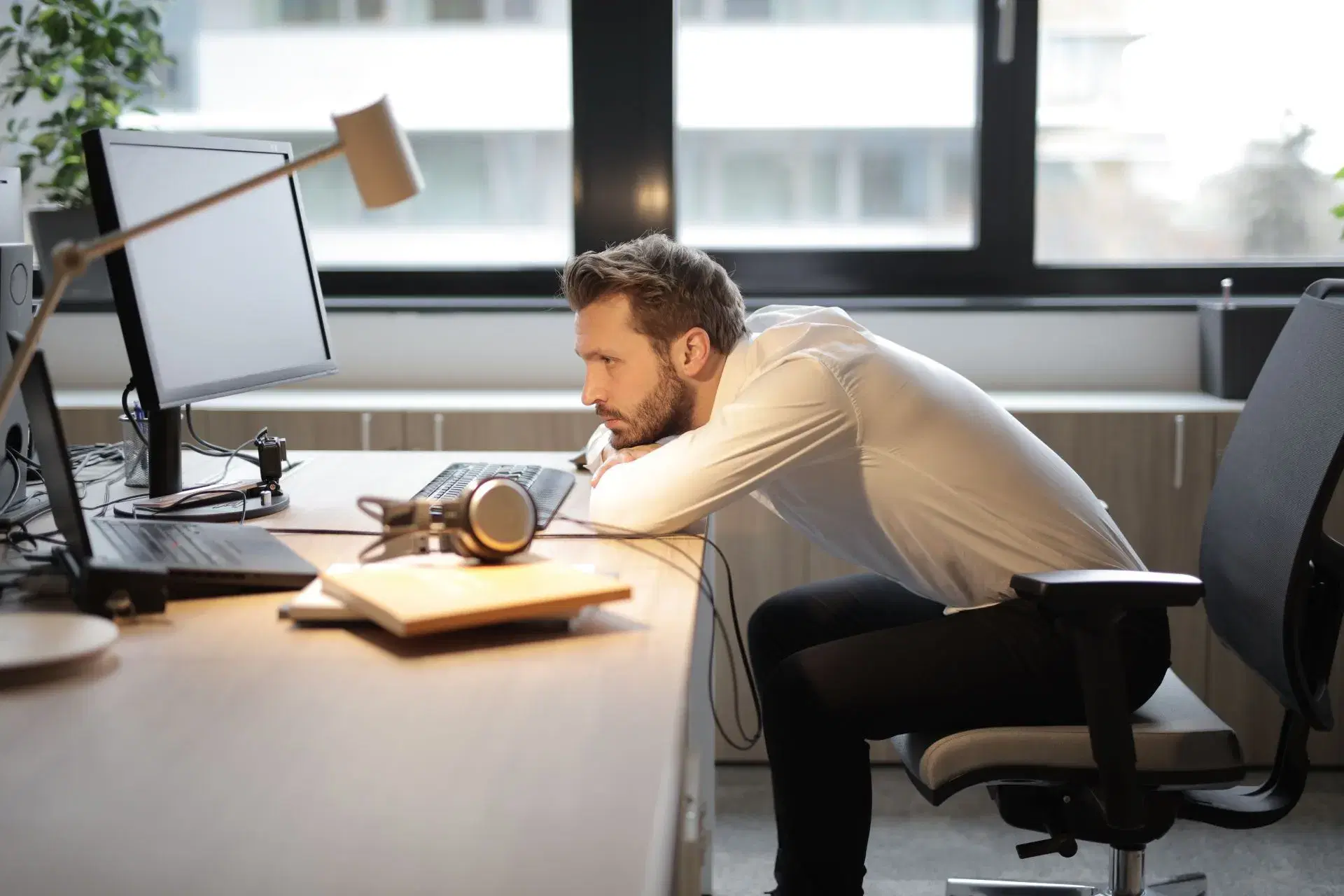
Often because your lower back has held one shape for hours. Sitting is not damaging in itself. For most people the trouble is the lack of change: the same joints loaded and the same muscles switched off, from the first email to the last. The ache usually turns up mid-afternoon, and again the moment you stand.
What sitting actually does to your lower back
Your lower back has a gentle inward curve when you are standing. Sit down and the pelvis tends to roll backwards, which flattens that curve and shifts load onto the back of the discs and the ligaments behind them.
That is fine for a while. Your spine is built to handle it. The problem is the hours. Held in one position, those tissues carry a steady load with no relief, and the muscles that would normally share the work are doing nothing at all. Movement is also how a disc gets its fluid moved through it, so long stretches of stillness are not what they are designed for.
Your hips are half the story
Sitting folds you at the hip. The muscles at the front of the hip spend the day in a shortened position, and the glutes, the big muscles behind you that should be helping your back, spend it switched off.
Stand up after several hours of that and the front of the hip pulls on the pelvis, while the muscles meant to take up the slack are cold. Your lower back ends up doing the work instead. That is the “give me a second, I can’t straighten up yet” feeling most desk workers know well.
Why it is worse at the end of the day
Soft tissue slowly deforms under a sustained load: it creeps. A ligament held at the same length for hours does not spring straight back, and the joints it supports feel loose and achy while it recovers. Add tired muscles and a body that has not moved much since breakfast, and the same desk that felt fine at 9am feels punishing by 4pm.
Sleep, stress and general activity all shift where your pain threshold sits, too. A hard week makes the same load hurt more. That is normal, and it is not in your head.
What actually helps
- The best posture is your next one. Change position every 20–30 minutes. Shift, lean, cross and uncross, sit forward, sit back.
- Get up briefly every half hour. Take calls standing. Walk to the far kitchen rather than the near one. A minute of movement resets far more than it looks like it should.
- Set the chair up once, properly. Feet flat, hips level with or slightly above the knees, and something supporting the small of your back. A rolled towel works as well as anything you can buy.
- Use a sit-stand desk for the switching. Standing all day has its own problems. Alternating is where the benefit is.
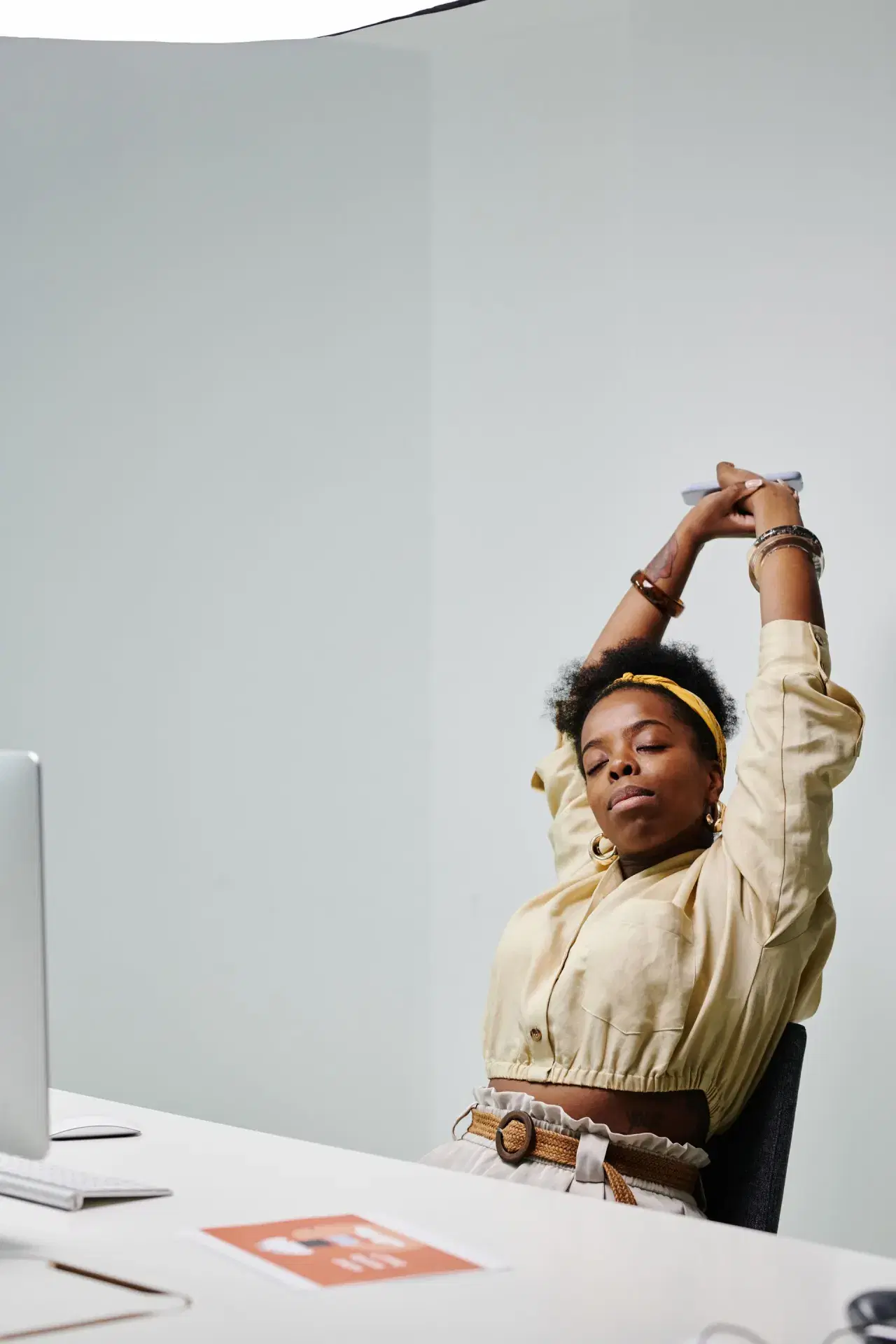
- Keep two or three movements handy. Standing backwards bends, a hip flexor stretch, and simply standing up and sitting down a few times will undo a good deal of a morning at the desk.
- Walk most days, and build some strength. Hips and trunk that are stronger tolerate longer days before they complain.
- Treat the commute like more sitting. A long drive is the same load, minus the chance to stand up.
For more movements like these, and when to stop, see which lower back stretches are worth doing. If it is your tailbone that hurts in a chair rather than your lower back, why your tailbone hurts when you sit covers that.
If your back settles overnight and flares again by the next afternoon, that is a loading pattern, which an assessment can pin down and some coaching can work on. That is the ground mobility and wellness care covers. If the pain has started travelling into your buttock or leg, it is worth reading what’s actually happening when a disc bulges? as well.
When to get it looked at
A few symptoms need medical care before anything else.
Go to a hospital emergency department straight away if you have numbness or altered feeling around the saddle area, meaning the groin, the inner thighs, the buttocks or the genitals; a loss of normal sensation in the genitals, including during sex; trouble starting to pass urine, or any new change in your bladder or bowel control; weakness in both legs, particularly if it is getting worse; new or worsening pain running down both legs; weakness in one leg that is severe or getting worse, or a foot that has started to catch or drag when you walk; or numbness in a leg that is spreading or getting worse quickly.
Go to a hospital emergency department straight away for back or neck pain after a serious fall or a high-impact accident, such as a car accident; back or neck pain with a fever or feeling generally unwell; or new back or neck pain if your immune system is weakened, for instance by long-term steroids or chemotherapy, if you inject drugs, or if you have recently had a spinal injection, spinal surgery or a dental procedure. Go to a hospital emergency department the same day if you have new clumsiness in both hands, or new unsteadiness on your feet.
See your GP promptly, before booking here, if you have a history of cancer, unexplained weight loss, pain at night that will not settle in any position, known osteoporosis with new severe pain, numbness that is spreading or getting worse slowly, or new, unexplained back pain as an older adult.
Otherwise, the ordinary threshold for booking an assessment is this: pain that has not started improving after a week or two, pain running into your leg, pins and needles, or a back that “goes out” every few months and has started shaping what you say yes to. We assess how you actually move, treat what we find, and explain it to you on the day.