
A disc does not slip. It is a tough cushion, bound firmly to the bone above it and the bone below. A bulge means part of that cushion has pushed out past its normal edge. Sometimes that irritates a nearby nerve and you feel it. Often it causes no pain at all.
What a disc actually is
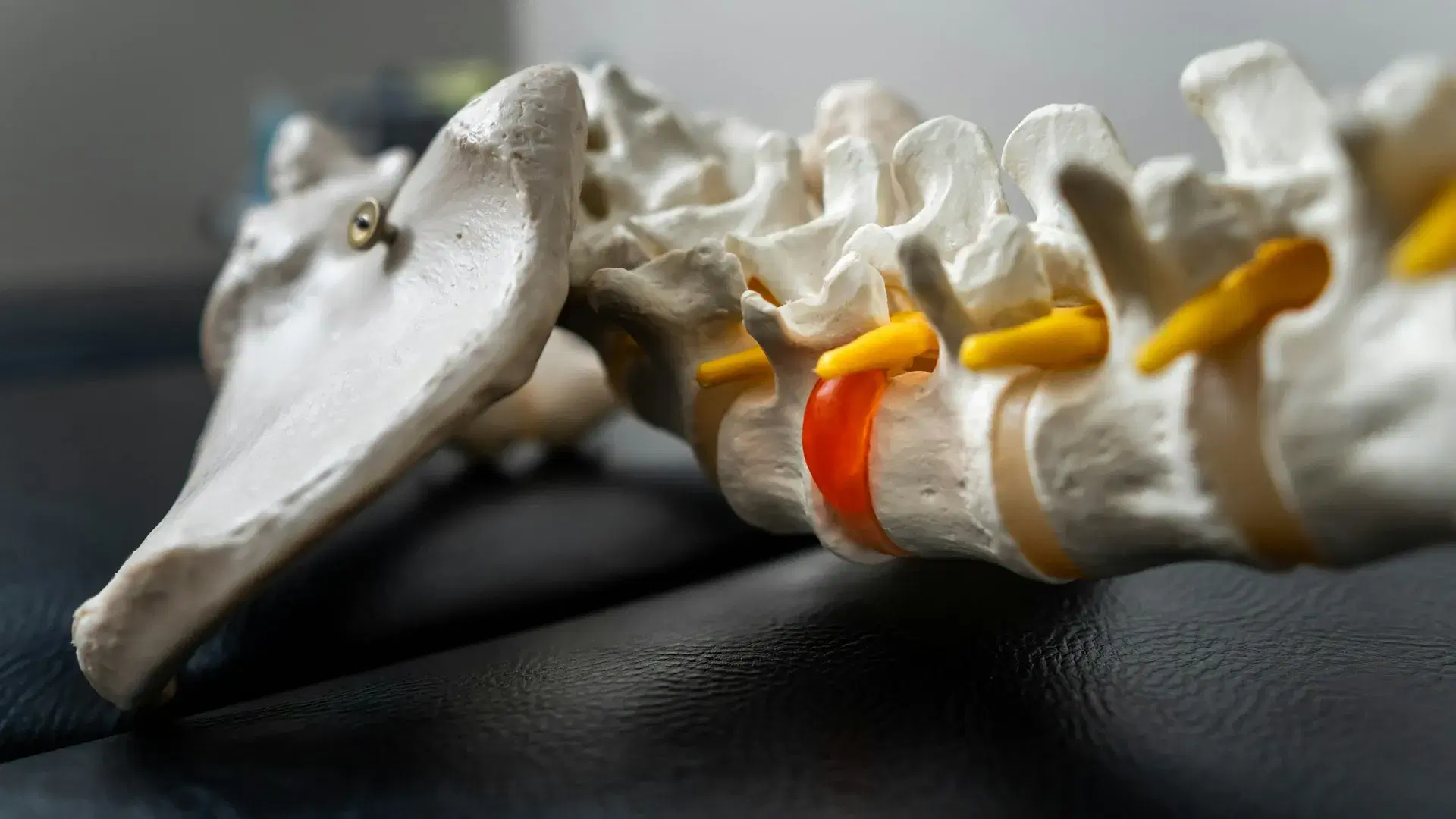
Between each pair of bones in your spine sits a disc. Picture a small, firm cushion. It has a tough outer wall built from many layers of fibre, and a softer, water-rich centre.
Those two parts do two jobs. They let your spine bend, twist and lean. And they spread load, so the bones are not grinding on each other every time you stand up or lift something.
Discs are not loose parts. That outer wall is attached to the bone above and the bone below, all the way around. It is why “slipped disc” is such a poor description: nothing slides out of place. What can happen is that the outer wall weakens or tears in one spot, and the softer centre presses into that weak area, pushing the edge of the disc outwards.
Bulge, herniation, annular tear: what the words mean
These are the words a radiologist uses to describe the shape of a disc on a scan.
- Disc bulge: the edge of the disc sits a little further out than it should, usually right around the disc.
- Disc herniation (you may also see protrusion or extrusion): a more focused push in one direction, where the softer centre has moved into or through a tear in the outer wall.
- Annular tear: a split in the layers of the outer wall itself.
- Degenerative disc (also written disc degeneration): a disc that has lost some height and water over the years. Like the others, it describes what the scan shows.
Every one of those words describes what a scan shows. None of them describes how much you hurt, how long it will take, or what you are allowed to do. We often see people who have read their report and stopped moving because of it.
Why a bulge on a scan is not the whole story
Disc bulges turn up regularly on the scans of people with no back pain at all, and they become more common as we get older. In that sense they are a bit like grey hair, a change that shows up over time, whether or not it is causing you any trouble.
So a bulge on a report is a finding, not an explanation. What matters is whether that finding matches your story: where the pain is, what brings it on, what eases it, and what your joints, muscles and nerves do when we test them. If the two do not line up, the disc may not be the thing driving your pain, and treating it as though it is would be a mistake.
Why disc pain can be so sharp
When disc material presses on a nerve root, two things can irritate that nerve. There is the pressure itself. And there is chemical irritation from the inflammation around an injured disc.
That is why the pain so often travels. The nerves in your lower back run down into the buttock, thigh, calf and foot, so an irritated nerve root can be felt as shooting pain down the leg, pins and needles, or numbness. That is what most people call sciatica. Your back itself may not even be the sorest part.
What care usually involves
Complete rest is rarely what we advise. Keep moving inside the range you can tolerate, then build from there.
In practice, care here means finding the positions and movements that ease your symptoms, hands-on work on the joints and muscles guarding around the injury, and staged exercise for strength and nerve mobility as things calm down. How long it takes varies from person to person, and your plan is paced to match.
That is the work behind disc and nerve rehabilitation, and it is also why we spend the first visit assessing before we treat.
When to get it looked at
Some symptoms need medical care first, not chiropractic care.
Go to a hospital emergency department straight away if you have numbness or altered feeling around the saddle area, meaning the groin, the inner thighs, the buttocks or the genitals; a loss of normal sensation in the genitals, including during sex; trouble starting to pass urine, or any new change in your bladder or bowel control; weakness in both legs, particularly if it is getting worse; new or worsening pain running down both legs; weakness in one leg that is severe or getting worse, or a foot that has started to catch or drag when you walk; or numbness in a leg that is spreading or getting worse quickly.
Go to a hospital emergency department straight away for back or neck pain after a serious fall or a high-impact accident, such as a car accident; back or neck pain with a fever or feeling generally unwell; or new back or neck pain if your immune system is weakened, for instance by long-term steroids or chemotherapy, if you inject drugs, or if you have recently had a spinal injection, spinal surgery or a dental procedure. Go to a hospital emergency department the same day if you have new clumsiness in both hands, or new unsteadiness on your feet.
All of these are uncommon, but each one needs to be checked urgently.
See your GP promptly, before booking here, if you have a history of cancer, unexplained weight loss, pain at night that will not settle in any position, known osteoporosis with new severe pain, numbness that is spreading or getting worse slowly, or new, unexplained back pain as an older adult.
Otherwise the ordinary threshold is simple. If pain is running into your leg, if pins and needles or numbness are hanging around, or if your back has not started to improve after a week or two of sensible movement, it is worth having it properly assessed. An assessment is how we work out what is actually driving it, and you get the findings explained to you in plain words the same day.