
Disc and nerve rehabilitation
Disc and nerve pain needs its own assessment, and this is the care planned around it.
Sound familiar?
- “slipped disc”
- “shooting pain down my leg”
- “pins and needles in my leg”
- “pinched nerve”
- “numb fingers”
- “disc herniation on my scan”
What’s happening in your body
A disc does not slip. Between each pair of spinal bones sits a firm cushion, bound to the bone above and below all the way around. It has a tough outer wall of layered fibre and a softer, water-rich centre. That combination lets your spine bend and twist while spreading load off the bones.
When part of that outer wall weakens or tears, the centre can press into the weak spot and push the disc’s edge outwards. Bulge, herniation and annular tear are all words for that shape. None of them tells you how much you will hurt, and all of them show up on scans of people with no pain.
Nerve roots leave the spine through small openings beside each disc. Irritate one and you feel it along the whole path that nerve travels, down the leg from the lower back, into the arm and fingers from the neck. Pressure is only part of it: inflammation around an injured disc irritates the nerve chemically as well. So the sorest place is often a long way from the problem.
What we most often treat
- Bulging and herniated discs, and tears through the disc wall (annular tears)
- Sciatica, and the nerve irritation clinicians call radicular pain or radiculopathy
- Arthritis in the spine, and the degenerative change that comes with it
- Back or neck pain severe enough to cut short standing, walking or an ordinary day
Two of them have pages of their own: sciatica and lower back pain.
If it is mostly stiffness and everyday ache rather than nerve symptoms, mobility and wellness care is the better fit.
How we go about it
Exercise chosen for the injury
Specific movements for strength, flexibility and nerve mobility.
Positions that ease the nerve
Finding the positions and movements that settle an irritated nerve, and using them day to day.
How you move and hold yourself
Advice and practice on the ergonomics of how you sit, stand and lift.
What care looks like week to week

Early visits
We take your history, test the nerve, check how your back or neck actually moves, and read any scan you already have alongside those findings rather than instead of them. Early treatment is gentle: hands-on work on the joints and muscles guarding around the injury, plus the positions that ease your symptoms.
As things settle
Exercise takes over: nerve-gliding movements first, then strength work. We work through the ordinary things that keep stirring it up too: how you sit, how you lift, how long you go before you get up.
Spacing visits out
As symptoms settle, visits spread out. Some people finish here; others come back if something flares.
Everyone moves through this differently, so the plan is paced to your body, reviewed with you as you progress, not read off a fixed schedule of visits.
The red flags we screen for
Screening for the small set of signs that need a hospital or a GP involved first is built into every assessment here. It is the part we take most seriously.
Go to a hospital emergency department straight away if you have numbness or altered feeling around the saddle area, meaning the groin, the inner thighs, the buttocks or the genitals; a loss of normal sensation in the genitals, including during sex; trouble starting to pass urine, or any new change in your bladder or bowel control; weakness in both legs, particularly if it is getting worse; new or worsening pain running down both legs; weakness in one leg that is severe or getting worse, or a foot that has started to catch or drag when you walk; or numbness in a leg that is spreading or getting worse quickly. Go to a hospital emergency department straight away for back or neck pain after a serious fall or a high-impact accident, such as a car accident; back or neck pain with a fever or feeling generally unwell; or new back or neck pain if your immune system is weakened, for instance by long-term steroids or chemotherapy, if you inject drugs, or if you have recently had a spinal injection, spinal surgery or a dental procedure.
Go to a hospital emergency department straight away if you have weakness in one arm that is severe or getting worse, or numbness in an arm that is spreading or getting worse quickly. Go to a hospital emergency department the same day if you have new clumsiness in both hands, or new unsteadiness on your feet.
See your GP promptly, before booking here, if you have a history of cancer, unexplained weight loss, pain at night that will not settle in any position, known osteoporosis with new severe pain, numbness that is spreading or getting worse slowly, new, unexplained back pain as an older adult, or pins and needles, numbness or weakness in an arm or hand. We coordinate with them, and your care here runs alongside theirs.
Common questions
Is a pinched nerve the same thing as sciatica?
Often they are two names for the same problem. “Pinched nerve” is the everyday name for a nerve root that has become irritated where it leaves the spine. When that happens in the low back, you feel it down the leg, which is what most people call sciatica. When it happens in the neck, you feel it into the arm and hand instead. Pressure is only part of the story: inflammation around a nerve root irritates it as well, so the examination tests how the nerve is behaving rather than looking for something to push back into place. Go to a hospital emergency department straight away if you have weakness in one arm that is severe or getting worse, or numbness in an arm that is spreading or getting worse quickly. See your GP promptly, before booking here, if you have pins and needles, numbness or weakness in an arm or hand, a history of cancer, unexplained weight loss, pain at night that will not settle in any position, or known osteoporosis with new severe pain. If it is your leg, the emergency signs listed on this page apply.
My scan shows a disc bulge. Does that mean I need surgery?
A bulge on a report describes a shape, and plenty of people with the same finding have no pain. What matters is whether the report matches your symptoms and your examination. If it does, and care is not helping as it should, that is when a surgical opinion is worth having, and we will write to your GP.
Is it safe to be adjusted when a disc or nerve is involved?
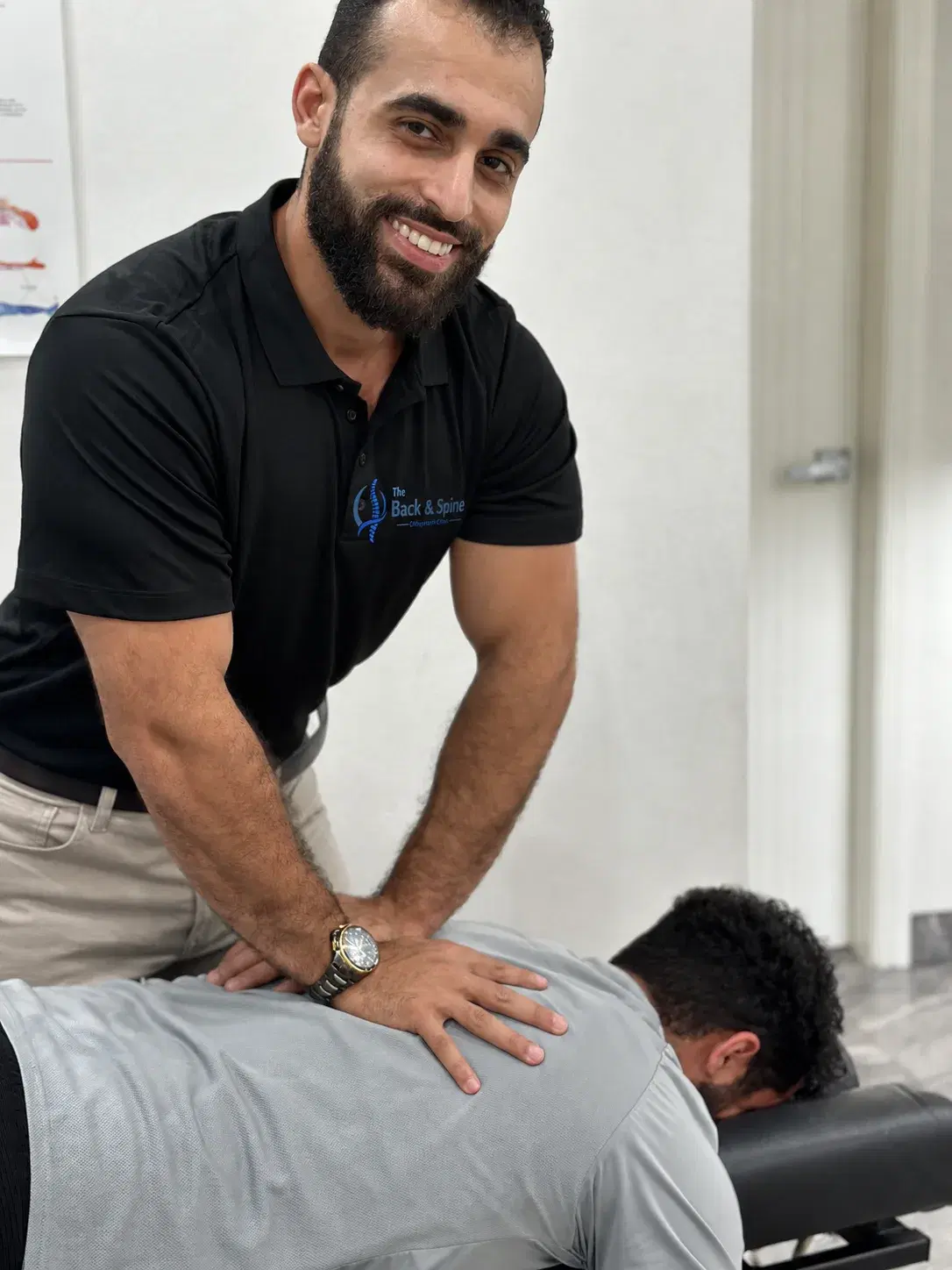
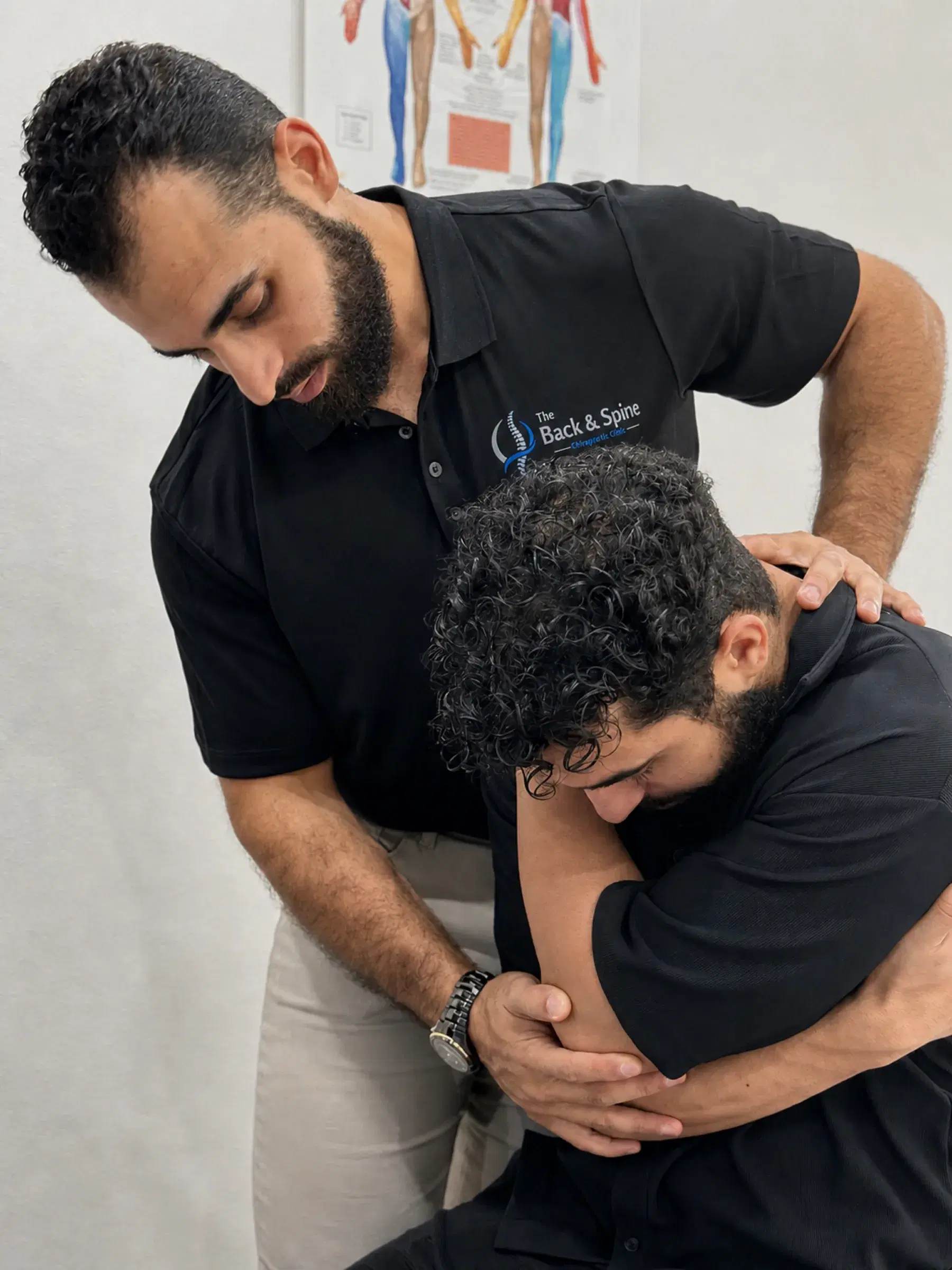
Technique is matched to how irritable things are, not applied the same way to everyone. When a nerve is angry, the first visits are usually gentle joint mobilisation, meaning slow movement with no thrust and no click, along with soft-tissue work and the positions that ease your symptoms. If you would rather not be adjusted at all, say so and Dr Laith Musallam, chiropractor, will work another way.
Should I rest, or keep moving?
Keep moving, within what you can tolerate. Long stretches of bed rest tend to leave nerve pain stiffer and more frightening rather than better. That does not mean pushing through sharp pain: it means short, frequent movement, using the positions that ease things, and building from there. We will show you where your line sits.
How long does nerve pain take to settle?
Honestly, it varies more than most people want to hear. Age, how long it has been there, your work and your general health all change the picture. We would rather give you an honest expectation than a flattering one, and the plan is adjusted as your body responds.
Take the first step towards better movement.
Suite 1, Lower Ground Floor, 225 Macquarie Street, Sydney. No referral needed to book.