

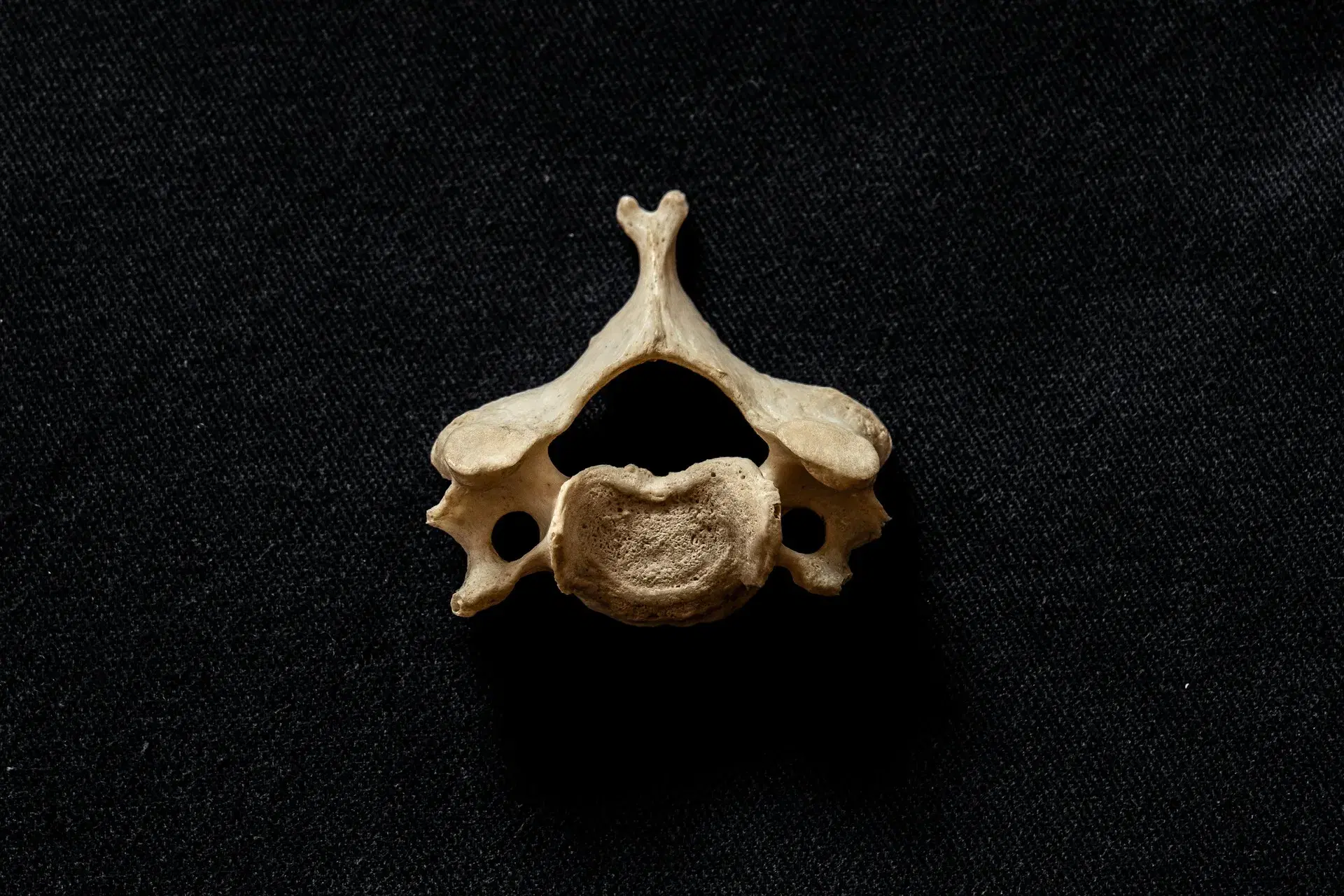
Four letters, counted down from the skull
Every vertebra has a name made of a letter and a number. The letter gives the region and the number gives the place within that region, counting from the top. C is for cervical, the neck, from C1 to C7. T is for thoracic, the mid back, from T1 to T12. L is for lumbar, the lower back, from L1 to L5. S is for sacrum, the triangular bone at the base of the spine, which begins as five segments and fuses into one bone as you grow.
The count runs downward, so a higher number means a lower position within the region, and T1 sits directly beneath C7. Add them up and there are twenty-four separate, movable vertebrae above the sacrum, with the tailbone, a few small fused segments, below it. A report that mentions T8 is pointing at the middle of the back of the rib cage. One that mentions L5 is pointing at the last bone above the pelvis. The label is a map reference.
The whole spine from the left side, with the front of the body on the left, from the top of the neck to the tailbone. Three brackets mark the movable vertebrae: seven in the neck, twelve in the mid back and five in the lower back. These three regions are highlighted, with the top vertebra, C1, and the last lumbar vertebra, L5, labelled at either end. Below them sit the sacrum, one fused bone, and the coccyx at the very bottom.
One vertebra, part by part
Most vertebrae share one plan, with the size and shape changing from region to region, and the same few parts come up again and again on reports.
- Body. The rounded block at the front that takes the weight. It grows larger from the neck to the lower back because each one carries more than the one above.
- Endplates. The thin layers of bone and cartilage on the top and bottom faces of the body, where it meets a disc. Disc material that has pushed through one into the bone of the vertebral body is what a report calls a Schmorl’s node, often a finding picked up by chance.
- Arch. The bony loop behind the body, made of two short stalks called pedicles and two flat plates called laminae. Body and arch together enclose a ring.
- Spinal canal. The tunnel made when those rings stack, which holds the spinal cord in the neck and mid back and a bundle of nerve roots lower down.
- Spinous and transverse processes. The spinous process is the bump you can feel down the middle of your back, and the transverse processes are the two wings at the sides. Both are anchor points for muscles and ligaments.
- Facet joints and the pars. Two pairs of small joint surfaces, one pair facing up and one facing down, link each vertebra to its neighbours, and the facet joints they make steer how the spine bends and turns. Between the upper and lower surface on each side is a narrow bridge of bone, the pars interarticularis, and a gap in that bridge is what a report calls spondylolysis.
Why L4/5 is a gap and not a bone
A single letter and number names a bone: L4 is the fourth lumbar vertebra. Two numbers joined by a slash name the level between two bones, which means the disc, the pair of joints and the opening for a nerve at that height. L4/5 and L4–L5 are two ways of writing the same place.
Counting levels from the top has one oddity. The skull rests on C1 and C1 turns on C2, and neither of those joints has a disc, so the first disc in the spine sits at C2/3. From there down, every pair of vertebrae has a disc between them until the sacrum, where the segments are fused.
Nerves are named by a separate rule, which is why a disc at one level can be paired with a nerve of a different number. In the lower back, the L4 nerve leaves through the opening at the L4/5 level, while the L5 nerve passes beside that disc on its way to an opening further down. In the cervical spine the rule turns over: each nerve takes the number of the vertebra below it, which is why there are eight neck nerves for seven neck vertebrae.
When the count does not come out at five
Not every spine follows the textbook. Some people have a lowest lumbar vertebra that has partly joined the sacrum on one side or both, and some have a top sacral segment that has stayed separate and looks like a sixth lumbar bone. This is called a transitional vertebra. It is a variation in how the spine formed, and it is present from birth.
It matters on a report for a practical reason. The person reading the image has to decide whether to count from the top, starting at the second neck bone, or from the bottom, starting at the sacrum, and the two methods can disagree by one level when a segment is extra or missing. Two reports on the same spine can then name the same disc differently. A good report says how it counted, and if two seem to disagree, the first thing to ask is whether they counted the same way.
What a level on a report does and does not tell you
A level names where something was seen. It does not say how much the finding matters, whether it is the source of your pain, or what should happen next, and the same word at the same level can mean quite different things in two people. Imaging is requested when clinically indicated, after a history and an examination, and the report is read against what they found.
That is why an assessment starts with you and not with the picture. If you have a report, bring it. A report lists what was seen at each level under its findings and sums it up in an impression at the end. For the words beside each level, such as protrusion or narrowing, it helps to know how to read a spine MRI report. The levels sit in regions built for different jobs: the thoracic spine is tied to the ribs, and the lumbar spine carries load and bends.
Shorthand you may meet on a report
Reports compress a lot of anatomy into a few characters, and a handful turn up again and again.
- C1 and C2, atlas and axis
- The names for the top two neck bones. The atlas carries the skull, and the axis has a peg of bone that the atlas turns around.
- C7
- The last neck vertebra. Its spinous process is longer than those above it, which is why it is often the bump you can feel at the base of the neck.
- T12/L1
- The level where the mid back becomes the lower back. The last pair of ribs attaches to T12, and in adults the spinal cord ends just below this height.
- L5/S1
- The lowest disc in the spine, between the last lumbar vertebra and the sacrum. It is also called the lumbosacral junction.
- S1 to S5
- The five segments of the sacrum. In an adult they are fused into one bone, so a report may name S1 as a landmark and rarely the others.
- Coccyx
- The tailbone, a few small segments fused together at the very bottom of the spine.
When to get it looked at
Call an ambulance if there is any confusion, sudden weakness or numbness in the face, arm or leg on one side, facial drooping, slurred speech, sudden trouble speaking, seeing or understanding, loss of vision, a seizure, or a sudden loss of balance or coordination.
Call an ambulance or go to a hospital emergency department straight away if a headache comes on suddenly and severely (the worst you have ever had), if a headache arrives with fever, a stiff neck or a rash, or if a headache follows a knock to the head.
Go to a hospital emergency department straight away if you have numbness or altered feeling around the saddle area, meaning the groin, the inner thighs, the buttocks or the genitals; a loss of normal sensation in the genitals, including during sex; trouble starting to pass urine, or any new change in your bladder or bowel control; weakness in both legs, particularly if it is getting worse; new or worsening pain running down both legs; weakness in one leg that is severe or getting worse, or a foot that has started to catch or drag when you walk; or numbness in a leg that is spreading or getting worse quickly.
Go to a hospital emergency department straight away for back or neck pain after a serious fall or a high-impact accident, such as a car accident; back or neck pain with a fever or feeling generally unwell; or new back or neck pain if your immune system is weakened, for instance by long-term steroids or chemotherapy, if you inject drugs, or if you have recently had a spinal injection, spinal surgery or a dental procedure.
Go to a hospital emergency department straight away if you have weakness in one arm that is severe or getting worse, or numbness in an arm that is spreading or getting worse quickly.
Go to a hospital emergency department the same day if you have new clumsiness in both hands, or new unsteadiness on your feet.
See your GP promptly, before booking here, if you have a history of cancer, unexplained weight loss, pain at night that will not settle in any position, known osteoporosis with new severe pain, numbness that is spreading or getting worse slowly, new, unexplained back pain as an older adult, or pins and needles, numbness or weakness in an arm or hand.
A number on a report is not something to act on by itself. An assessment is worth arranging when a report names a level and you are unsure what sits there, when the place the report points to does not match the place that hurts, or when two reports seem to disagree. Bring the report and any images you were given.