

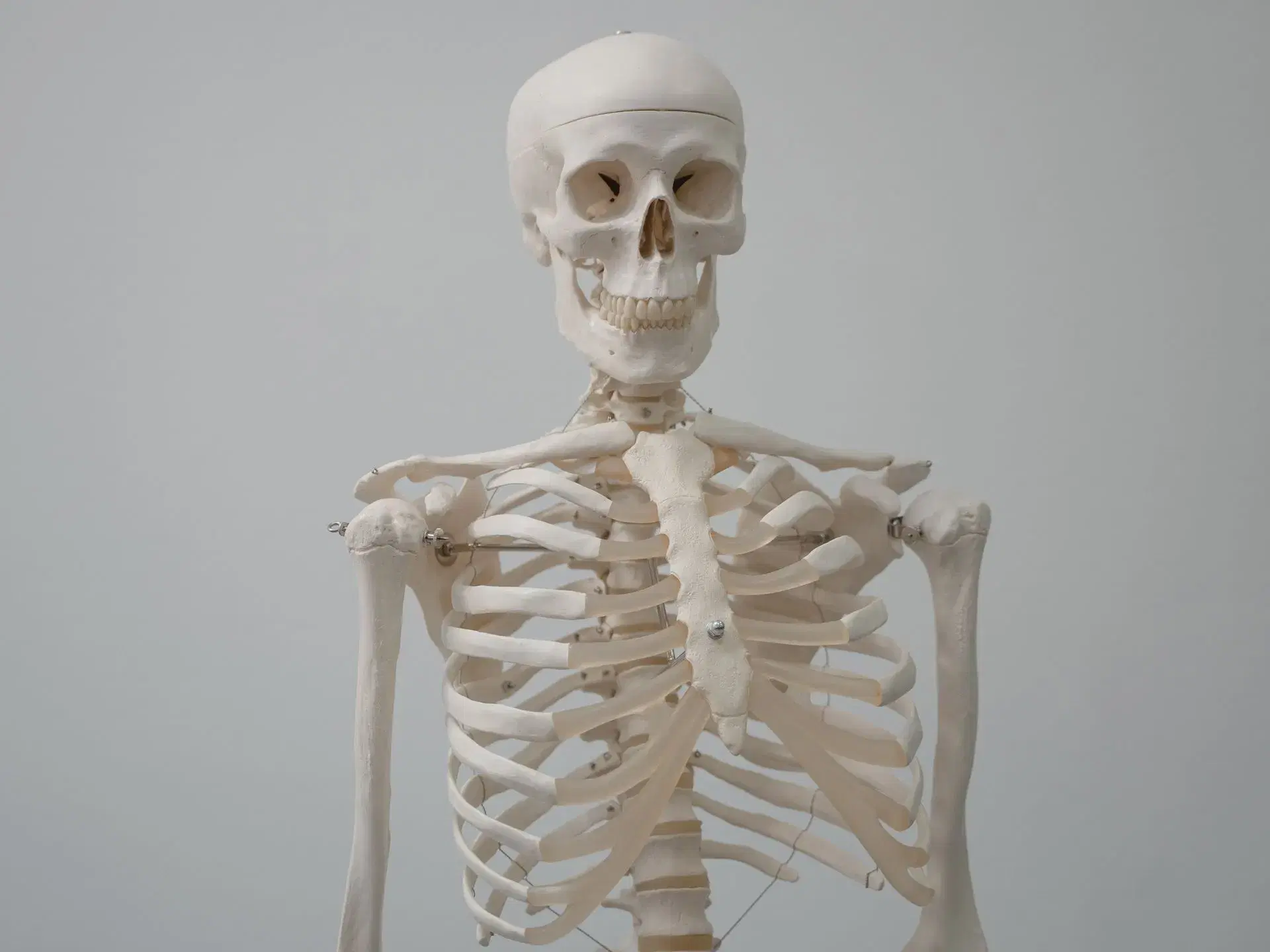
Where the occipital nerves run
The occipital nerves are sensory nerves from the second and third levels of the neck, meaning they mainly carry feeling rather than movement. They pass out between the bones at the top of the neck, climb through the thick muscles at the base of the skull and fan up the back of the scalp, the largest reaching towards the crown. A smaller one supplies the skin behind the ear.
Neuralgia means pain along the path of a nerve. When one of these nerves is irritated, the pain follows its territory: the base of the skull, the back of the head, sometimes behind the eye on the same side. What irritates the nerve is not always clear. Tight muscles at the base of the skull, irritated joints at the top of the neck, an old neck injury and sustained pressure on the nerve are all named, and sometimes no cause is found.
The quality of the pain is the pointer
Most headaches are described as an ache, a band or a throb. This one is described differently: jabbing, stabbing or like an electric shock, lasting seconds at a time and coming in bursts, often with a duller ache in between. It is usually on one side, though it can be both. The scalp over the area is often tender to the lightest touch, so brushing your hair, resting on a pillow or wearing a cap can set it off, and pressing firmly where the nerve comes through the muscle can bring it on.
The International Headache Society’s classification, in its third edition of 2018, describes a frequent episodic tension-type headache as usually on both sides of the head, pressing or tightening rather than pulsating, and mild to moderate. It describes a cervicogenic headache as a headache caused by a disorder of the neck, usually but not always accompanied by neck pain. Neither of those matches the brief, stabbing, shock-like pain of occipital neuralgia.
What tends to set it off
- Positions held for a long time. Looking down at a phone, or a head turned towards a second monitor, loads the muscles and joints around the nerves.
- Pressure at the base of the skull. A pillow edge, a hard headrest or a helmet strap can press where the nerve comes through.
- Touch on the scalp. Combing, a shower, a hat or lying on that side can start a jab when the skin has become oversensitive.
- An earlier neck injury. A fall or a whiplash-type event in the past is worth mentioning even if the neck settled long ago.
A neck that has locked to one side overnight is a different problem, usually called wry neck. Note what you were doing and which side it was in, because the pattern across several episodes says more than any one of them.
Why a short diary earns its place
The International Headache Society’s classification names a headache diary as its preferred way of identifying tension-type headache and the headaches that can overlap with it, and a diary does the same job here. Write down the date and time, the side, what it felt like in your own words, how long it lasted, what you were doing, and any medicine you took. A few weeks of that shows whether the pain is shocks or a band, whether movement or touch starts it and whether it clusters around particular days.
Head pain that can look like this and needs a doctor first
A tender scalp and sharp pain at the back of the head have other causes, and three of them are time-sensitive.
- Sudden, severe pain at the back of the head or the top of the neck. A tear in the wall of an artery in the neck can start like this, particularly with dizziness, double vision, unsteadiness or a drooping eyelid. Call an ambulance.
- A new headache with a tender scalp after the age of 50. Giant cell arteritis, also called temporal arteritis, is an inflammation of arteries in the head that can threaten sight. Jaw pain when chewing or aching shoulders alongside the headache make it more likely, and it needs a doctor the same day. A change in vision alongside the headache goes to a hospital emergency department straight away.
- Burning or stabbing over one side of the scalp, with skin that is sore to touch. Shingles can start this way days before a rash, so have someone check along the hairline, and see your GP promptly if anything appears.
Who makes the diagnosis, and who works beside them
Occipital neuralgia is diagnosed from the pain pattern and the tenderness over the nerve, once other causes have been ruled out. Doctors sometimes confirm it by injecting local anaesthetic around the nerve to see how the pain responds. That is a medical procedure, not part of a chiropractic assessment. Medicines for nerve pain are for your GP or doctor.
An assessment here looks at what the neck contributes: how the top of the neck moves, whether pressing on particular joints and muscles reproduces your usual pain, how the scalp feels compared with the other side, and a short screen of eyes, face, strength and balance. Care for an irritated upper neck is aimed at those muscles and joints and at the positions that load them, and it runs beside medical care and not instead of it. The top two joints of the cervical spine carry much of the head’s turning, which is why the examination starts there. The more common neighbours, tension-type and neck-related headache, raise their own questions: tension headache or neck headache? and can a headache really start in your neck?
Which head pain does this sound like?
Most headaches do not fit one box neatly, so read these as rough patterns, not a self-test.
- Stabbing or electric, seconds at a time, tender scalp, from the base of the skull
- The picture usually meant by occipital neuralgia, and the one a doctor may want to confirm.
- Steady one-sided ache from the base of the skull, set off by head movement or neck position
- The neck-related pattern, where the neck is examined for what it contributes.
- Pressing band round the head, both sides, not pulsating
- The tension-type pattern, which often shares a desk day with neck pain.
- Throbbing, with nausea or discomfort in bright light
- A question for your GP or doctor, who diagnose and manage migraine; neck pain can come with it.
- New head pain with a tender scalp after 50, jaw pain on chewing or a change in vision
- Needs a doctor the same day, because an inflammation of the arteries in the head can threaten sight. A change in vision goes to an emergency department straight away.
- A headache that arrives suddenly and severely, or with fever, a stiff neck or a rash
- Not one to sort out at home. Call an ambulance or go to an emergency department straight away.
When to get it looked at
Call an ambulance if there is any confusion, sudden weakness or numbness in the face, arm or leg on one side, facial drooping, slurred speech, sudden trouble speaking, seeing or understanding, loss of vision, a seizure, or a sudden loss of balance or coordination.
Call an ambulance for sudden, severe pain at the back of the head or the top of the neck with dizziness, double vision, unsteadiness or a drooping eyelid.
Call an ambulance or go to a hospital emergency department straight away if a headache comes on suddenly and severely (the worst you have ever had), if a headache arrives with fever, a stiff neck or a rash, or if a headache follows a knock to the head.
Go to a hospital emergency department straight away if a headache comes with a painful red eye, blurred vision or halos around lights.
Go to a hospital emergency department straight away for back or neck pain after a serious fall or a high-impact accident, such as a car accident; back or neck pain with a fever or feeling generally unwell; or new back or neck pain if your immune system is weakened, for instance by long-term steroids or chemotherapy, if you inject drugs, or if you have recently had a spinal injection, spinal surgery or a dental procedure.
Go to a hospital emergency department straight away if you have weakness in one arm that is severe or getting worse, or numbness in an arm that is spreading or getting worse quickly.
Go to a hospital emergency department the same day if you have new clumsiness in both hands, or new unsteadiness on your feet.
See your GP promptly, before booking here, if you have pins and needles, numbness or weakness in an arm or hand, a history of cancer, unexplained weight loss, pain at night that will not settle in any position, or known osteoporosis with new severe pain.
See your GP first if you have a brand-new type of headache, if your usual headache has changed its pattern, if your first bad headaches have started after the age of 50, if they are worse lying down or when you cough or strain, if you are taking pain relief for headaches more than a couple of days most weeks, or if you think you may have migraine and have never been assessed.
If sharp, shooting pain at the back of the head is new to you, see your GP first, and a new headache with a tender scalp after the age of 50 needs a doctor the same day. Once a doctor has seen it, an assessment is worth booking if the pain keeps recurring, if the scalp has become tender to the touch, or if it follows particular neck movements. Bring a short diary of when it happens, which side it is on and what you were doing.