

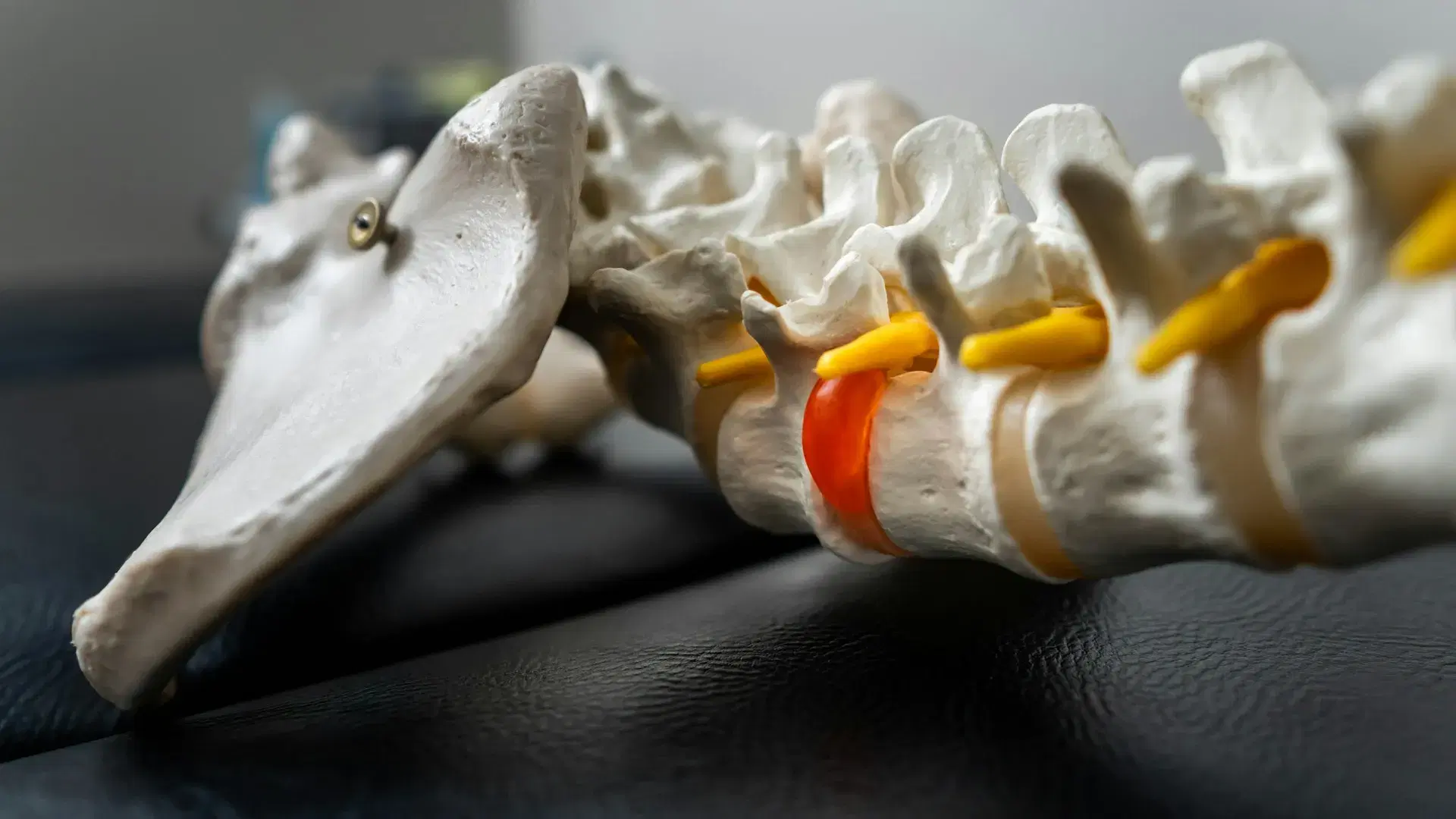
What a forward bend asks of the spine
Bending forward folds the spine and the hips together. As the spine rounds, the front of each disc is squeezed and the back of it is stretched, the small joints at the back of the spine glide apart, and the ligaments and long muscles behind the spine lengthen. The muscles are not idle while this happens. They let the trunk down against gravity like a brake, then lift it again on the way back up. Near the bottom of a full bend they ease off and the ligaments take more of the load.
A bend therefore has three parts that can each hurt for a different reason: the way down, the bottom and the way back up. The useful question is where in the movement the pain starts. Bending is close to the mirror image of standing still: in lower back pain when standing, the arch is the sensitive direction and a bend often feels easier.
The sock test
Putting on a sock is an ordinary morning bend, and it comes in versions that load the back differently. Notice which one hurts.
- Standing on one leg and reaching down. The full bend: the spine rounds and the hips fold at once, with a balance demand on top, so stand near a wall.
- Sitting with your ankle on the opposite knee. Asks for a lot of hip rotation and a rounded lower back, so a stiff hip can show up here.
- Sitting on the edge of the bed and reaching for your foot. Rounds the spine with less demand on balance and on the hips.
- Squatting down to your feet with your back upright. Bends the hips and knees and keeps the spine closer to straight, so it shows how much of the pain belongs to the rounding.
If only the standing version hurts, the longer reach and the pull behind the straight leg may be part of it. At that point a sensitive sciatic nerve and tight hamstrings feel alike, so note whether the pull stays in the back of the thigh or runs on towards the foot. If the seated version hurts as well, the rounding of the lower back itself is the more likely source.
On the way down, at the bottom and on the way back up
Where in the bend it hurts only tips the odds. Even on examination, back pain often cannot be pinned to one structure, and two can be present together. Pain that starts as you lower yourself is often the muscles braking against the load, or a disc sensitive to the rounding. It tends to sharpen the further you go and is often easier if you keep the trunk upright and bend the knees.
Pain at the very bottom, or when you hold the bend to tie a lace, wash a basin or pull weeds, tends to point to the ligaments and discs at the end of their range, because long held bends load these. Pain on the way back up, and especially a catch or hesitation as you straighten, more often belongs to the muscles doing the lift and the small joints at the back of the spine closing again. Needing a hand on your thigh to straighten is a detail worth mentioning.
Why bending is often hardest early in the day
Many people find bending hardest in the first hour or so after getting up, and easier by the afternoon. The discs are fuller after a night lying flat and the back is stiff from lying still, so the same bend asks more of it. If that is your pattern, note how many minutes the stiffness takes to loosen once you are moving, because that timing is the main clue in back pain after sleeping. It is an argument for doing the bending jobs later in the morning where you can, and no argument for avoiding bending.
Bending from the hips instead of the back
A hip hinge shares the bend between the hips and the spine, so the lower back does not do all of it. Push your hips back as if closing a car door with them, soften your knees and let the trunk tilt forward with a long back, then ask a clear question: does the pain change when the hips do more of the bend? Rounding the back is a normal movement, so use the hinge as a test of what changes, not as the only correct way to bend. Learn the hip hinge in small steps, with a point at which to stop, before you try it with a load. Once a load is in your hands, keeping it close and planning the lift matter more than the shape of the bend, for lifting at work, at home and at the gym alike.
When bending sends pain into the leg
If bending sends pain, tingling or numbness into the buttock or down a leg, an irritated nerve root may be involved, which is the sciatica pattern. A disc is one common reason. When a disc bulges, part of its soft centre pushes outward against the tougher outer wall, close to the nerve root beside it. If back pain when sneezing or coughing shoots into the leg as well, it points the same way, towards a nerve root, and is worth mentioning at an assessment. Imaging does not decide this on its own. The Royal Australian College of General Practitioners’ 2022 guidance for GPs says not to request imaging for acute low back pain unless a careful clinical assessment has raised a high suspicion of a serious cause, so a scan, when clinically indicated, follows an examination and does not replace it. For pain from an irritated nerve root, the college adds that imaging is not routinely indicated, and that in the first six weeks it is considered only if symptoms are severe and not improving and surgery is being considered.
When to get it looked at
Go to a hospital emergency department straight away if you have numbness or altered feeling around the saddle area, meaning the groin, the inner thighs, the buttocks or the genitals; a loss of normal sensation in the genitals, including during sex; trouble starting to pass urine, or any new change in your bladder or bowel control; weakness in both legs, particularly if it is getting worse; new or worsening pain running down both legs; weakness in one leg that is severe or getting worse, or a foot that has started to catch or drag when you walk; or numbness in a leg that is spreading or getting worse quickly.
Go to a hospital emergency department straight away for back or neck pain after a serious fall or a high-impact accident, such as a car accident; back or neck pain with a fever or feeling generally unwell; or new back or neck pain if your immune system is weakened, for instance by long-term steroids or chemotherapy, if you inject drugs, or if you have recently had a spinal injection, spinal surgery or a dental procedure.
Go to a hospital emergency department the same day if you have new clumsiness in both hands, or new unsteadiness on your feet.
See your GP promptly, before booking here, if you have a history of cancer, unexplained weight loss, pain at night that will not settle in any position, known osteoporosis with new severe pain, numbness that is spreading or getting worse slowly, or new, unexplained back pain as an older adult.
A sudden, sharp pain on an ordinary bend needs a different reading if your bones may be thin. With osteoporosis or long-term steroid use, a simple bend can crack a bone in the spine, so that pain goes to a GP before you try any exercise.
When the same movement hurts week after week, when you now avoid ordinary jobs such as tying laces or loading the washing machine, or when the pain has started to travel down one leg, the next step is an assessment. Say which part of the bend it is: the way down, the bottom or the way back up. That single detail narrows what an examination looks at first.