

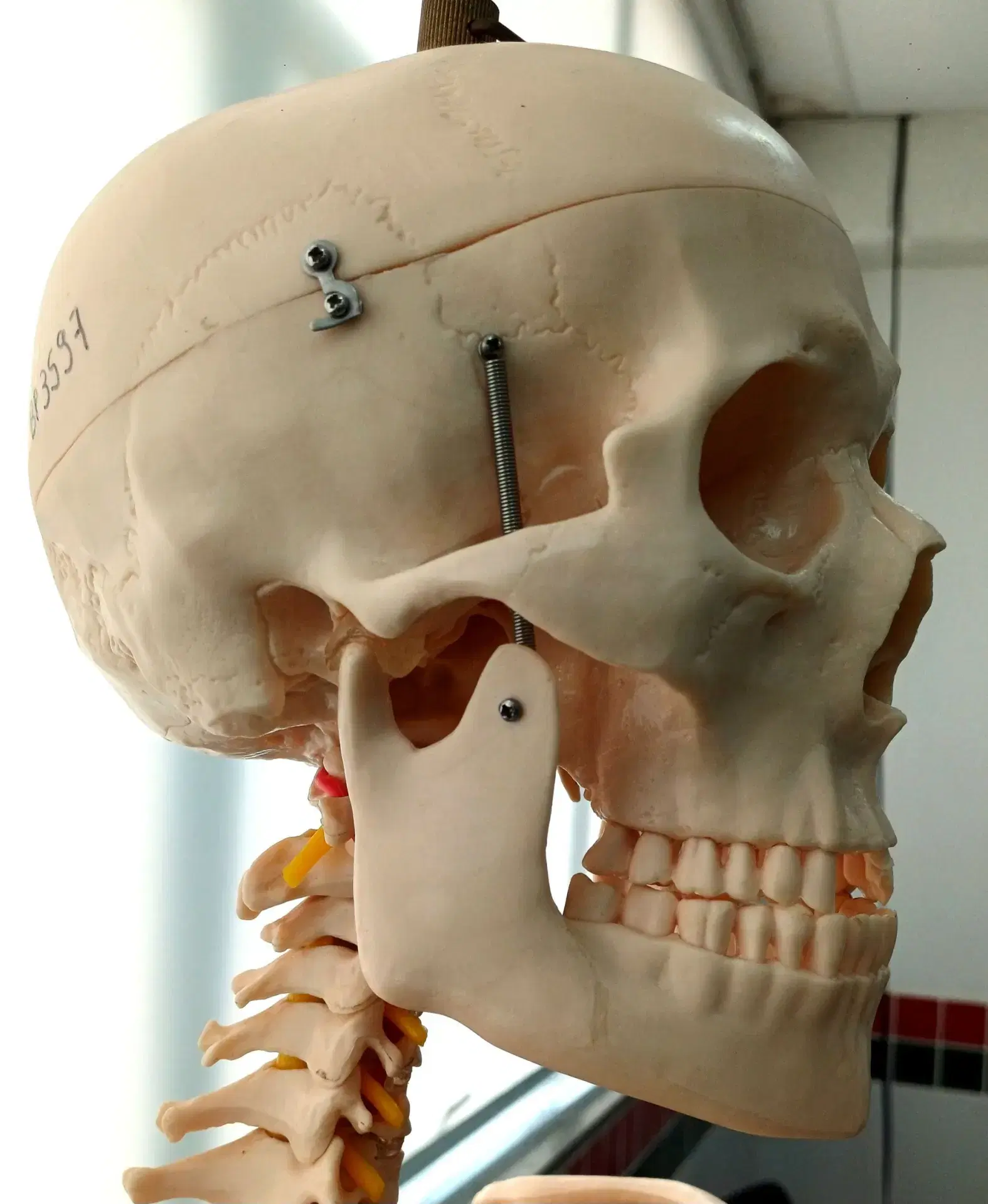
The muscle that makes the slope of your shoulders
The trapezius is a flat, kite-shaped muscle that covers the back of the neck, the top of the shoulders and the upper back. It runs from the base of the skull and down the spine towards the middle of the back, and out to the collarbone and the shoulder blade. Its upper fibres form the slope people squeeze when they say their shoulders are tight, and its middle and lower fibres sit between and below the shoulder blades and steady them.
Why it takes the blame when you are tense
It is a working muscle all day. It holds the shoulder blades up while your arms are in front of you, takes a share of a heavy bag, and shrugs when you are cold, startled or braced. Ask any muscle to do that for hours and it aches, and the trapezius is large and close enough to the surface that you feel it. It is easy to see why “carrying stress in your shoulders” became a phrase, although the explanation does not need stress at all: a muscle with a long job aches.
A shrug-and-turn comparison
Two slow movements say something about where the pain is coming from. Think of them as a comparison, not a test, and do not force either one.
- Lift both shoulders towards your ears, hold for a moment, then lower them. If the sore spot is strongest while the shoulders are up, or as they come down, the muscle is the likelier source.
- Turn your head slowly to look over one shoulder, then the other. If the pain is sharpest at the end of the turn, sits at the base of the skull or one side of the neck, or catches in one direction only, the neck joints are the likelier source.
Pain can follow both movements, and then both areas may be involved. Stop at once if either brings on dizziness, pins and needles or weakness in the arm. Dizziness that does not pass once you keep still, or that comes with double vision, slurred speech, numbness in the face or a loss of balance, means calling an ambulance. Dizziness that passes is a GP visit before you test the turn again, and arm symptoms go to a GP first.
When the neck is the real source
The joints and discs of the lower neck can send pain across the top of the shoulder and into the trapezius, and the muscle tightens around the sore joint to guard it. The muscle is then tender to press, and it can be worked on for a long time without changing what the neck is doing. That is why a trapezius that never stays loose is worth a look at the neck.
Pain that sits on one side of the neck, or catches in one direction of a turn, fits neck pain on one side, and sharp or burning pain that climbs from the base of the skull over the back of the head fits occipital neuralgia.
Giving the muscle a different job through the day
The muscle does better with variety: a different arm position, a different load, a different screen height. Raise the monitor so the head stays over the shoulders, rest the forearms on the desk so the muscle is not holding the arms up, keep the mouse close, and swap the bag to the other side. A minute of moving the arms every half hour is easier to keep up than a long stretch once a day.
Much of this load comes from the head-forward desk shape known as tech neck, and the upper trapezius stretch is aimed at the upper fibres, with the steps and when to stop.
Sorting muscle from neck in an assessment
An assessment looks at how the neck turns, tilts and bends, which direction reproduces your pain, and which neck joint is stiff or sore to press. It also looks at how the shoulder blades move as you lift your arms, how the muscle and its neighbours respond to pressure and load, and the upper back and ribs underneath. Tingling or weakness in an arm goes to a GP first, and reflexes, strength and sensation in the arms are tested here once a doctor has seen it. Scans are arranged when clinically indicated.
Muscle, neck or shoulder?
Where the pain sits and what changes it say more than the word trapezius does.
- An aching slope, worse with the arms held in front, tender to press
- Fits the muscle itself, often with a stiff joint nearby.
- Pain at the base of the skull or one side of the neck, sharp at the end of a head turn
- Points to the neck joints, with the muscle guarding them.
- Pain deep in the shoulder when the arm goes out to the side
- Points to the shoulder joint itself, a separate problem from the trapezius.
- An ache with tingling, numbness or weakness in the hand
- Suggests a nerve, and goes to a GP first.
- Stiffness across the neck and both shoulders, worst on waking, in someone over 50
- Can be polymyalgia rheumatica, which a GP checks with blood tests. See your GP promptly, and the same day if a new headache or jaw pain on chewing comes with it. A change in vision with any of these means a hospital emergency department straight away.
- Shoulder or neck pain with chest pressure, sweating or breathlessness
- Needs an ambulance, not an assessment.
- Soreness after a heavy press or row
- Fits a muscle that has been asked for more than it is used to.
When to get it looked at
Call an ambulance if there is any confusion, sudden weakness or numbness in the face, arm or leg on one side, facial drooping, slurred speech, sudden trouble speaking, seeing or understanding, loss of vision, a seizure, or a sudden loss of balance or coordination.
Call an ambulance if arm, jaw or neck pain comes with chest pain, pressure or tightness, shortness of breath, sweating, nausea or dizziness.
Call an ambulance or go to a hospital emergency department straight away if a headache comes on suddenly and severely (the worst you have ever had), if a headache arrives with fever, a stiff neck or a rash, or if a headache follows a knock to the head.
Call an ambulance if turning your head brings on dizziness that does not pass once you keep still, or dizziness with double vision, slurred speech, numbness in the face or a loss of balance.
Go to a hospital emergency department straight away for back or neck pain after a serious fall or a high-impact accident, such as a car accident; back or neck pain with a fever or feeling generally unwell; or new back or neck pain if your immune system is weakened, for instance by long-term steroids or chemotherapy, if you inject drugs, or if you have recently had a spinal injection, spinal surgery or a dental procedure.
Go to a hospital emergency department straight away if you have weakness in one arm that is severe or getting worse, or numbness in an arm that is spreading or getting worse quickly.
Go to a hospital emergency department the same day if you have new clumsiness in both hands, or new unsteadiness on your feet.
See your GP promptly, before booking here, if you have pins and needles, numbness or weakness in an arm or hand, a history of cancer, unexplained weight loss, pain at night that will not settle in any position, or known osteoporosis with new severe pain.
Trapezius pain that arrives with tingling, numbness or weakness in the arm or hand, that follows a fall or a car accident, or that comes with chest pressure, sweating or breathlessness needs a doctor before an appointment here. If the muscle stays tight whatever you change, keeps returning on one side, or now limits how far you turn your head, the next sensible step is a look at the neck, shoulders and upper back as one region.