

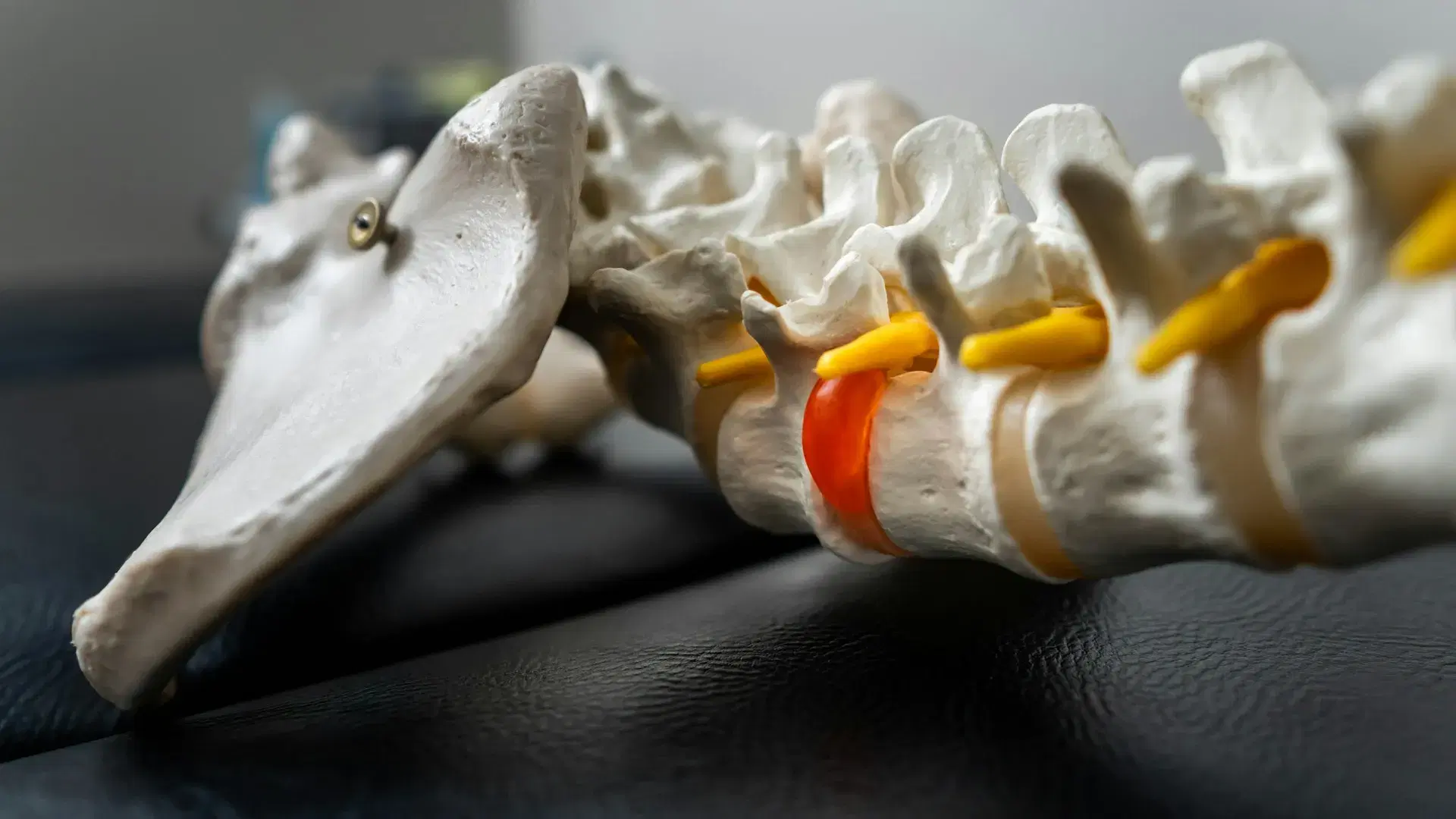
A ladder of words for one disc
A radiologist describing a disc draws on a short, shared vocabulary, ordered by the shape the disc’s contents have taken and whether any of it has come away. At the bottom is the bulge, a wide, even swelling. Above it sit protrusion, extrusion and sequestration: a focused push on a broad base, a push with a narrow neck and a fuller end, and a piece that has come away.
The disc itself is a tough outer wall around a softer centre, and when a disc bulges, that wall gives a little. A word on a report tells you what shape the disc has taken, and very little else about you.
Base against widest part: the rule that separates two words
Protrusion and extrusion are told apart by comparing two widths on the image, in each plane the scan shows. The first is the base, the width of the opening the material has pushed through. The second is the widest part of the material now sitting outside the disc. If the base is the broader of the two in every plane, the word is protrusion, and the shape is a hill. If the part outside is broader than the opening in any one plane, the word is extrusion, and the shape is closer to a drip or a mushroom, with a narrow neck and a fuller end.
Because the line between them is a measurement, two careful readers can land on opposite sides of it for a borderline disc. A report that says protrusion after an older one said extrusion does not necessarily describe a changed disc: the slice, the settings and the reader can each move a borderline shape across the line.
Where it sits matters more than what it is called
The back of each disc faces the spinal canal, and the nerve roots cross that ground on their way out to the body, so a report says where a protrusion sits as well as how big it is. Central means in the middle, facing the sac that holds the nerves. Paracentral, the word in a great many reports, means just to one side, nearest the root that is passing down on that side. Foraminal means inside the exit tunnel the root travels through, and far lateral means just outside it, and a report may write that as extraforaminal.
Two protrusions of the same size can have little else in common. One in the middle of a roomy canal may touch next to nothing. One tucked beside a root, or inside its tunnel, has far less room to be in. That is why a report names a side and a zone, and why your symptoms are read against them.
A lumbar disc cut across and seen from above, with the front of the body at the top. The disc is a layered ring around a soft gel centre, with the spinal canal behind it. On the right side of the picture, a highlighted hill of disc material pushes backward from the ring, broadest at its base, into the side of the canal. There it meets the nerve root passing down on that side and presses it back.
The verbs that follow the noun
Reports also use a second, smaller set of words for what the disc is doing to its neighbours. For a nerve root the verbs usually run in rising order: contact and abutment, which many reports use alike, then displacement, and then nerve root compression. Each describes the picture rather than how the root feels, radiologists do not all draw those lines in the same place, and the picture is taken lying down. Whoever sent you for the scan can tell you how a word is being used in your report.
A bigger word is not a worse back
A protrusion can turn up on the report of a back that has never troubled its owner, and a modest one can sit beside a root that is very sore. The word names a shape, and pain depends on more than shape: how irritated the root has become, and what the muscles around it are doing.
That is why imaging has a high bar to clear. The Royal Australian College of General Practitioners’ 2022 guidance for GPs on imaging in adults with acute low back pain says a scan is not routine for nerve pain from the spine, and in the first six weeks is only worth considering when symptoms are severe, not improving and surgery is on the table. We request imaging when clinically indicated, so the decision rests on an examination rather than on a wish to see the disc.
What gets looked at beside the word
An assessment takes the report as one piece of information. It asks where your symptoms travel and whether that matches the level and side the report names, then tests the strength, reflexes and feeling of the leg. It watches which positions send symptoms further down the leg and which let them draw back, because that pattern can say more than the size of a disc does. The hip and the buttock muscles are checked as well, since they can produce leg pain of their own.
Movement is usually kept going, and Australia’s Low Back Pain Clinical Care Standard (2022) encourages people with low back pain to stay active. How much, and in what form, is decided after the examination.
The ladder, word by word
Each of these describes a shape. Whoever sent you for the scan can read it against your history, and the wording can differ a little from one radiologist to the next.
- Bulge
- The edge of the disc sits a little beyond the bone above and below it, over a wide stretch of its rim, more than a quarter of the way round. The shape is a gentle, even swelling.
- Protrusion
- Disc material pushes out in one place, and no part of it is wider than its base. Picture a hill, broadest at its foot.
- Extrusion
- Some of the material is wider than the opening it came through. Picture a drip or a mushroom, with a narrow neck and a broader end.
- Sequestration
- A piece of extruded material has lost its connection to the disc it came from, so it counts as a kind of extrusion. It is also called a free fragment, and it can lie above or below the disc.
- Migration
- Material has moved up or down the canal away from the level of the disc. It can accompany an extrusion or a sequestration, and the report says which way.
- Focal and broad-based
- Focal describes a push in one narrow place. Broad-based describes one spread across a wider stretch of the edge, sitting between a focal push and a bulge.
When to get it looked at
Go to a hospital emergency department straight away if you have numbness or altered feeling around the saddle area, meaning the groin, the inner thighs, the buttocks or the genitals; a loss of normal sensation in the genitals, including during sex; trouble starting to pass urine, or any new change in your bladder or bowel control; weakness in both legs, particularly if it is getting worse; new or worsening pain running down both legs; weakness in one leg that is severe or getting worse, or a foot that has started to catch or drag when you walk; or numbness in a leg that is spreading or getting worse quickly.
Go to a hospital emergency department straight away for back or neck pain after a serious fall or a high-impact accident, such as a car accident; back or neck pain with a fever or feeling generally unwell; or new back or neck pain if your immune system is weakened, for instance by long-term steroids or chemotherapy, if you inject drugs, or if you have recently had a spinal injection, spinal surgery or a dental procedure.
Go to a hospital emergency department the same day if you have new clumsiness in both hands, or new unsteadiness on your feet.
See your GP promptly, before booking here, if you have a history of cancer, unexplained weight loss, pain at night that will not settle in any position, known osteoporosis with new severe pain, numbness that is spreading or getting worse slowly, or new, unexplained back pain as an older adult.
The word protrusion or extrusion on a report is a reason for an assessment, not for a rush, and not for keeping still, as long as no warning sign is present. Book one if pain keeps travelling down a leg, if pins and needles come and go in the foot without spreading, or if the word is the only explanation you have been given for a back that keeps limiting you. Bring the images as well as the written report, so the words can be checked against the pictures they describe.