

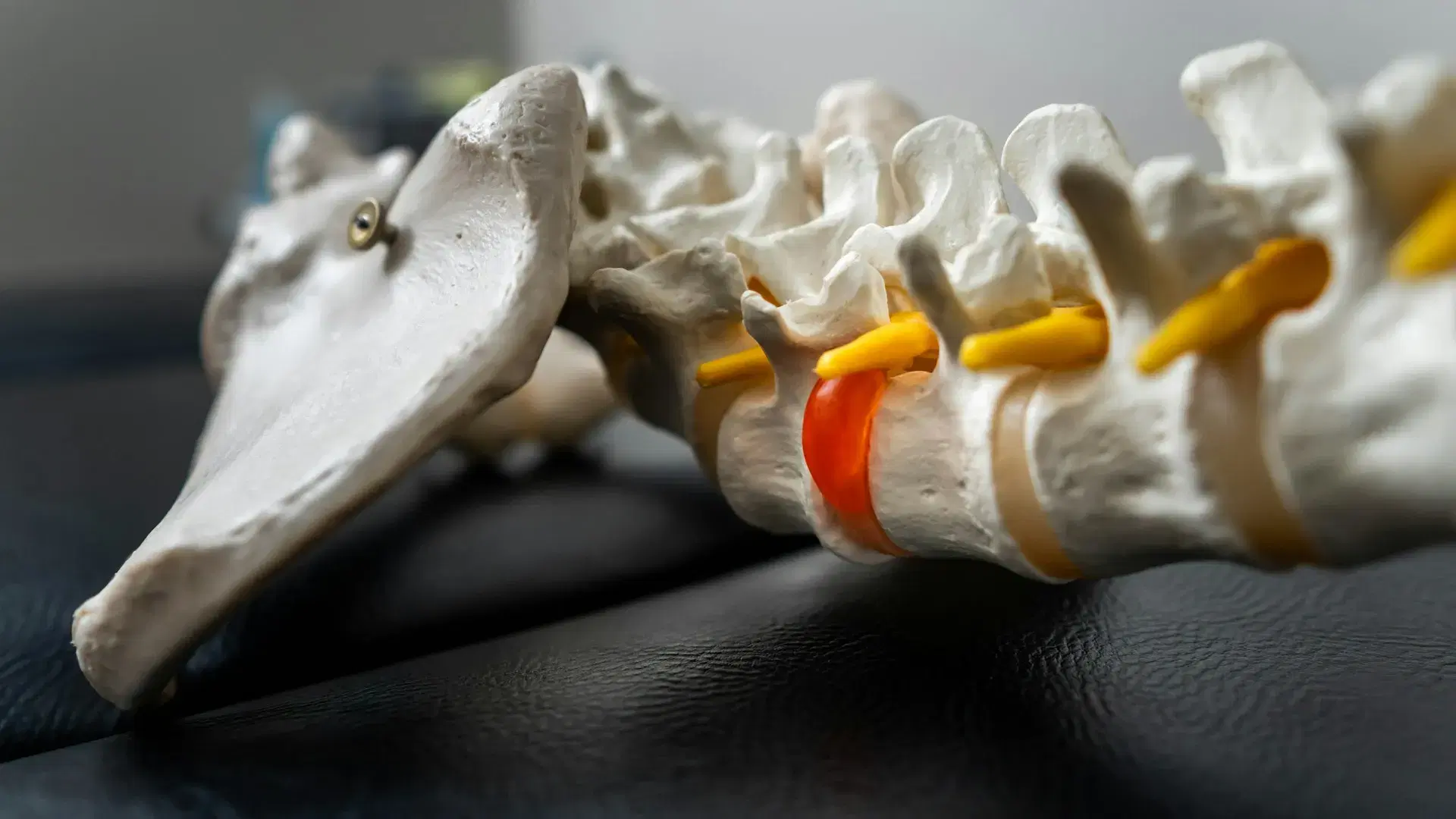
A doorway at every level, on both sides
Between each pair of stacked vertebrae, on the left and on the right, there is a gap shaped a little like a keyhole. It is called the foramen, and the plural is foramina. A spinal nerve root leaves the canal through it on its way to the arm, the leg or the trunk, so every root has its own doorway on its own side.
The front wall is the back of the disc and the vertebral bodies beside it, the back wall is a facet joint, and the roof and floor are short bridges of bone from the vertebrae above and below. The root sits in the opening with a cushion of fat around it, and that cushion is what a radiologist is judging when a report says how much room is left.
What can close it from the front, the back or the roof
Because the doorway is small, a modest change in one wall takes a bigger share of the room than it would in the wide central canal.
- The disc. One that has lost height lets the vertebrae settle together and shortens the opening. One that bulges sideways crowds it from the front.
- The facet joint. Wear can enlarge the joint behind the opening, and bony edges on it can point inward.
- A slipped vertebra. When one bone sits forward on the next, as under spondylolisthesis, the halves of the doorway stop lining up.
- Movement. Leaning back, and tilting or turning towards one side, narrow the opening. Bending forward widens it, so a scan taken lying still catches only one of its shapes.
L4 and L5 from the left side, with the front of the body on the left. The opening between them, the foramen where a spinal nerve root leaves the canal, is highlighted and drawn smaller than usual; the root itself is left out so the opening can be seen. The disc in front of the opening has lost height, so L4 has settled lower and the opening is shorter. Bony spurs reach into it from the back corners of the two vertebral bodies, and behind it the facet joint is enlarged.
Reading a report line: level, side and grade
A typical line reads “moderate right foraminal narrowing at L4–L5”. It carries three facts.
- Level. L4–L5 is the opening between the fourth and fifth lumbar vertebrae. In the neck the levels run C5–C6 and so on.
- Side. Right, left or bilateral. An opening affects only the root that passes through it, so a right-sided line concerns the right-sided nerve.
- Grade. Mild, moderate or severe, judged from how much fat is left around the root and whether the root looks squeezed. Reporters do not all draw the lines in the same place.
Bilateral means both openings at that level are narrowed. It does not mean both arms or both legs are affected, and plenty of people with a bilateral line have symptoms on one side only, or none.
Which nerve uses which doorway, and where the neck differs
A root is named for a vertebra beside its opening, but the neck and the lower back count differently. In the lower back a root leaves below the vertebra that shares its number, so the L4 root uses the L4–L5 opening and the L5 root uses L5–S1. In the neck the count runs the other way, because the first neck root leaves above the top vertebra, so the C6 root uses the opening between C5 and C6.
That is the foraminal half of a two-part story. A narrowed opening affects the root leaving at that level. In the lower back, a disc pushing backward and a little sideways is more likely to meet the root still passing down towards the next opening, which is why a disc at L4–L5 usually meets the L5 root and not the L4 root that leaves at that level. The dermatome map shows where each root is felt.
Why the grade and the symptoms keep missing each other
A narrowed opening is a statement about space, and a root is irritated by more than a shortage of it. Disc material that has leaked past its wall can inflame a root with plenty of room, and a root can sit in a tight opening for years without trouble. So severe narrowing can sit beside no symptoms, and a sore arm or leg beside an opening the report calls mild.
A grade is one radiologist’s reading of one picture. For the lower back, the Australian Commission on Safety and Quality in Health Care’s Low Back Pain Clinical Care Standard (2022) says that what to expect from imaging, and the limited role it plays in diagnosing low back pain, should be talked through with you. Imaging is requested when clinically indicated, and a report line is read beside an examination, not ahead of it. If the rest of your report reads like another language, start with how to read a spine MRI report.
Matching the named opening to the strip you feel
An examination starts with where the symptoms sit: which finger or toe, which side, and whether the pattern follows the strip of skin one root supplies. The positions that narrow the opening, such as leaning back or tilting the head towards the sore side, are then tried on purpose to see whether the arm or leg symptoms change, and the positions that widen it are tried too. Strength, reflexes and sensation follow, one nerve at a time.
An opening that lines up with a root that tests as irritated counts for a good deal. One that does not line up stays on the report, and the search for the source goes on. When the arm is the complaint, the match runs from the neck out to the fingers, the way a pinched nerve in the neck is traced, and pins and needles, numbness or weakness in an arm or hand go to a GP first.
Words that sit around the opening
Report words describe the picture, not you. The person who ordered the scan is the one to read them against your history.
- Neural foramen, foramina
- The opening between two vertebrae through which a nerve root leaves the canal.
- Foraminal narrowing, foraminal stenosis
- The opening has less room than it should. Narrowing is the plain word and stenosis the formal one.
- Perineural fat
- The cushion of fat around the root. A report may call it preserved, meaning intact, or effaced, meaning lost.
- Exiting and traversing root
- In the lower back, the exiting root leaves at the level named and the traversing root passes down the canal to leave one level lower, the one a disc there more often meets. In the neck the roots run almost straight out, so a disc usually meets the root leaving at that same level.
- Unilateral, bilateral
- One side or both. This describes the openings, not where anything hurts.
When to get it looked at
Call an ambulance if there is any confusion, sudden weakness or numbness in the face, arm or leg on one side, facial drooping, slurred speech, sudden trouble speaking, seeing or understanding, loss of vision, a seizure, or a sudden loss of balance or coordination.
Call an ambulance or go to a hospital emergency department straight away if a headache comes on suddenly and severely (the worst you have ever had), if a headache arrives with fever, a stiff neck or a rash, or if a headache follows a knock to the head.
Go to a hospital emergency department straight away if you have numbness or altered feeling around the saddle area, meaning the groin, the inner thighs, the buttocks or the genitals; a loss of normal sensation in the genitals, including during sex; trouble starting to pass urine, or any new change in your bladder or bowel control; weakness in both legs, particularly if it is getting worse; new or worsening pain running down both legs; weakness in one leg that is severe or getting worse, or a foot that has started to catch or drag when you walk; or numbness in a leg that is spreading or getting worse quickly.
Go to a hospital emergency department straight away for back or neck pain after a serious fall or a high-impact accident, such as a car accident; back or neck pain with a fever or feeling generally unwell; or new back or neck pain if your immune system is weakened, for instance by long-term steroids or chemotherapy, if you inject drugs, or if you have recently had a spinal injection, spinal surgery or a dental procedure.
Go to a hospital emergency department straight away if you have weakness in one arm that is severe or getting worse, or numbness in an arm that is spreading or getting worse quickly.
Go to a hospital emergency department the same day if you have new clumsiness in both hands, or new unsteadiness on your feet.
See your GP promptly, before booking here, if you have a history of cancer, unexplained weight loss, pain at night that will not settle in any position, known osteoporosis with new severe pain, numbness that is spreading or getting worse slowly, new, unexplained back pain as an older adult, or pins and needles, numbness or weakness in an arm or hand.
Start from the line on your report. If it leaves you unsure which side or which nerve it means, or if pain or tingling in one leg, or pain in one arm, keeps tracing the same strip of skin, the examination can match the one to the other. Pins and needles, numbness or weakness in an arm or hand mean a GP visit first, and an assessment can follow once that has happened.