

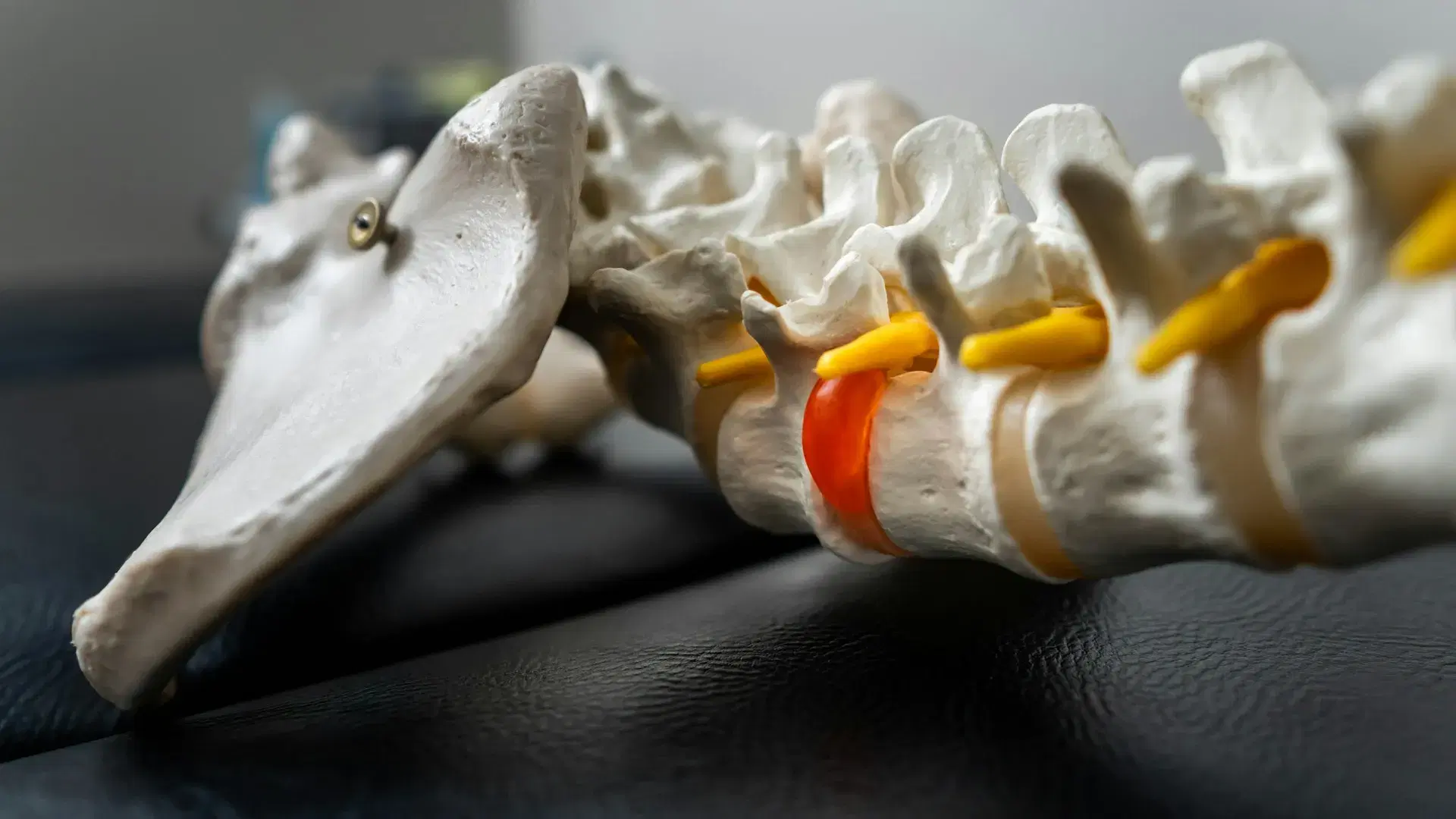
A ring of bone with a ligament in its wall
Every vertebra has a ring of bone at the back of it. Stack the rings and you get the spinal canal, a channel that carries the spinal cord and, below it, the bundle of nerve roots that carries on past the end of the cord. In a back that is working well the nerves float in fluid with room around them. Stenosis means some part of that channel has less room than it should.
The walls are not all bone. At the front sit the back of each vertebral body and the back of each disc. Behind and to the sides sit the small facet joints and a tough, elastic band called the ligamentum flavum, which lines the canal like a curtain. Narrowing can sit in three places: the central canal, the side pockets just inside it, and the exit openings, where a report calls it foraminal stenosis.
What takes up the room
Narrowing is rarely one thing. It is usually several small changes that together take up space, and they tend to arrive slowly.
- The disc. A disc that has lost height can bulge backward at its rim, into the front of the canal.
- The facet joints. Wear thickens these joints and can add small bony edges that point inward.
- The ligamentum flavum. A thicker ligament has to go somewhere, which is into the canal. Reports call it ligamentum flavum hypertrophy.
- A vertebra that has shifted. When one bone sits forward on the one below, as in spondylolisthesis, the canal is stepped instead of straight.
- The starting size. Some people are born with a narrower canal, so the same small change costs them more room.
None of this means the spine is failing. These are ordinary changes in joints that have been used for many years, and what matters is where each one sits in relation to the nerves.
A lumbar level cut through the disc and seen from above, with the front of the body at the top. The disc at the front bulges backward into the canal, and the facet joints at the back corners are enlarged. The ligament along the back wall is thickened. Together they leave the canal, highlighted in blue, as a small space with the bundle of nerves in their sac squeezed inside it.
Why leaning forward gives the nerves room
The canal changes shape as you move. Bending forward pulls the ligament flat and opens the space a little. Leaning back lets the ligament buckle inward and the discs bulge backward, so the same nerves have less room. Standing up straight is a mild version of leaning back.
That is behind the classic pattern, which has its own name: neurogenic claudication. The legs feel heavy, tired or crampy as you stand or walk, often both of them, and the feeling fades once you sit or lean forward. Poor circulation can set a similar walking limit, and the difference is in the stop: walking pain from the back eases with sitting or bending forward, while circulation pain fades when you simply stand still.
What mild, moderate and severe are measuring
A scan report may grade the narrowing as mild, moderate or severe, and some add a measurement across the canal. Those words describe how much of the space is taken up on the picture. The symptoms depend on how the nerves inside the space are behaving, so nobody can read your symptoms off the grade.
A report that lists narrowing at four levels is not describing four sore places. Each level is read against what the examination finds, which means strength, reflexes and sensation in the legs, and the ones that match are the ones that count. One kind of line is not background: pressure on the spinal cord, or on the cauda equina, the bundle of nerve roots at the bottom of the canal, goes back to whoever ordered the scan promptly, before booking here.
We arrange a scan when clinically indicated, not as a routine step, and the Australian Commission on Safety and Quality in Health Care’s Low Back Pain Clinical Care Standard (2022) wants someone to explain to you how limited imaging is in diagnosing low back pain. Bring any report you have. Most of the words on a spine MRI report are names for ordinary parts, and whether an X-ray or scan is worth having at all comes down to the examination.
The same narrowing in the neck
The neck has a canal too, and it holds the spinal cord itself rather than loose nerve roots. Narrowing there can press on the cord, and the first signs are different: clumsy hands with buttons, handwriting or keys, or a feeling of being less steady on your feet. That is why new clumsiness in both hands, or new unsteadiness on your feet, means a hospital emergency department the same day.
How far you get, and arranging a day around it
An assessment starts with the pattern: how far you get, what posture changes it, which leg or both, and whether the back or the legs are the bigger complaint. Movement testing asks the back to lean backward and to bend forward and notes what each does to the legs. Walking and balance are watched, the hips are examined because a stiff hip limits walking too, and circulation in the legs is checked when the story could fit it.
Day to day, the aim is to keep walking and find the arrangement that works. The same standard says to stay active, and to keep up your usual activity or return to it as soon as you can. For this pattern that can mean walks broken up by somewhere to lean or sit.
Where the narrowing sits, and what it tends to do
These are the places a report can put the narrowing, and the pattern each one tends to produce.
- Central canal
- The middle of the ring, where the nerve roots run together. Symptoms tend to involve both legs, with heaviness or cramping on standing or walking.
- Lateral recess
- The side pocket inside the ring, just before a root leaves. It tends to produce symptoms in one leg that follow a single nerve.
- Foramen
- The exit opening at each level. Narrowing here tends to involve the root leaving at that level, on that side.
- The neck canal
- It holds the spinal cord, so hands, balance and walking can be involved as well as the arms.
When to get it looked at
Call an ambulance if there is any confusion, sudden weakness or numbness in the face, arm or leg on one side, facial drooping, slurred speech, sudden trouble speaking, seeing or understanding, loss of vision, a seizure, or a sudden loss of balance or coordination.
Call an ambulance or go to a hospital emergency department straight away if a headache comes on suddenly and severely (the worst you have ever had), if a headache arrives with fever, a stiff neck or a rash, or if a headache follows a knock to the head.
Go to a hospital emergency department straight away if you have numbness or altered feeling around the saddle area, meaning the groin, the inner thighs, the buttocks or the genitals; a loss of normal sensation in the genitals, including during sex; trouble starting to pass urine, or any new change in your bladder or bowel control; weakness in both legs, particularly if it is getting worse; new or worsening pain running down both legs; weakness in one leg that is severe or getting worse, or a foot that has started to catch or drag when you walk; or numbness in a leg that is spreading or getting worse quickly.
Go to a hospital emergency department straight away for back or neck pain after a serious fall or a high-impact accident, such as a car accident; back or neck pain with a fever or feeling generally unwell; or new back or neck pain if your immune system is weakened, for instance by long-term steroids or chemotherapy, if you inject drugs, or if you have recently had a spinal injection, spinal surgery or a dental procedure.
Go to a hospital emergency department straight away if you have weakness in one arm that is severe or getting worse, or numbness in an arm that is spreading or getting worse quickly.
Pain or weakness in both legs that is new or getting worse means a hospital emergency department straight away, not a booking.
Go to a hospital emergency department the same day if you have new clumsiness in both hands, or new unsteadiness on your feet.
See your GP promptly, before booking here, if you have a history of cancer, unexplained weight loss, pain at night that will not settle in any position, known osteoporosis with new severe pain, numbness that is spreading or getting worse slowly, new, unexplained back pain as an older adult, or pins and needles, numbness or weakness in an arm or hand.
Short of an emergency, the time to have a narrowed canal examined is when standing or walking has started to set a limit on how far you go, when outings are planned around somewhere to sit or lean, or when the heaviness in your legs arrives at a predictable distance. Bring any report you already have, so the wording about narrowing can be explained in person instead of left to stand on its own.