

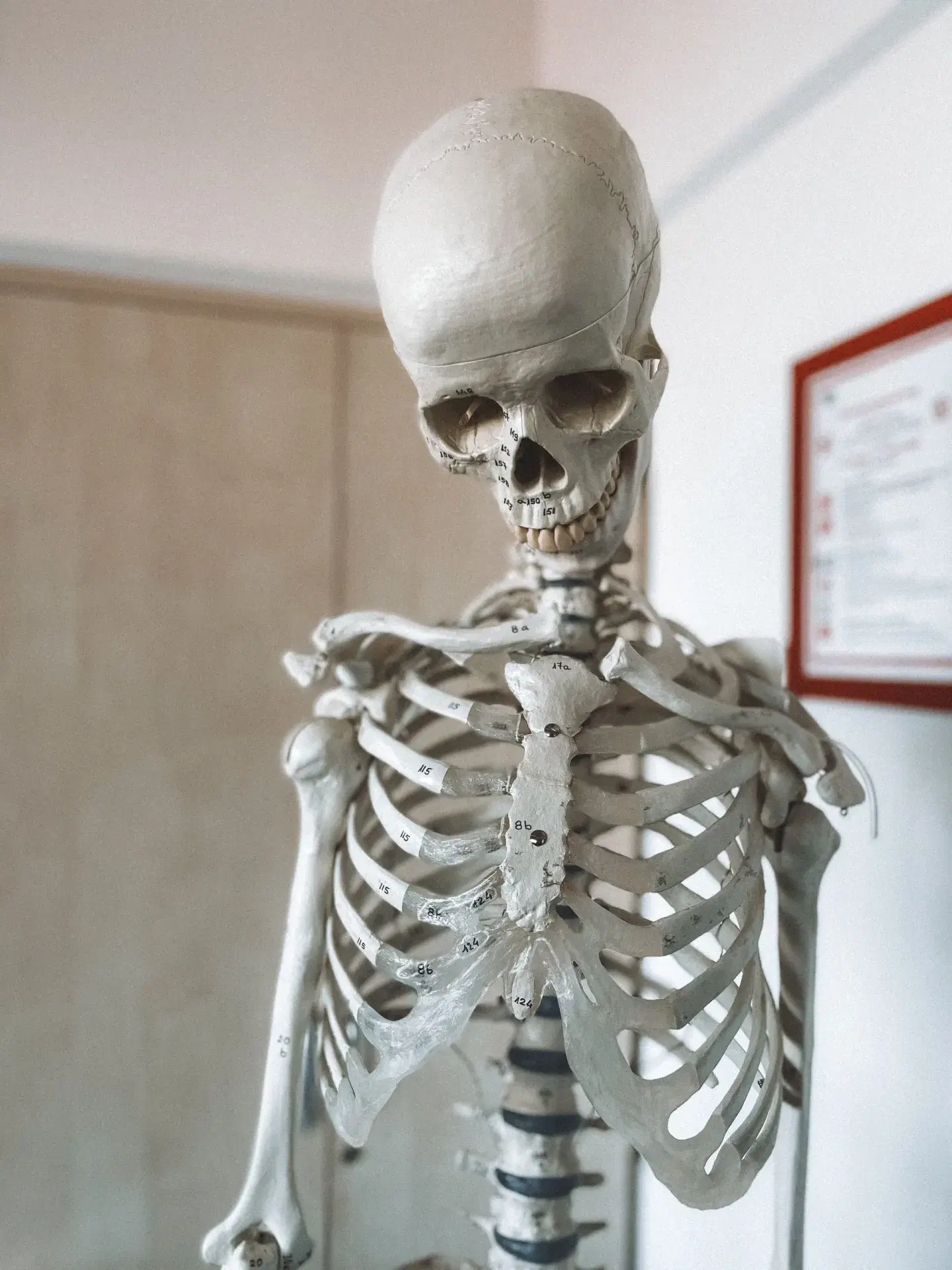
What the shoulder is doing when you lie on it
The shoulder is a shallow socket holding a large, loose ball, and the rotator cuff tendons run over the top of that ball through a narrow space beneath the bony roof of the shoulder blade. A small fluid-filled cushion, the bursa, sits in the same space. With the arm hanging by your side there is room. Lying on the shoulder squeezes the tissue between the ball and the mattress, and moving the arm across your chest or up beside your head narrows the space under the roof as well.
Why the day can feel fine
By day the arm keeps moving and the load keeps changing, so tissue under pressure is released before it starts to ache. At night one position can be held for an hour or more with nothing else competing for your attention, so an ache that sat in the background all day becomes the loudest thing in the room. Night pain is a familiar feature of shoulder problems for exactly that reason, and it is rarely a verdict on how serious one is.
What does change the picture is pain that wakes you whichever way you lie, or that is there at rest. Pain at night that stays whatever the position goes to a GP first.
How you hold the arm in bed
- Under the pillow or the head. The arm sits above shoulder height, which narrows the space under the roof and can stretch the nerves to the hand. If the hand goes numb as well, the position of the wrist and elbow matters too, and that is the question behind numb hands at night.
- Folded across the chest, or hugging a pillow tightly. The arm crosses the midline, a position that squeezes the top of the shoulder.
- Lying on the sore side. Your body weight goes through the joint, and the tendons are pressed against the bone.
- Lying on the good side. The top arm, which is the sore one, drops forward across your body unless something holds it up, so it hangs from the shoulder for hours.
- On your back. The arm sinks behind the line of the body, which stretches the front of the shoulder.
Arranging pillows for the night
None of this needs a special pillow, only a few ordinary ones used on purpose. Change one thing at a time so you can tell which change made a difference.
- On your back. One pillow under the head and a folded towel or a small pillow under the sore arm, so the elbow is level with the body and the arm is not dropping behind it.
- On the good side. Hug a full pillow at chest height and rest the top arm on it. That holds the arm up and out of its drop across the body.
- If you roll onto the sore side. A long pillow behind your back makes rolling over less automatic.
- Under the head. A pillow that fills the gap between ear and shoulder keeps the neck level. Broad shoulders need a taller one, and that height is the first thing to sort when choosing a pillow for neck pain.
When the shoulder is not the source
Pain felt in the shoulder is not always generated there. A neck nerve root can send pain to the top of the shoulder and the outer upper arm. That pain tends to follow head position, may come with neck stiffness or tingling in the hand, and is not tender when the joint itself is pressed. Tingling, numbness or weakness in the arm or hand goes to your GP first, before booking here. A neck that aches with no arm symptoms is ordinary neck pain, and it is examined alongside the shoulder. The heart is the source that matters most: shoulder or arm pain with chest pressure, breathlessness, sweating or nausea means calling an ambulance. Pain at the tip of the shoulder can also come from the diaphragm, the gallbladder or the top of the lung, so a shoulder that moves freely, is not sore to press and still aches goes to a GP.
A shoulder that has become stiff in every direction, including turning the arm outwards, and aches at night is a recognisable pattern with its own name, a frozen shoulder. By day, the height at which the shoulder catches as the arm lifts is the most useful detail about shoulder pain when lifting the arm. A blade whose edge lifts off the ribs as you push is a winged shoulder blade, and it goes to a GP if it is new or the arm is weak.
Testing a shoulder that only hurts after dark
The first questions are which positions bring it on, which side you sleep on and whether lifting the arm by day catches too. Then you move the shoulder in every direction and the chiropractor moves it for you, tests the strength of the rotator cuff muscles, watches how the shoulder blade moves and checks the neck and upper back. The upper trapezius, the muscle running from the neck out to the shoulder, can ache without the joint being involved, which is the pattern behind trapezius pain.
What the night is telling you
Night pain can be more than one thing at once, and each pattern is a prompt for the examination, not an answer.
- Hurts only when lying on that shoulder, fine on the other side
- Compression of the tendons and the bursa under the roof of the shoulder is the usual reading.
- Aches on either side and wakes you when you roll, but is easy by day
- An irritated shoulder that is noticed when it is held still. If lifting the arm catches by day, that is examined too.
- Aching in the shoulder and the neck, changing with head position, perhaps with tingling in the hand
- A neck origin is possible, so the neck is examined as well as the shoulder. Tingling, numbness or weakness in the arm or hand goes to your GP first.
- Stiff in every direction, including turning the arm out, and sore at night
- The frozen shoulder pattern, which is told apart from a sore one by moving the arm for you.
- Aching at rest whichever way you lie, with nothing that changes it
- A different question, and one for a GP first.
- Both shoulders stiff and aching on waking, in someone over 50
- Can be polymyalgia rheumatica, an inflammatory condition a GP tests for, so see your GP promptly. With a new headache, a tender scalp or jaw pain when chewing, see a doctor the same day. Any change in vision goes to an emergency department straight away.
- A hot, red or swollen shoulder, with a fever or a joint you can barely move
- Can be an infected joint. Go to a hospital emergency department straight away.
When to get it looked at
Call an ambulance if there is any confusion, sudden weakness or numbness in the face, arm or leg on one side, facial drooping, slurred speech, sudden trouble speaking, seeing or understanding, loss of vision, a seizure, or a sudden loss of balance or coordination.
Call an ambulance if arm, jaw or neck pain comes with chest pain, pressure or tightness, shortness of breath, sweating, nausea or dizziness.
Go to a hospital emergency department straight away for back or neck pain after a serious fall or a high-impact accident, such as a car accident; back or neck pain with a fever or feeling generally unwell; or new back or neck pain if your immune system is weakened, for instance by long-term steroids or chemotherapy, if you inject drugs, or if you have recently had a spinal injection, spinal surgery or a dental procedure.
Go to a hospital emergency department straight away if you have weakness in one arm that is severe or getting worse, or numbness in an arm that is spreading or getting worse quickly.
Go to a hospital emergency department straight away if a shoulder turns hot, red or swollen, with a fever or with pain that stops you moving it.
Go to a hospital emergency department the same day if you have new clumsiness in both hands, or new unsteadiness on your feet.
See your GP promptly, before booking here, if you have pins and needles, numbness or weakness in an arm or hand, a history of cancer, unexplained weight loss, pain at night that will not settle in any position, or known osteoporosis with new severe pain.
A run of broken nights that has gone on for weeks makes an assessment worth booking, and so does pain that is also there when you lift your arm by day, or that wakes you on most nights but settles when you change position. Take a note of which positions bring it on and which arrangement of pillows gave the easier night.